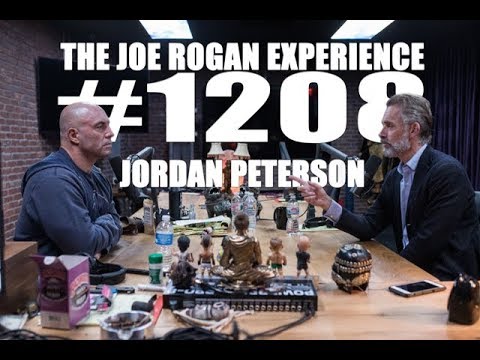
Joe Rogan Experience #1208 - Jordan Peterson
Joe Rogan (host), Jordan Peterson (guest), Narrator, Narrator
In this episode of The Joe Rogan Experience, featuring Joe Rogan and Jordan Peterson, Joe Rogan Experience #1208 - Jordan Peterson explores jordan Peterson and Joe Rogan Dissect Responsibility, Hierarchies, Meaning, Media Joe Rogan and Jordan Peterson explore Peterson’s intense global lecture tour, emphasizing how personal responsibility, honesty, and disciplined effort are transforming the lives of many young men and women who follow his work.
Jordan Peterson and Joe Rogan Dissect Responsibility, Hierarchies, Meaning, Media
Joe Rogan and Jordan Peterson explore Peterson’s intense global lecture tour, emphasizing how personal responsibility, honesty, and disciplined effort are transforming the lives of many young men and women who follow his work.
They dive into the nature of meaning as a felt, biological signal that arises when individuals voluntarily shoulder optimal levels of responsibility and challenge, contrasting this with nihilism, resentment, and ideological extremism.
A major thread examines hierarchies, gender differences, and the Scandinavian ‘gender paradox,’ arguing that competence-based hierarchies are unavoidable and often beneficial, while warning about the dangers of identity politics, enforced equality of outcome, and power-only narratives.
They also critique social media, outrage culture, and postmodern theory, linking them to misrepresentation, online mobbing, and attempts to delegitimize free speech and individual autonomy, and they close by stressing the urgent need for ethically grounded individuals in a technologically accelerating world.
Key Takeaways
Voluntarily taking on responsibility creates meaning and counters nihilism.
Peterson argues that when people choose to shoulder substantial responsibility—for themselves, their families, and their communities—they experience a deep sense of purpose that offsets suffering, bitterness, and destructive behavior.
Get the full analysis with uListen AI
Hierarchies are inevitable and often competence-based, not purely tyrannical.
Using examples like plumbers and athletes, they contend that functional hierarchies mostly reward skill, reliability, and reciprocity; the task is to keep them from ossifying into corrupt power structures, not to abolish them.
Get the full analysis with uListen AI
Equality of opportunity and equality of outcome are incompatible goals.
Research on personality and vocational interests shows that in more gender-egalitarian societies, men and women’s choices diverge more (e. ...
Get the full analysis with uListen AI
Meaning lives on the edge between order and chaos—optimal challenge.
They describe meaning as a neurophysiological signal that arises when you are competent yet stretched—like lifting close to your limit or engaging in a demanding, honest conversation—where you grow without being overwhelmed.
Get the full analysis with uListen AI
Online outrage and anonymity distort feedback and damage mental health.
Twitter and similar platforms disproportionately reward impulsive, angry responses, making critiques feel like a mob at your door while muting the emotional impact of genuine praise, which can lead to anxiety, depression, and self-censorship.
Get the full analysis with uListen AI
Identity politics and power-only narratives are historically and psychologically dangerous.
Peterson links modern intersectional, oppressor–oppressed frameworks to 20th‑century totalitarian logic, arguing that when people are judged solely as group members and everyone is a ‘victimizer’ on some axis, guilt and punishment become totalizing.
Get the full analysis with uListen AI
Competition, properly structured, is fundamentally cooperative and character‑building.
Analyzing team sports, they show that real competition is nested in cooperation, rules, and long-term team development; it teaches discipline, fairness, and respect, rather than mere domination or cruelty.
Get the full analysis with uListen AI
Notable Quotes
“Every single person who sets out to put themselves together ethically is a net positive to everyone around them.”
— Jordan Peterson
“You don’t admire people who don’t take care of themselves—unless there’s something wrong with you.”
— Jordan Peterson
“Your best strategy for success in life isn’t the exercise of raw power. It’s skill and reciprocity.”
— Jordan Peterson
“The sense of meaning tells you you’re on the edge where you’re competent and out of undue danger, but pushing yourself enough so that you’re continually developing.”
— Jordan Peterson
“One of the core lessons of competition is to be inspired by those who are more successful, not to try to chip them down and take away their accomplishments.”
— Joe Rogan
Questions Answered in This Episode
How can individuals practically identify the ‘optimal load’ of responsibility that generates meaning without leading to burnout or breakdown?
Joe Rogan and Jordan Peterson explore Peterson’s intense global lecture tour, emphasizing how personal responsibility, honesty, and disciplined effort are transforming the lives of many young men and women who follow his work.
Get the full analysis with uListen AI
If gender differences in interests and personality grow in more egalitarian societies, how should policymakers think about diversity targets and claims of systemic bias?
They dive into the nature of meaning as a felt, biological signal that arises when individuals voluntarily shoulder optimal levels of responsibility and challenge, contrasting this with nihilism, resentment, and ideological extremism.
Get the full analysis with uListen AI
What concrete safeguards can democratic societies implement to prevent competence-based hierarchies from hardening into corrupt, power-abusing elites?
A major thread examines hierarchies, gender differences, and the Scandinavian ‘gender paradox,’ arguing that competence-based hierarchies are unavoidable and often beneficial, while warning about the dangers of identity politics, enforced equality of outcome, and power-only narratives.
Get the full analysis with uListen AI
Given the documented psychological harm of social media outrage, what personal or institutional norms could help preserve free expression while limiting mob behavior?
They also critique social media, outrage culture, and postmodern theory, linking them to misrepresentation, online mobbing, and attempts to delegitimize free speech and individual autonomy, and they close by stressing the urgent need for ethically grounded individuals in a technologically accelerating world.
Get the full analysis with uListen AI
How can someone who feels deeply attracted to activist causes distinguish between genuine concern for the oppressed and resentment or a desire for unearned moral status?
Get the full analysis with uListen AI
Transcript Preview
Three, two, one. Here we are again.
Hey, Joe.
Hello, Jordan. (laughs)
(laughs) How are you doing, man?
Good to see you, man. I'm doing great. You have, uh, the, the schedule that you have and the amount of energy and enthusiasm you maintain with the schedule i- is very remarkable. 'Cause you're not stopping. You're not slowing down. I mean, you've, you've had your foot on the gas for like two solid years now.
Make hay while the sun shines.
I guess so.
Yeah.
Is that what it is? Is that how you feel about it?
Well, you know, when you have an opportunity that's completely preposterous-
(laughs)
... you're a fool to take it for granted.
Yeah.
You know?
I guess that's it, right?
So, and s- yeah, so Tammy and I have been to 100 cities since January. So everywhere, you know? And part of what keeps us going... Well, first of all, I have a really good crew, you know? Like the CAA guys, they're really good. Live Nation's been really good. They make sure the theaters are smooth and, and we've had no problems at all. Um, and then I have lots of people who are helping me with my scheduling, and Tammy travels with me. And then the, the lectures themselves, well, I really like doing them, partly because I do a different lecture every night and so that keeps me sharp and it makes sure that I'm thinking about new things all the time and trying to formulate my thoughts more precisely. And they're also unbelievably positive, so that's also, that al- that's also something that makes it a lot easier to, to do.
Mm-hmm.
Because, you know, I, I go to a city and there's 1,500 to 2,000 people waiting for me there, which is like staggering in and of itself wherever I go. And they're all there listening intently and, and it's, it's a sophisticated discussion, or at least as sophisticated as I can make it. And I'm communicating directly with the audience, and all the people are there to try to get their lives together. And so the, the, the feeling in the, in the hall is really, really positive. And then I usually talk to about 150 people afterwards and, you know, they're, they... All of them, all of them, well, many of them, you know, they just say hi and they're polite and we have a photograph and all that. But lots of them have stories about how they've been putting their lives together and they're thrilled to death about it, you know? That they're out of the hole they were in or they've started a new business or they've sold a new business or they just decided to get married or they're gonna have some kids or they've fixed up their relationship with their parents or they quit drinking or, and they're, they're not addicted. I talked to one guy in Europe. He'd stopped, he was, he was addicted, I don't remember what to, but it wasn't, it was something that wasn't good. He s- he'd stopped for nine months and got nine of his friends to quit too. So he comes up, he's just like bouncing, you know? He's so damn happy that his life is better. And not only that, that he had this additional positive effect on other people. So... And it's so fun because I have these conversations with people, they're brief, but they're very personal and they're very intense, you know, because they, they... You think, people have to trust you to tell you that their lives weren't going so well, and then they have to trust you even more to tell you that they're going better now because, of course, what you want when you tell someone that things are going better is you want real encouragement and real sense from the person you're talking to that they're happy for you. And I'm absolutely thrilled to hear these things. Like, I was in Whole Foods this morning. I w- I went down near where I'm staying, and two of the guys that work behind the meat counter came out to talk to me and... independently. And they'd both been reading my books and watching my lectures, and one of them said he had a seven-year-old son, he really wanted to do right by him. He was looking for ethical and moral guidance and, you know, he found the books really helpful and that it was helping him put his life together and... And so, c- our guy at the car rental place last night told me the same thing and, and so it's so exciting. It's so ridiculously exciting to go everywhere around the world and to go into airports or to walk down the street and have people come up and say, um, "I've been watching you on YouTube." They often mention you. "Uh, I've been listening to what you say. I've been developing a vision for my life. It's really helped me out a lot. Thanks a lot." And Jesus, like, to be able to have that happen, you know, time after time, day after day, all over the place, that's just absolutely... It makes going to 100 cities, like, c- continually, uh, energizing 'cause it's so positive. And so... And then there's all this weird crap in the press, you know, about my dangerous followers and all this alt-right nonsense. And it's so ridiculous, you know? I've talked to 250,000 people in, in, in seven months. We haven't had one incident that was negative in that entire time. Not one. Nothing. No misbehavior on anyone's part. We had one heckler who was obviously not a fan of mine, given that he was a heckler. That was it. Other than that, the audiences behave perfectly. They all dress up, they come in suits, which is really cool.
Install uListen to search the full transcript and get AI-powered insights
Get Full TranscriptGet more from every podcast
AI summaries, searchable transcripts, and fact-checking. Free forever.
Add to Chrome