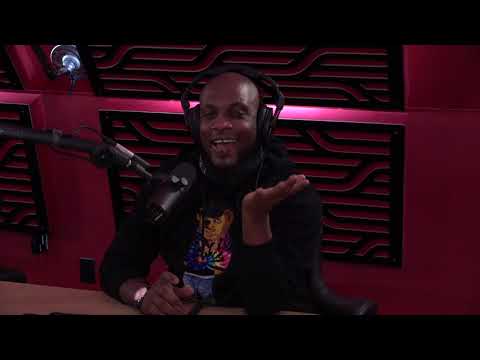
Joe Rogan Experience #1606 - Ali Siddiq
Narrator, Joe Rogan (host), Ali Siddiq (guest), Guest (guest), Narrator, Narrator, Guest (guest)
In this episode of The Joe Rogan Experience, featuring Narrator and Joe Rogan, Joe Rogan Experience #1606 - Ali Siddiq explores ali Siddiq on comedy, prison, parenting, and America’s growing pains Joe Rogan and Ali Siddiq spend four hours trading stories about standup comedy, life after prison, parenting, and the strange dynamics of fame and modern culture.
Ali Siddiq on comedy, prison, parenting, and America’s growing pains
Joe Rogan and Ali Siddiq spend four hours trading stories about standup comedy, life after prison, parenting, and the strange dynamics of fame and modern culture.
Ali details his path from incarceration to respected comic, his frustrations with a new radio job, and his philosophy on developing material, work ethic, and helping younger comedians.
They dive into broader issues—policing, education, healthcare, political extremism, religion, and race—using personal anecdotes and dark humor to explore how people learn (or refuse to) over time.
The conversation repeatedly returns to responsibility: to craft, to family, to communities, and to being honest about your own flaws, ego, and blind spots.
Key Takeaways
You must be brutally honest about your actual skill level.
Ali regularly asks himself, “Would I pay to see this show again? ...
Get the full analysis with uListen AI
Competition in comedy should be with yourself, not other comics.
Both men confess early-career jealousy, wanting others to bomb so they’d look better, and explain how that mindset stunts growth. ...
Get the full analysis with uListen AI
Don’t build a life where you need a boss to survive.
Ali’s pandemic-driven decision to take a 5‑day‑a‑week radio job—with meetings, formats, and contracts—clashes with his 20+ years of autonomy as a comic. ...
Get the full analysis with uListen AI
Your formative environment hardwires how you deal with conflict.
Ali describes learning in prison that “you’re right if you’re violent or loud,” then realizing, years later, that this ruined his relationships because he never learned to communicate without threats or shutdowns—an issue many people never examine.
Get the full analysis with uListen AI
Strong communities require local representation and rooted police.
They argue that much police brutality comes from officers not being from the communities they police. ...
Get the full analysis with uListen AI
Healthcare and education should be treated like fire departments.
Rogan frames universal healthcare and better schooling as shared infrastructure: everyone pays into fire services without question; similarly, not bankrupting or abandoning people when they’re sick or undereducated benefits the entire country long‑term.
Get the full analysis with uListen AI
You have to design systems with ‘room for crazy.’
From gender-ID rules in sports to Trump telling supporters to “show strength,” they stress that policy and rhetoric must account for the fringe 1–2% who are unhinged. ...
Get the full analysis with uListen AI
Notable Quotes
“You gotta wreck your life a little bit so you know how to not wreck your life.”
— Ali Siddiq
“If you tell me you’ve made no mistakes, I’m like, ‘How have you done that?’”
— Joe Rogan
“If you’re a funny standup comic, having a boss is kryptonite.”
— Joe Rogan
“The most important commodity of a country should be its citizens.”
— Ali Siddiq
“Some people are just dumb, man. And they’re out there voting and driving cars like the rest of us.”
— Joe Rogan
Questions Answered in This Episode
How did Ali Siddiq’s time in prison most concretely shape the way he writes and performs comedy today?
Joe Rogan and Ali Siddiq spend four hours trading stories about standup comedy, life after prison, parenting, and the strange dynamics of fame and modern culture.
Get the full analysis with uListen AI
What’s the practical line between being ‘supportive’ of other comics and being honest when they’re not ready for bigger opportunities?
Ali details his path from incarceration to respected comic, his frustrations with a new radio job, and his philosophy on developing material, work ethic, and helping younger comedians.
Get the full analysis with uListen AI
If healthcare and education were funded like fire departments, what trade‑offs in taxes or military spending would people actually accept?
They dive into broader issues—policing, education, healthcare, political extremism, religion, and race—using personal anecdotes and dark humor to explore how people learn (or refuse to) over time.
Get the full analysis with uListen AI
How should comedy handle highly sensitive moments like celebrity deaths—does intent (e.g., Ari Shaffir’s ‘bit’) ever outweigh impact?
The conversation repeatedly returns to responsibility: to craft, to family, to communities, and to being honest about your own flaws, ego, and blind spots.
Get the full analysis with uListen AI
What would effective police and political representation look like if it were truly built from inside each community, as Ali suggests?
Get the full analysis with uListen AI
Transcript Preview
(drum roll) Joe Rogan podcast, check it out. The Joe Rogan Experience.
Train by day, Joe Rogan podcast by night. All day. (instrumental music plays) All right, we'll move on. What's good, brother? How are you?
I'm good, man. Thanks for having me.
Pleasure to get you in here, man.
Thanks for having me.
My pleasure. Um, y- you live in Houston.
Yes, I do.
Which has got a gigantic rich history of standup comedy.
Yes. Um, (clears throat) well, we go back to Theodores, Sam Kinison.
Yeah. Did you ever do the Laugh Stop? Did you do that place?
I did the Laugh Stop.
Did you do the old one in River Oaks or the upstairs one?
The, the old one in River Oaks.
Yeah. That was the shit, right?
That was the... I, I'll always remember that place 'cause that was the only time I've ever in life, and I'm ashamed of this, I, I wanted a comic to do bad.
(laughs)
(laughs) And that was the only time I've ever wanted a comic to do bad because I had just start- I had just started. I... maybe, maybe four months in. And the guy... so you had to go in and you had to sign this open mic list, and it's like 30 people on the list. And I'm like number 27, and he's 26. And he was-
Mm-hmm.
... like, he's talking to me. He's like, "Yeah, man, I've been doing standup for 25 years, man. It's crazy." You know? And I was like, "Wow, 25 years." And I'm thinking I'm a pretty good student of standups and I'm like, "I hope he's not good."
(laughs)
Because if he's good and he's 26 on this list, and I just started and he's been doing it 25 years, I'm like, "Yo, it's gonna be a long road for me." (laughs)
(laughs)
So I was like, "No," and he wasn't. I was like so relieved. I was like-
(laughs)
... "Oh, goodness gracious, thank you." (laughs) It was, it was ridiculous.
That's a funny way of look... Uh, that's... there's a lotta layers, right, to why someone succeeds or doesn't succeed in standup. And if you're, if you're 25 years in and you're not doing well, like some- you're something. You've t- you've taken a turn the wrong way somewhere.
At four months, you don't know that. You... like-
Right.
... I'm, I'm literally... was it? Yeah. So I'm five months out of prison at this point. So this is four months of me doing standup. And I'm really like, "Man, I hope that this guy is not good."
(laughs)
'Cause he, he doesn't look like he's on drugs. He doesn't look like he just went down some drug binge.
(laughs)
I'm like, he's pretty clean cut and I'm like, "He... please be terrible. Please be terrible."
Install uListen to search the full transcript and get AI-powered insights
Get Full TranscriptGet more from every podcast
AI summaries, searchable transcripts, and fact-checking. Free forever.
Add to Chrome