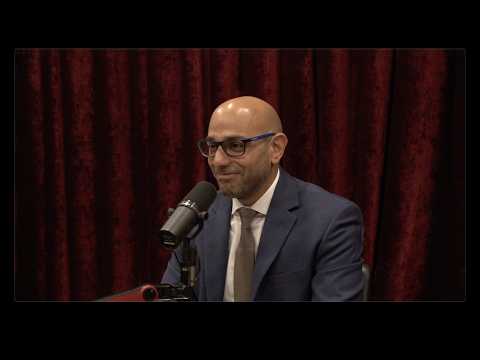
Joe Rogan Experience #2462 - Aaron Siri
Joe Rogan (host), Joe Rogan (host), Aaron Siri (guest)
In this episode of The Joe Rogan Experience, featuring Joe Rogan and Joe Rogan, Joe Rogan Experience #2462 - Aaron Siri explores rogan and Siri challenge vaccine policy, data, mandates, and liability protections Joe Rogan interviews attorney Aaron Siri about his shift from mainstream trust in vaccines to skepticism driven by legal discovery, FDA/CDC source documents, and vaccine injury litigation.
Rogan and Siri challenge vaccine policy, data, mandates, and liability protections
Joe Rogan interviews attorney Aaron Siri about his shift from mainstream trust in vaccines to skepticism driven by legal discovery, FDA/CDC source documents, and vaccine injury litigation.
Siri argues vaccines are uniquely shielded from normal product-liability pressures due to the 1986 National Childhood Vaccine Injury Act, creating distorted incentives and weaker safety-evidence norms compared with other pharmaceuticals.
They dispute common public-health narratives about disease mortality reductions, vaccine trial design (placebo controls and follow-up duration), autism-causation claims, and the ethics/constitutionality of mandates and censorship.
The conversation expands into institutional capture (revolving door), media incentives (pharma advertising), social-media censorship, AI/search manipulation, and broader concerns about groupthink and “secular religion” dynamics in science-adjacent debates.
Key Takeaways
Vaccines are portrayed as a ‘religion’ because questioning them is socially punished.
Rogan and Siri repeatedly claim vaccine discourse triggers label-based dismissal (“anti-vaxxer” akin to “flat-earther”), creating cognitive dissonance and discouraging open debate even when citing primary-source documents.
Get the full analysis with uListen AI
1986 liability protections are framed as the core structural problem.
Siri argues that unlike almost any other product, routine childhood vaccines cannot be sued for design defect in the usual way, which he says removes the market incentive to improve safety and transparency over time.
Get the full analysis with uListen AI
Siri claims vaccine safety evidence standards are weaker than for top-selling drugs.
He contrasts multi-year placebo-controlled drug trials with what he describes as days-to-weeks safety follow-up for many childhood vaccines and asserts most routine injected childhood vaccines were not licensed on inert-placebo trials.
Get the full analysis with uListen AI
Mandates shift risk decisions from individuals to institutions, amplifying distrust.
Both argue that coercive policies (school/work requirements, lockdown orders) turn medical choices into compliance tests, and that officials then “double down” to preserve legitimacy rather than correct course.
Get the full analysis with uListen AI
Disease-mortality declines are attributed largely to sanitation and care, not vaccines alone.
Using measles as the central example, Siri cites a claimed ~98% mortality decline before widespread vaccination and argues improved living conditions and acute care explain much of the reduction.
Get the full analysis with uListen AI
Some vaccines may reduce transmission; others may not—policy should reflect that distinction.
Siri says MMR and chickenpox can prevent transmission, while others (he mentions pertussis) do not and may affect spread dynamics, implying blanket messaging about transmission is misleading.
Get the full analysis with uListen AI
The U.S. newborn Hep B vaccine policy is criticized as low-benefit, non-trivial risk.
They argue birth-dose Hep B is hard to justify for low-risk infants, citing Denmark’s targeted approach and Siri’s claim that infant Hep B disease risk is near-zero while vaccine injury is possible.
Get the full analysis with uListen AI
Siri claims the CDC cannot produce studies disproving autism links for early-life vaccines.
He describes FOIA litigation resulting in a list of studies he says mostly address MMR or unrelated ingredients, concluding the CDC lacks direct studies on vaccines given in the first six months of life and autism—contrasting with public claims of ‘thorough debunking.’
Get the full analysis with uListen AI
The vaccine injury compensation system is presented as inadequate accountability.
Siri describes VICP as lacking normal discovery, using special masters instead of typical judges/juries, and capping pain-and-suffering/death compensation, which he argues weakens deterrence and transparency.
Get the full analysis with uListen AI
Information control (media, platforms, AI) is portrayed as a key amplifier of dogma.
They argue pharma ad dollars reduce critical coverage, platforms removed primary-source discussions during COVID, and LLMs may echo dominant narratives (or even fabricate citations), making “primary sources” essential.
Get the full analysis with uListen AI
Notable Quotes
“The only product in America where you cannot sue to say, ‘Had you made that product safer, my child wouldn’t be dead,’ are childhood vaccines.”
— Aaron Siri
“Vaccines sit in their own little universe. They’re unlike any other medical product.”
— Aaron Siri
“If you have to get sick, sure can’t beat the measles.”
— Brady Bunch clip (played during episode)
“I save my beliefs for religion… you don’t need to with these products.”
— Aaron Siri
“Federal health authorities… should be able to recommend and encourage, never mandate, ever.”
— Aaron Siri
Questions Answered in This Episode
On the 1986 Act: what specific legal claims are barred (design defect, failure-to-warn, negligence), and what claims—if any—remain viable against manufacturers or administrators?
Joe Rogan interviews attorney Aaron Siri about his shift from mainstream trust in vaccines to skepticism driven by legal discovery, FDA/CDC source documents, and vaccine injury litigation.
Get the full analysis with uListen AI
When you say routine childhood vaccines weren’t licensed against inert placebos, which exact licensure packages support that—and what do manufacturers/FDA cite as the ethical or methodological rationale?
Siri argues vaccines are uniquely shielded from normal product-liability pressures due to the 1986 National Childhood Vaccine Injury Act, creating distorted incentives and weaker safety-evidence norms compared with other pharmaceuticals.
Get the full analysis with uListen AI
You mention short safety follow-up (days/weeks) for vaccine trials: which vaccines and what follow-up durations are you referring to, and how do those compare with post-marketing surveillance obligations?
They dispute common public-health narratives about disease mortality reductions, vaccine trial design (placebo controls and follow-up duration), autism-causation claims, and the ethics/constitutionality of mandates and censorship.
Get the full analysis with uListen AI
Measles: can you walk through the CDC mortality sources you cite for ~400 deaths/year pre-vaccine, and how case fatality rates changed with nutrition, antibiotics, and hospitalization improvements?
The conversation expands into institutional capture (revolving door), media incentives (pharma advertising), social-media censorship, AI/search manipulation, and broader concerns about groupthink and “secular religion” dynamics in science-adjacent debates.
Get the full analysis with uListen AI
You suggested some studies associate natural measles/mumps with lower CVD/cancer mortality—what are the strongest studies, and what confounders (socioeconomic status, healthcare access) were controlled?
Get the full analysis with uListen AI
Transcript Preview
Joe Rogan Podcast, check it out.
The Joe Rogan Experience.
Train by day, Joe Rogan Podcast by night. All day. [upbeat rock music]
So you had a pile of notes, and then you just folded them up. Like did you commit them to memory?
No, just these two things. I have the links I sent you guys, and then-
Oh, okay
... and just some stuff there, just-
I just saw the pieces-
... just in case
... of paper that you folded. I was like, "What's in there?"
It's just... That's just-
[laughs] How did... First of all, I wanna, I wanna talk you through, like when you were a younger man, before you had looked into this, what was your opinions on medical science? What was your opinions on vaccines? Were you skeptical, or did you just kind of assume that everything that we're told is exactly how it is, and the experts have only the best interests of human beings in mind and not, not money?
I had what you would effectively call the mainstream view.
Yeah.
Vaccines saved humanity.
Me too.
We'd all be dead without them.
Yep. [laughs]
Um, you know, they are the, uh, um, there was the Bible given to, to Moses at Sinai, and then there were vaccines.
Yeah.
That's basically, you know?
I think it's anybody that didn't consider themselves a fool. You know? If y- you would c- you would have to be a fool, like a real fool-
Right
... to ignore all this medical science, which is the reason why there's so many people alive today that would've died. And a lot of that's true, with penicillin, antibiotics. There's a lot of stuff that has saved a lot of people's lives. Um, b- but the vaccine one, until this COVID epidemic, I would've never questioned it. I mocked anti-vaxxers. I was like, "These people are silly. Don't they know all the good things that vaccines have done?" And the, just the blatant propaganda that we were force-fed, like one of those ducks they're trying to make foie gras with-
Mm-hmm
... th- it just made me stop and pause and go, "Is the whole thing like this? Is this whole thing just a dirty money-laundering operation?" Because it kind of seems like that's at least part of the reason why they were telling people to get boosted when they knew it wasn't working, and, and telling young people that didn't need it to... They wanted to make a lot of money. That's the only reason why you would do any of those things, after a certain amount of information is out. And so it just made me stop and think about the whole thing, and go, "Well, wh- why would I assume that this is the one area where pharmaceutical drug companies, doctor- everybody's been totally honest in this one area," when it's like a religious thing i- if you question it. And one of... that's the... Well, I love the title of your book.
Install uListen to search the full transcript and get AI-powered insights
Get Full TranscriptGet more from every podcast
AI summaries, searchable transcripts, and fact-checking. Free forever.
Add to Chrome