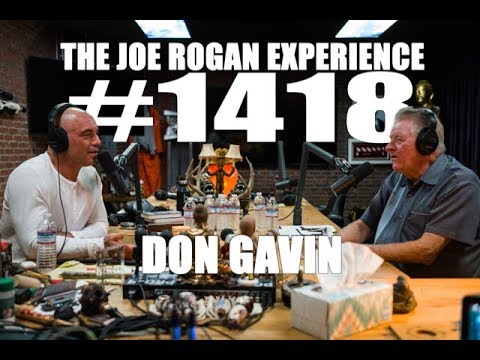
Joe Rogan Experience #1418 - Don Gavin
Joe Rogan (host), Don Gavin (guest)
In this episode of The Joe Rogan Experience, featuring Joe Rogan and Don Gavin, Joe Rogan Experience #1418 - Don Gavin explores boston Comedy Legend Don Gavin Recounts Wild Origins Of Standup Boom Joe Rogan sits down with Boston comedy pioneer Don Gavin to revisit the birth, peak, and collapse of the 1980s Boston standup explosion. They detail the rough bar origins of clubs like the Ding Ho and Nick’s, the hyper-aggressive Boston style, and how a small, hard-partying group of comics created one of the strongest scenes in the country. Gavin shares war stories about drugs, IRS trouble, vicious club politics, road gigs, and why many Boston killers never became nationally famous. They close by discussing Gavin’s late-career push to finally release his standup album and embrace modern platforms and social media.
Boston Comedy Legend Don Gavin Recounts Wild Origins Of Standup Boom
Joe Rogan sits down with Boston comedy pioneer Don Gavin to revisit the birth, peak, and collapse of the 1980s Boston standup explosion. They detail the rough bar origins of clubs like the Ding Ho and Nick’s, the hyper-aggressive Boston style, and how a small, hard-partying group of comics created one of the strongest scenes in the country. Gavin shares war stories about drugs, IRS trouble, vicious club politics, road gigs, and why many Boston killers never became nationally famous. They close by discussing Gavin’s late-career push to finally release his standup album and embrace modern platforms and social media.
Key Takeaways
The Boston comedy boom was built by comics, not businessmen.
Early clubs like the Ding Ho and Nick’s were essentially run and curated by comedians, creating a high-quality, competitive environment that pushed everyone to be better and made Boston uniquely strong compared to other cities.
Get the full analysis with uListen AI
A dense, aggressive joke style defined Boston standup.
Gavin describes a rapid-fire approach with constant punchlines and tags, leaving no room to breathe—something that often overwhelmed slower, more theatrical headliners imported from New York or LA.
Get the full analysis with uListen AI
Success without structure led many comics into serious IRS trouble.
Most Boston comics were paid in cash and simply didn’t file taxes; when visibility increased via press, the IRS cracked down, hitting people like Gavin with massive back-tax and interest bills that took years to settle.
Get the full analysis with uListen AI
Comics often sabotaged out-of-town headliners to defend their turf.
Local clubs would stack lineups with Boston “murderers” before a visiting star, leading to big-name comics like Billy Crystal and Richard Lewis bombing after the crowd had already been destroyed by locals.
Get the full analysis with uListen AI
Many of the best Boston comics never built national profiles.
Because there was so much paid work locally, many stayed in Boston rather than relocating or recording specials, leaving legendary performers like Mike Donovan and others largely undocumented outside the region.
Get the full analysis with uListen AI
Writing and discovering great material often happens live onstage.
Gavin writes longhand and develops bits onstage, while Rogan records every set and sometimes opens with brand-new ideas, relying on spontaneity to generate key punchlines he then refines and keeps.
Get the full analysis with uListen AI
Even veteran comics must adapt to modern distribution to be discovered.
Gavin is only now formally releasing a 2011 album via SiriusXM, streaming, and Instagram, acknowledging that visibility today is driven by consistent content and digital presence rather than just live reputation.
Get the full analysis with uListen AI
Notable Quotes
“There wasn’t a Boston style other than being very aggressive maybe.”
— Don Gavin
“There were about 12 of you… to this day I swear, I think they're the best comics I’ve ever seen in my life.”
— Joe Rogan
“For years I was called the best kept secret in Boston and in comedy… I’m kind of tired of that term. I’d rather not have a secret anymore.”
— Don Gavin
“Comedy clubs are an asylum that needs to be run by the inmates.”
— Joe Rogan
“We did it for the love… It really never entered my mind to release anything. I’m an idiot.”
— Don Gavin
Questions Answered in This Episode
What specific factors made Boston’s audience so demanding and sophisticated compared to other cities?
Joe Rogan sits down with Boston comedy pioneer Don Gavin to revisit the birth, peak, and collapse of the 1980s Boston standup explosion. ...
Get the full analysis with uListen AI
How might the careers of Boston’s legendary club comics have differed if today’s internet and streaming platforms had existed in the 1980s?
Get the full analysis with uListen AI
Where is the line between healthy local pride and toxic territorialism when comics try to “defend” their scene against outsiders?
Get the full analysis with uListen AI
Given his long experience, what does Don Gavin see as the biggest differences between young comics now and in his era?
Get the full analysis with uListen AI
If you were building a new comedy scene from scratch today, what lessons from the Boston boom and collapse would you apply or avoid?
Get the full analysis with uListen AI
Transcript Preview
... three, two... Hello, Don Gavin.
Hello, Joe Rogan.
Good to see you, sir.
It's good to see you. It's been a long time.
Pleas- Yeah, it's a pleasure to get you on here, man.
I'm thrilled to be here.
We've talked about you, uh, I don't know how many times. Many times.
I've heard that from, from my son. He says you mention my name glowingly, is the word he uses.
Yeah, well, hey, man, you were a giant inspiration to me when I was, uh, coming up-
That's good to hear.
... when I was a kid. Well, you know, I've talked about this so many, many times, but that era of, uh, Boston comedy, when I started in '88, and, uh, you guys had already been through the Ding Ho and all that's, uh, been gone. And it was the heyday of comedy. It was an amazing time, and, you know, I was very fortunate to be able to see guys like you and, and Sweeney and, you know, and all those guys. Mike Donovan and Kevin Knox, and I mean, you can go down the list over and over and over again. Lenny Clarke, and just an amazing time for, for standup back then.
Yeah, that was certainly the heyday. Uh, I came in, I started at around '79 and had been going on for one or two years, but going on meaning not much going on, you know. And then it built and built and built, and then to the point that, uh, that explosion, as you said, uh, wow. It... And, and I, I always like to think people talk about a Boston style, there wasn't a Boston style other than being very aggressive maybe.
Yeah.
Uh, there were... But everybody had different ways of doing, because we didn't know.
Yeah.
It wasn't like an LA style or a New York style. There was just d- all different approaches coming out to the same end, you know?
Yeah, you started in '79, so that was really, like, the beginning of comedy clubs, right?
Yeah. Well, they weren't even comedy clubs. You mentioned the Ding Ho. Ding Ho used to be a, uh, like a saloon, and (laughs) the guys that were sitting at the bar when we first went in there, they refused to leave. So they stayed at the bar and all they would do is when we put somebody on the... uh, up on the stand, you know, they'd turn around and say, "Hey, shut the fuck up, we're trying to drink here."
(laughs)
You know, and we couldn't get... we couldn't get rid of them, so finally we wheeled it out because they got so tired of hearing the microphone or the... But that was, that was a... just a little... a joint, that's all you can say.
Just-
And it became a Chinese restaurant there. Yeah.
Install uListen to search the full transcript and get AI-powered insights
Get Full TranscriptGet more from every podcast
AI summaries, searchable transcripts, and fact-checking. Free forever.
Add to Chrome