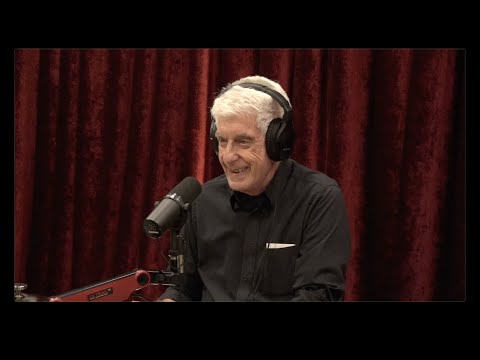
Joe Rogan Experience #2288 - Jacques Vallée
Narrator, Jacques Vallée (guest), Joe Rogan (host), Narrator, Narrator
In this episode of The Joe Rogan Experience, featuring Narrator and Jacques Vallée, Joe Rogan Experience #2288 - Jacques Vallée explores jacques Vallée Explores Remote Viewing, UFO Evidence, And Human Consciousness Jacques Vallée recounts his early work at SRI in the 1970s, where he helped support and conceptually shape government-funded parapsychology research, including the development of coordinate remote viewing used by intelligence agencies.
Jacques Vallée Explores Remote Viewing, UFO Evidence, And Human Consciousness
Jacques Vallée recounts his early work at SRI in the 1970s, where he helped support and conceptually shape government-funded parapsychology research, including the development of coordinate remote viewing used by intelligence agencies.
He and Rogan discuss experiments and cases involving telepathy, autistic savants, remote viewing of Soviet assets, and Vallée’s own anomalous experiences, raising questions about latent human abilities and the limits of current physics.
Vallée then shifts to historical and modern UFO/UAP evidence, emphasizing rigorously investigated cases, physical trace analysis (including metals studied with Garry Nolan), and patterns of humanoid entities and craft over centuries.
Throughout, he argues that many conventional explanations (secret tech, misperceptions) can’t account for the most solid cases, and suggests that non-local phenomena, alternate dimensions, or even simulation-like realities may be needed to explain the data.
Key Takeaways
Remote viewing was formalized with strict scientific protocols and used operationally.
At SRI, physicists like Hal Puthoff and Russell Targ, working with gifted subjects such as Ingo Swann and Joe McMoneagle, developed coordinate remote viewing—using geographic coordinates as a kind of 'address' for information—and produced intelligence-quality descriptions of hidden Soviet facilities and lost spacecraft.
Get the full analysis with uListen AI
Some psychic effects appear real but are fragile, intermittent, and hard to control.
Vallée describes his own sessions with Ingo Swann, including an overwhelming physiological reaction when 'sent' to a peak in the Andes, suggesting a genuine signal that most people can’t reliably harness, and which collapses when over-analyzed or named too quickly.
Get the full analysis with uListen AI
High-credibility UFO cases predate modern technology and show consistent features.
Cases like Socorro (USA), Valensole (France), and the Trinity incident in 1945 all involve egg-shaped craft, short humanoids breathing our air, physical traces, and multi-agency investigations, undercutting the idea that all UAP are recent experimental aircraft or cultural inventions.
Get the full analysis with uListen AI
Physical materials from UFO events can be analyzed with modern isotopic tools.
Vallée and Garry Nolan have subjected recovered metal samples (e. ...
Get the full analysis with uListen AI
Advanced electronic warfare can fake or distort radar targets, complicating UAP interpretation.
Vallée notes existing and emerging tech that can capture radar signatures and replay them elsewhere, or greatly alter apparent target size—meaning some 'teleporting' or impossible radar returns could be sophisticated spoofing, even as this cannot explain all well-documented visual plus instrument cases.
Get the full analysis with uListen AI
Elite witnesses often remain silent due to professional risk, skewing the data we see.
CEOs, technologists, and military professionals regularly confide strong experiences (e. ...
Get the full analysis with uListen AI
Standard space-travel explanations may be wrong; dimensional or 'simulation' models might fit better.
Given centuries of similar-looking craft and entities, and events where objects appear to 'fade out' rather than accelerate away, Vallée argues we may be dealing with phenomena that step in and out of our spacetime—more like accessing another layer or universe minutes away than traversing light-years in classical fashion.
Get the full analysis with uListen AI
Notable Quotes
““The main thing that came out of the SRI study is that there is a signal. The question is how gifted people catch it and process it before the rational mind destroys it.””
— Jacques Vallée
““This was not a photograph. You told Raytheon to build you a device to measure the exhaust of an enemy aircraft, not a camera to track flying saucers.””
— Jacques Vallée (paraphrasing a Raytheon memo about the Tic Tac imagery)
““There are hundreds of Air Force cases that cannot be explained, and scientists could have looked at them. Instead, they’re looking at vague pictures of lights in the sky for the last twelve months.””
— Jacques Vallée
““If there is another universe five minutes ahead of us, it would take them five minutes to get here, not two thousand years at the speed of light.””
— Jacques Vallée
““We’re not talking about propulsion in the way we think of propulsion. We’re talking about something where the rules are different, and we need to start thinking along those rules.””
— Jacques Vallée
Questions Answered in This Episode
If remote viewing and other psi phenomena are real but unreliable, how could science design large-scale, repeatable experiments that respect their fragility instead of forcing them into conventional lab paradigms?
Jacques Vallée recounts his early work at SRI in the 1970s, where he helped support and conceptually shape government-funded parapsychology research, including the development of coordinate remote viewing used by intelligence agencies.
Get the full analysis with uListen AI
Given Vallée’s examples of dimensional or phase-like disappearances, what kinds of theoretical physics models—beyond standard relativity and quantum mechanics—could accommodate 'stepping out' of our spacetime?
He and Rogan discuss experiments and cases involving telepathy, autistic savants, remote viewing of Soviet assets, and Vallée’s own anomalous experiences, raising questions about latent human abilities and the limits of current physics.
Get the full analysis with uListen AI
How should investigators separate sophisticated radar/electronic spoofing from genuinely anomalous targets in modern UAP incidents where both technologies and unknowns may coexist?
Vallée then shifts to historical and modern UFO/UAP evidence, emphasizing rigorously investigated cases, physical trace analysis (including metals studied with Garry Nolan), and patterns of humanoid entities and craft over centuries.
Get the full analysis with uListen AI
What institutional or cultural changes would be required for governments and academia to systematically mine historical UFO case files, instead of focusing narrowly on recent military reports?
Throughout, he argues that many conventional explanations (secret tech, misperceptions) can’t account for the most solid cases, and suggests that non-local phenomena, alternate dimensions, or even simulation-like realities may be needed to explain the data.
Get the full analysis with uListen AI
If multiple types of entities and craft are reported across centuries, is it more plausible that there are many visiting civilizations, a single highly protean intelligence, or some form of reality-shaping interface with human consciousness?
Get the full analysis with uListen AI
Transcript Preview
(drum music) Joe Rogan podcast, check it out.
The Joe Rogan Experience.
Train by day, Joe Rogan podcast by night, all day. (rock music) What up, sir? Very good to see you.
Good to see you.
I really enjoyed our conversation last night. We all went out to dinner and Hal Puthoff blew my mind.
I, as you know, I've known him for a long time. Uh...
Yeah, when did you meet him? What year?
Uh, I knew him at SRI. Actually I was at Stanford Research Institute before him, um, uh, in one of the very early internet research teams when, uh, there was no internet. It was called the ARPANET. It was a-
Wow.
... a network of the advanced research project agency and it was all, you know, computer experiment and so on. It turned into... We had, um, engine number three on the internet at, at SRI.
Wow.
In California.
Engine number three-
So it was part of the-
... on the ARPANET.
By the time I joined them, there were like 30 machines already, so, uh, and it was exciting and then, um, you know, uh, Dr. Puthoff and Russell Targ came in with a proposal to SRI to do, uh, parapsychology research at SRI, which had never been done. And it was funny because the... So I was already there, you know, in, in a team.
What year was this?
Hm?
What year?
Oh, God. Um, uh, '74.
Wow.
'73... Yeah. '74, '74.
So the ARPANET was around '74?
Yeah.
Wow.
And, um, the... It was funny because I was in, in my office and the vice president of SRI came in, uh, closed the door, and said, um, "Jacques, uh, you know, you've published some things, uh, controversial under your name on UFOs. Um, and, uh, you haven't lost your scientific reputation which is why you're here working for us at SRI, uh, on, on the ARPANET. But, um, you know, there's a proposal from, uh, Dr. Puthoff and Dr. Targ to do parapsychology research here and we've never done that." And I said, "Well, you know, it's, it's a very valid... I, I think it's a very valid area of research. We should, you know... We're in the kind of institution that should do that." He said, "Well, let me, let me draw something on your whiteboard." And he drew a scale, a horizontal scale. And on, on one side there was a, a, a little square. He said, "This is the most we can expect in terms of funding for research in parapsychology. You know, it's maybe at most a million a year, okay? And here is what I manage, you know, in this division." He drew a huge cube, you know, it said $150 million. "Should we jeopardize the research we do for Xerox and IBM and AT&T and Bank of America and so on, just to do some research on, you know, uh, uh, psychic things?" And I said, "Well, um, you know, the, the re- the reason we, we get all this money from DOD and Bank of America and so on, is that we do the research that they can't do themselves. We do, we do the... You know, we go out and we take risk, and, uh, I think we should, uh, take the same risk with, uh, uh, with Hal Puthoff and Russell Targ because this could be very big. You know, there is a lot of literature on this already and we can bring science into it, and they can bring the science into it, you know?" And he said, um, "Well, there is a meeting of the board of directors of SRI, you know, in two days, and most of them are against it. What do I tell them?" And I said, "Well, I can, you know, I can write up the, the reasons why in science you have to take chances and this is science. I mean, this isn't just engineering." And he said, uh, "Well, um, give me a memo by, by tomorrow at 12:00." So I went home and I, I wrote a two-page memo, which was confidential, I don't, don't think anybody has seen it, for the, for the board, explaining why there was scientific evidence, you know, enough of it so that good research could be done and, uh, I, I, you know... Obviously that, that may have helped in, uh, getting, getting the approval for them to come in. And then after the first year, you know, they were there because, uh, you know, the, the, the money kept coming and the results can... you know, good scientific results came, c- came in, came out of it.
Install uListen to search the full transcript and get AI-powered insights
Get Full TranscriptGet more from every podcast
AI summaries, searchable transcripts, and fact-checking. Free forever.
Add to Chrome