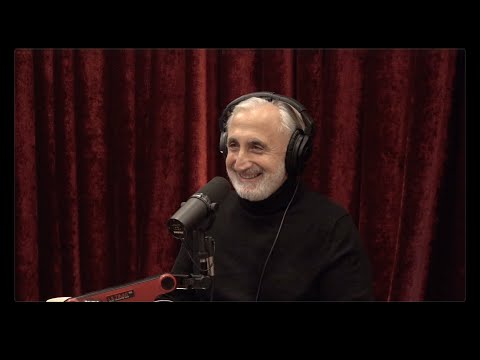
Joe Rogan Experience #2263 - Gad Saad
Joe Rogan (host), Gad Saad (guest), Gad Saad (guest), Guest (unidentified third speaker) (guest), Narrator, Narrator, Narrator
In this episode of The Joe Rogan Experience, featuring Joe Rogan and Gad Saad, Joe Rogan Experience #2263 - Gad Saad explores joe Rogan and Gad Saad Dissect Minds, Myths, Woke Culture, and AI Joe Rogan and Gad Saad range widely across parenting, early exposure to politics and media, and how children lose innocence in a hyper-connected world. Saad explains key ideas from cognitive psychology and decision science—game theory, stopping rules, cognitive dissonance, and the null-results bias in research—while they connect these to politics, COVID-era behavior, and ideological rigidity.
Joe Rogan and Gad Saad Dissect Minds, Myths, Woke Culture, and AI
Joe Rogan and Gad Saad range widely across parenting, early exposure to politics and media, and how children lose innocence in a hyper-connected world. Saad explains key ideas from cognitive psychology and decision science—game theory, stopping rules, cognitive dissonance, and the null-results bias in research—while they connect these to politics, COVID-era behavior, and ideological rigidity.
They criticize modern academia, DEI, and the woke movement as a "mind virus," drawing parallels to evolutionary biology, costly signaling, and parasitic ideas that captured institutions and distorted science, medicine, and public discourse. Immigration, trans ideology in sports, and campus culture are framed as examples where empathy and ideology override reality.
The conversation then moves to diet, evolutionary medicine, and training, with Rogan describing his largely carnivore diet, brain fog reduction, and the importance of discipline, while Saad adds evolutionary explanations for obesity and health mismatches. They also explore AI, quantum computing, autonomous vehicles, and the geopolitical AI arms race, speculating on future realities like telepathic communication and AI-driven diagnostics.
Throughout, they discuss social media toxicity, the danger of being attached to ideas, and why Rogan avoids online conflict, ending on the importance of curiosity, long-form conversation, and maintaining low-conflict relationships in a culture that incentivizes outrage.
Key Takeaways
Humans resist changing their minds because cognitive dissonance feels painful.
Saad cites Leon Festinger’s work to explain how people perform "mental gymnastics" to keep beliefs consistent, even when new evidence appears—something visible in partisan politics, COVID reactions, and social media fights.
Get the full analysis with uListen AI
Real-world decisions use "stopping rules" rather than exhaustive analysis.
From his PhD work, Saad explains that people decide when they have "enough" information—e. ...
Get the full analysis with uListen AI
Science is distorted by a strong bias against publishing null results.
Saad describes a rigorous study on dysphoria and decision-making that found mostly no effects; a top journal rejected it because it lacked significant findings, illustrating how the "null results bias" skews the scientific record and meta-analyses.
Get the full analysis with uListen AI
Woke ideology operates like a parasitic mind virus that overrides reality.
They argue that concepts like DEI, trans women in women’s sports, or open-border absolutism show how empathy and identity politics can be weaponized to ignore data, erase biological realities, and punish dissent.
Get the full analysis with uListen AI
Evolutionary mismatch explains many modern health and behavior problems.
Traits that were adaptive in scarcity—like preferring fatty, energy-dense food—become harmful in a world of caloric abundance, contributing to obesity, diabetes, and other chronic diseases; understanding this can steer diet and lifestyle choices.
Get the full analysis with uListen AI
AI and quantum computing pose transformative—and potentially destabilizing—power.
They discuss China’s massive AI investments, America’s response, and quantum computers that can solve problems no classical computer could handle in the universe’s lifetime, hinting at a future where AI-plus-quantum could resemble an almost "godlike" problem-solver.
Get the full analysis with uListen AI
Personal peace requires not attaching your identity to your ideas or online fights.
Rogan stresses that ideas are tools, not the self; he deliberately avoids Twitter battles, believes constant negativity is like junk food for the mind, and values low-conflict relationships—even seeking to reconcile when past comments have caused friction.
Get the full analysis with uListen AI
Notable Quotes
“Ideas are just ideas. You are not your ideas.”
— Joe Rogan
“The most dangerous force in nature are parasitized minds.”
— Gad Saad
“If you think you understand quantum physics, you don’t understand quantum physics.”
— Gad Saad (quoting Richard Feynman)
“Most professors are not intellectuals. They’re just playing a game—publish or perish, get tenure, game the system.”
— Gad Saad
“If it wasn’t for Elon buying Twitter, the world would be a far more fucked-up place right now.”
— Joe Rogan
Questions Answered in This Episode
In what concrete ways can individuals train themselves to be less attached to their ideas and more open to changing their minds?
Joe Rogan and Gad Saad range widely across parenting, early exposure to politics and media, and how children lose innocence in a hyper-connected world. ...
Get the full analysis with uListen AI
How should universities practically rebuild curricula and culture to reverse decades of ideological capture without creating a new kind of dogma?
They criticize modern academia, DEI, and the woke movement as a "mind virus," drawing parallels to evolutionary biology, costly signaling, and parasitic ideas that captured institutions and distorted science, medicine, and public discourse. ...
Get the full analysis with uListen AI
What safeguards, if any, could realistically prevent a combined AI–quantum computing breakthrough from being weaponized by states or corporations?
The conversation then moves to diet, evolutionary medicine, and training, with Rogan describing his largely carnivore diet, brain fog reduction, and the importance of discipline, while Saad adds evolutionary explanations for obesity and health mismatches. ...
Get the full analysis with uListen AI
How do we balance compassion (for immigrants, trans people, etc.) with empirical reality and long-term societal stability in law and policy?
Throughout, they discuss social media toxicity, the danger of being attached to ideas, and why Rogan avoids online conflict, ending on the importance of curiosity, long-form conversation, and maintaining low-conflict relationships in a culture that incentivizes outrage.
Get the full analysis with uListen AI
Given the mismatch between our evolved brains and the modern environment, what are the most impactful, realistic behavior changes an average person can make to improve health and mental clarity?
Get the full analysis with uListen AI
Transcript Preview
(drumbeats) Joe Rogan podcast, check it out. The Joe Rogan Experience. Train by day, Joe Rogan podcast by night, all day. (instrumental music plays)
My man. Joe Rogan. Good to see you again. (laughs) You're gorgeous. You are too, you beautiful bastard. Shut up. Come on. Can I read you something? Oh, okay. You wanna read me something? This is from my son- Okay. ... just before I came on the show. "Hi, Daddy. I was wondering if the show will be live anywhere, and tell Joe that I say hello and I love his show." Oh. You just made his life. How old is he? Well, last week was his bar mitzvah. Oh, so he's 13. He's 13. Okay. And it was- That's about the age you shouldn't be listening to my show yet. (laughs) You used to disturb me, uh, when I would meet my youngest daughter's friends when they were, uh, before high school. Yeah. And they would say they love my podcast. I was like, "Geez, this is really not for you. Like, some of these subjects- Yeah, yeah, yeah. ... is not for you." But the kids today, they're not, uh, 12-year-olds when I was a 12-year-old. Yeah. These kids have a far more advanced understanding of the world, for good or for bad. Yeah. Yeah. Probably l- ... I mean, I don't know if it's good or bad, 'cause I mean, I think, uh, uh, our childhood we were more exposed to things than our parents were. I don't necessarily think that's bad, so why would I think it's bad for kids today? I think the explosion though is- Yeah. ... (clears throat) you could go on and see porn that you and I don't even know they exist. Yeah, it is an issue. Yeah. (clears throat) That, that most certainly is a problem. But I don't know, um, if it's worse or better. Yeah. Do you know what I'm saying? Like, I would rather have the l- loss of innocence that I had as a 14-year-old than the loss of innocence my parents had. I think they just lived in a more ignorant time, and with knowledge, you're also gonna get all the bad stuff. Like, I see a lot of assassination videos. Yeah. Okay. (exhales) You know, it's funny you say a, uh, the age of innocence, because I've always said that the two things that protect me in life were my Belgian Shepherds, whom, whom I love. And I, I saw by the way that you were talking recently about Belgian Malinois. Yeah. So my, we've ... My kids have grown up with ... By, by the way, the Belgian Malinois is one of four types of Belgian Shepherds. The only difference across the four types is that the Belgian Malinois has short hair- Ah. ... whereas the ones that we had have long hair. They even look more wolfish, more intimidating. And- Scary dogs. And so anyways, so I always said that the two things that protect me when I sort of enter the, the sanctity of my home was the love of my family, my Belgian Shepherds, and the innocence of my children. Mm. Because, you know, the world- Right. ... out there is ugly, and then you go back home- That's true. And so once that becomes polluted, because they just know more, I feel like I'm losing part of them. Mm. That's interesting. Um, I don't think you should think that way. (laughs) I think they're human beings and you should want them to know things. It's just that- Yeah. ... we enjoy the position of being the person that has all the deep, dark knowledge of the world and dealing with this innocent child that wants to watch- Yeah. ... Dora the Explorer. (laughs) You know? << Doo-doo-doo-Dora >> You know? Like you ... (laughs) Peppa Pig. Yeah, Peppa Pig, all those kind of shows. Yeah. And th- there's, you know, there's something beautiful in watching a little person learn stuff about the world, and, and shocking when they find out about, like, murders and danger and scary things. And, you know, and then their, their realm of knowledge expands to ... you know. What amazes me is seeing my children get a political awakening. So my son- Mm. ... who's really pre- precocious, he's 13, my daughter's 16, she wasn't as into it, but during the last US elections, maybe because of the TikTok stuff and so on- Sure. ... she became ... she sort of woke up to it, and she would come to me and say, you know, "W- why do we like Trump? Why don't we li-" And so- Mm-hmm. ... I saw an awakening in her that my son already had. I mean, he literally will sit with me, watch ... I mean, Tucker's no longer on, but he would watch Tucker with me and have conversations with me when he was 11, 12. My daughter came a bit later into the game. But it's so rewarding to see them wake up to these things and have meaningful conversations with me on these topics. It's beautiful. God, I didn't know anything about politics. Blissfully, blissfully unaware when I was 13. Is that right? Right. But I did worry about, um, Russia. When I was in high school, everybody was terrified. Before the fall of the Soviet Union, we were terrified that we were gonna go to war with Russia. It was like a thing that was hovering over our head every day. Yeah. That was kind of all I knew about politics. Like, Russia bad, United States good. Russia bad, wants to kill United States. Like, that's what we were basically told. All the movies, like Red Dawn, you know, Russia invades America. Can I incorporate some professorial elements to what you just said? Please do. So, one of my intellectual heroes is John von Neumann, who was a Hungarian Jewish polymath. He was a mathematician, he was a game theorist, and one of the things that he did, he was one of the pioneers of using game theory. Do you, do you know what game theory is? Yes. In economics? Yeah. Okay. Yes. Do you want me to explain it for our viewers? Yeah. Yeah, please. So a, a classic example of a g- of, of a game theory context would be the prisoner's dilemma, right? You, you capture two prisoners, you take them apart as the cops do. Each of them can either squeal, confess or not. And depending on whether ... So there are four possibilities. Both can confess, one confess, the other one ... So there ... It's a two-by-two matrix, and there are different payoffs in each of these matrices. And then the question is, what is the optimal behavior? So that's called game theory, because you u- you use game theoretic, you know, framework to model what should be some optimal behavior. Well, in the context of the Cold War, that's when game theory was first being applied, that the Russians can, or the Soviets, can nuke us or, or not, we can nuke them or not. Mm-hmm. And so there were all these models that were developed. So for example, mutually assured d- destruction- Mm-hmm. ... is a-
Install uListen to search the full transcript and get AI-powered insights
Get Full TranscriptGet more from every podcast
AI summaries, searchable transcripts, and fact-checking. Free forever.
Add to Chrome