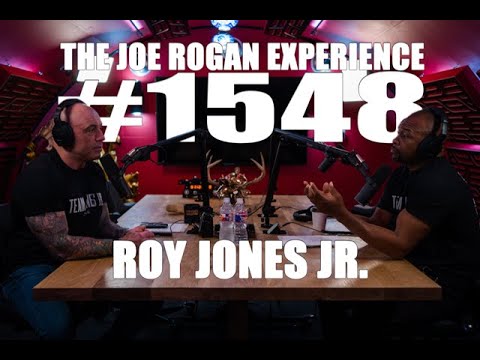
Joe Rogan Experience #1548 - Roy Jones Jr.
Roy Jones Jr. (guest), Joe Rogan (host)
In this episode of The Joe Rogan Experience, featuring Roy Jones Jr. and Joe Rogan, Joe Rogan Experience #1548 - Roy Jones Jr. explores roy Jones Jr. Reveals Rooster-Inspired Greatness, Tyson Comeback Mindset, Legacy Joe Rogan and Roy Jones Jr. dive deep into Roy’s unconventional path to boxing greatness, from studying fighting roosters and classic legends to developing one of the most unique styles in history.
Roy Jones Jr. Reveals Rooster-Inspired Greatness, Tyson Comeback Mindset, Legacy
Joe Rogan and Roy Jones Jr. dive deep into Roy’s unconventional path to boxing greatness, from studying fighting roosters and classic legends to developing one of the most unique styles in history.
Roy revisits key moments of his career: the infamous Olympic robbery, his dominant prime, moving up to heavyweight to fight John Ruiz, and the brutal cost of cutting back down to light heavyweight.
They break down the upcoming Mike Tyson exhibition, how the rules keep shifting in Tyson’s favor, and how Roy mentally prepares to face such a dangerous opponent at 51.
Beyond specific fights, the conversation explores confidence versus ego, father–son conflicts, the importance of “not being neutered” as a man, fighter safety, and Roy’s current life as a trainer and global boxing ambassador (including his Russian citizenship).
Key Takeaways
Unconventional observation can fuel elite performance.
Roy built parts of his style by studying his father’s fighting roosters—learning about confidence, feints, unpredictability, and dominance, then translating those animal behaviors into boxing strategy.
Get the full analysis with uListen AI
Confidence is essential, but it must be backed by knowledge.
He rejects the idea he was ‘just a freak athlete’; he can verbally walk through every knockout setup, emphasizing that high ring IQ and preparation, not just speed and power, made his style work.
Get the full analysis with uListen AI
Massive weight cuts, especially after moving up, can permanently change a fighter.
Roy describes dropping from 203 to 175 after winning the heavyweight title as the hardest thing he ever did, costing him muscle, strength, and durability—and directly affecting the Tarver fights.
Get the full analysis with uListen AI
Systemic injustice can become a long-term motivational engine.
The Seoul Olympic robbery devastated him, but he reframed it as a “blessing in disguise” that galvanized fan support and gave him a career-long chip on his shoulder to prove his greatness.
Get the full analysis with uListen AI
Rules and structure can meaningfully tilt risk in combat sports.
For the Tyson exhibition, shorter two-minute rounds and other late rule changes favor Tyson as the bigger puncher; Roy points out that keeping Tyson “fresh” longer increases the danger to him.
Get the full analysis with uListen AI
Great fighters often need to separate from controlling fathers or trainers.
Roy likens some father-trainer relationships to neutering a young lion—he believes he had to leave his father to avoid being emotionally ‘gelded’ and to realize his full potential.
Get the full analysis with uListen AI
Legacy extends through teaching and global engagement.
Roy now trains fighters around the world, stresses teaching complete boxing (offense, defense, footwork, counters), maintains ties to Russia where he’s hugely popular, and sees giving back as his responsibility.
Get the full analysis with uListen AI
Notable Quotes
““People used to think that I was very egotistical. I’ve never been an egotistical person. But what I was, was a highly confident person. I’m God’s game rooster.””
— Roy Jones Jr.
““If I didn’t beat that, I never would’ve made it in boxing.””
— Roy Jones Jr. (on separating from his father’s control)
““When you neuter a man, he becomes nothing. He don’t care no more. He ain’t gonna fight back.””
— Roy Jones Jr.
““In boxing, you have to take every fight like tomorrow is not promised. Anything can happen at any time.””
— Roy Jones Jr.
““If I gotta die boxing, I’m gonna die a happy man.””
— Roy Jones Jr.
Questions Answered in This Episode
How would Roy’s rooster-inspired, reflex-heavy style translate if he were starting his career in today’s analytics-driven, strength-and-conditioning era?
Joe Rogan and Roy Jones Jr. ...
Get the full analysis with uListen AI
What structural reforms would most effectively restore integrity to Olympic and amateur boxing after decisions like Roy’s 1988 robbery?
Roy revisits key moments of his career: the infamous Olympic robbery, his dominant prime, moving up to heavyweight to fight John Ruiz, and the brutal cost of cutting back down to light heavyweight.
Get the full analysis with uListen AI
Given Roy’s experience with extreme weight cycling, should combat sports impose stricter limits on weight cuts or add more weight classes in MMA?
They break down the upcoming Mike Tyson exhibition, how the rules keep shifting in Tyson’s favor, and how Roy mentally prepares to face such a dangerous opponent at 51.
Get the full analysis with uListen AI
How can fighters and coaches preserve the productive parts of a hard-driving father–son coaching relationship while avoiding the ‘mental neutering’ Roy describes?
Beyond specific fights, the conversation explores confidence versus ego, father–son conflicts, the importance of “not being neutered” as a man, fighter safety, and Roy’s current life as a trainer and global boxing ambassador (including his Russian citizenship).
Get the full analysis with uListen AI
If Roy were to fully commit to training a top heavyweight like Deontay Wilder for six months, what specific technical and psychological changes would he prioritize to maximize that fighter’s potential?
Get the full analysis with uListen AI
Transcript Preview
(drumming music plays) Joe Rogan podcast. Check it out. The Joe Rogan Experience.
Train by day, Joe Rogan podcast by night, all day. (rock music plays) Roy Jones Jr., ladies and gentlemen.
Hey, what's up, my brother? How you doing?
I'm honored to have you in here. I've been a fan forever.
I know this, and I was gonna tell you that I am very happy to be here for you and for me, because I've been a fan of yours as well. But I always loved the support that you give me. You've always supported me since day one. You've been one of the best people that I could hear talk about me s- since day one. So, I just wanna say thank you, man, for all the support, for being a brother.
Thank you, sir. Thank you.
'Cause I feel-
My, my pleasure. Listen-
I feel like we brothers now, you know.
For sure. Uh, li- I've been a fan forever.
Yeah.
Like, from way back in the day, you know. Y- you know your song, Y'all Must Have Forgot?
Yeah.
I didn't forget shit.
(laughs)
I remember all of it, man.
There it is.
I remember when your fights were basically executions.
Yes, exactly.
There was this, there's some-
(laughs)
... there was some years, man, where you would just, like, see how is this guy gonna survive and how long? And you, you had, uh, there was a time in your career when you were at your peak, where you had devised this style that was so different than anyone else's. Very few jabs. You would throw-
Yeah.
... a lead hook. No one knew how to prepare for it, because there was no sparring partners that could emulate it.
Right.
Your speed was off the charts. Your movement was off the charts. Y- I- it's, I think to this day, you're the only person in CompuBox history that went a full round without having a single punch scored on them.
And they say I'm not the best defensive fighter ever.
Listen, man. (laughs)
(laughs)
That's, that's ... No one's ever ... Now, I mean, maybe Willie Pep might have done that back in the day.
And that was before CompuBox.
Yeah.
But since CompuBox era, nobody has ever gone a complete round without getting a punch scored on them.
It was ridiculous.
Now, you, and you tell me he ain't the best pound for pound, or he ain't the best, at least, defensive fighter? And we know about the offense. But I don't argue and I just listen to what people say.
No, there was a time where I've always said, like, people would say, "Oh, but he didn't fight anybody." I'm like, "The fuck he didn't."
(laughs)
Install uListen to search the full transcript and get AI-powered insights
Get Full TranscriptGet more from every podcast
AI summaries, searchable transcripts, and fact-checking. Free forever.
Add to Chrome