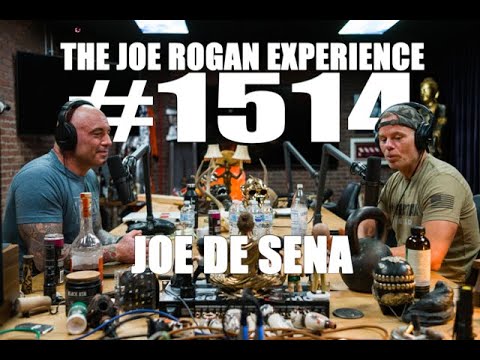
Joe Rogan Experience #1514 - Joe De Sena
Joe Rogan (host), Joe De Sena (guest), Narrator
In this episode of The Joe Rogan Experience, featuring Joe Rogan and Joe De Sena, Joe Rogan Experience #1514 - Joe De Sena explores joe Rogan and Joe De Sena on Discomfort, Discipline, and Transformation Joe Rogan talks with Spartan Race founder Joe De Sena about extreme physical challenges as a tool for changing lives, from hauling kettlebells worldwide to running brutal training camps for kids. De Sena shares stories of transforming morbidly obese participants through raw-food diets and long daily hikes, and describes how discomfort and rigid structure build real discipline. They explore culture and health, from Japan’s COVID response and American obesity to diet debates, fasting, and factory farming. The conversation repeatedly returns to personal responsibility: using goals, schedules, and hard physical work to toughen the mind, especially for children growing up in comfort.
Joe Rogan and Joe De Sena on Discomfort, Discipline, and Transformation
Joe Rogan talks with Spartan Race founder Joe De Sena about extreme physical challenges as a tool for changing lives, from hauling kettlebells worldwide to running brutal training camps for kids. De Sena shares stories of transforming morbidly obese participants through raw-food diets and long daily hikes, and describes how discomfort and rigid structure build real discipline. They explore culture and health, from Japan’s COVID response and American obesity to diet debates, fasting, and factory farming. The conversation repeatedly returns to personal responsibility: using goals, schedules, and hard physical work to toughen the mind, especially for children growing up in comfort.
Key Takeaways
Use concrete events and deadlines to drive consistent training.
Both men emphasize that having a date on the calendar—a fight, a race, a Spartan event—forces you to wake up earlier, eat better, and do the work you’d otherwise avoid. ...
Get the full analysis with uListen AI
Structure and write down your workout commitments.
Rogan suggests scheduling specific, measurable tasks (e. ...
Get the full analysis with uListen AI
Discomfort is a primary tool for growth, not something to avoid.
De Sena repeatedly uses extreme discomfort—cold water, long hikes, carrying rocks—to reshape people’s behavior and self-image. ...
Get the full analysis with uListen AI
Early, intense challenges can positively rewire kids’ brains.
De Sena’s 14‑day farm camps strip away phones, enforce early mornings and hard physical labor, and include controlled combat sports. ...
Get the full analysis with uListen AI
Simple, whole-food diets plus high activity can drive massive change.
De Sena describes taking a 696‑pound man down to 265 pounds in 18 months using only raw fruits and vegetables and 10–20 miles of daily hiking. ...
Get the full analysis with uListen AI
Our food and ad systems stack the deck against health.
They argue that fast food, factory farming, and sophisticated marketing make it an unfair fight for the average person, especially in poor neighborhoods. ...
Get the full analysis with uListen AI
Physical training stabilizes mood and improves how you treat others.
Rogan notes he’s a worse thinker and person when he skips workouts; hard exercise is his primary tool for stress relief, clarity, and kindness. ...
Get the full analysis with uListen AI
Notable Quotes
“When you can’t change your situation, you change yourself.”
— Joe De Sena
“The number one motivator for human beings is the avoidance of discomfort.”
— Joe De Sena
“The best thing you could ever do is force yourself to a schedule.”
— Joe Rogan
“Your mind has to tell your body who the fucking boss is.”
— Joe Rogan
“Kids never meet themselves if they’re always on the couch with a phone.”
— Joe De Sena (paraphrased sentiment from his camp discussion)
Questions Answered in This Episode
How far can you safely push extreme weight loss and raw diets before medical risks outweigh the benefits?
Joe Rogan talks with Spartan Race founder Joe De Sena about extreme physical challenges as a tool for changing lives, from hauling kettlebells worldwide to running brutal training camps for kids. ...
Get the full analysis with uListen AI
What would a realistic national strategy to improve baseline fitness and resilience actually look like, beyond slogans?
Get the full analysis with uListen AI
Could mandatory service or rite-of-passage programs for young adults work in the U.S., or would they clash too hard with American ideas of freedom?
Get the full analysis with uListen AI
How much responsibility lies with individuals versus food companies and regulators when it comes to the obesity crisis?
Get the full analysis with uListen AI
In a post-COVID world, how might events like Spartan races evolve to keep both the transformative challenge and genuine safety?
Get the full analysis with uListen AI
Transcript Preview
(singing)
Thanks for doing this.
My pleasure. Hello, Joe.
That's right. (laughs)
How are you? We're rolling.
Oh, we're rolling.
What's going on, man?
All right.
Nice to meet you.
Thanks for having me.
So, uh, the kettlebell, you bring this fucking thing everywhere you go.
I, I do.
Literally everywhere?
I, I, uh, lived overseas and I started at... You know why I started it? I had a, um, 696-pound guy come to the farm, uh, six years ago, and he wanted, he wanted help losing weight. And I, I helped him, uh, over 18 months get down to 265 pounds.
Wow.
And one of the methods I used to motivate him was I said, "As you lose weight, I'll carry weight." And e- eventually I was carrying a 100-pound sandbag. Fast forward, and, and we can get into it, I moved overseas with my family and I tried to carry that 100-pound sandbag 'cause I had made that commitment to him and they wouldn't let it through TSA. So when I landed in, in, uh, Asia, I asked my wife, I said, "Hey, could you order a 20-count po-" It's stupid that I'm carrying a sandbag. "Can you order a 20-pound kettlebell? I'll just carry a 20-pounder around so I'm not a complete fraud." And she confused pounds with, uh, ke- kilograms and I ended up with a, a 44-pounder and it just became my shtick, my thing. (laughs)
(laughs)
(laughs)
So when you... You say you carry it everywhere, I mean, you go everywhere with it.
I go everywhere with it. So on pande... During the pandemic, I haven't... Like I wouldn't carry it if we were going to a grocery store, but if, if I'm traveling to see you or I'm going anywhere in the world, kettlebell's coming with me. Vegas, anywhere.
Do you take it as a carry on? Like how does-
Depends on the country. Um, we operate in a lot of countries and, and every country treats it differently. So some US flights, they'll let me carry it on, which is strange. Uh, others, they, they ask me to check it.
You know, they won't let you bring a pool cue on a plane?
Yeah.
'Cause they say it's like a weapon.
Well, the stuff-
How is that not like a weapon?
Well, uh, my answer to them is, "You'd have to be pretty fucking strong." (laughs)
You, you're pretty fucking strong.
I'm not that strong. (laughs)
You could smash somebody with one of those things.
No, but they've let me bring it on planes. China doesn't mind at all. India, in India, you're gonna love this, they ask me to put it in someone else's luggage. So in other words, somebody had just dropped off their luggage, I'm checking the kettlebell, "Stick it in that blue suitcase. Get it when you get to the other end."
Install uListen to search the full transcript and get AI-powered insights
Get Full TranscriptGet more from every podcast
AI summaries, searchable transcripts, and fact-checking. Free forever.
Add to Chrome