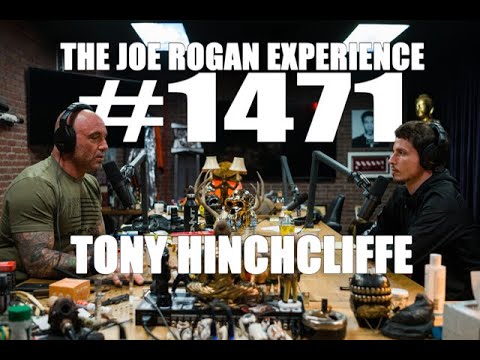
Joe Rogan Experience #1471 - Tony Hinchcliffe
Joe Rogan (host), Tony Hinchcliffe (guest), Jamie Vernon (guest), Guest (unidentified, brief interjection) (guest), Guest (unidentified, brief interjection) (guest), Guest (unidentified, brief interjection) (guest), Guest (unidentified, brief interjection) (guest), Guest (unidentified, brief interjection) (guest)
In this episode of The Joe Rogan Experience, featuring Joe Rogan and Tony Hinchcliffe, Joe Rogan Experience #1471 - Tony Hinchcliffe explores joe Rogan, Tony Hinchcliffe Roast Lockdowns, Martial Arts, Media, Madness Joe Rogan and Tony Hinchcliffe riff on early COVID-19 lockdown rules in Los Angeles, mocking the arbitrary-seeming activity lists and debating personal responsibility versus government control.
Joe Rogan, Tony Hinchcliffe Roast Lockdowns, Martial Arts, Media, Madness
Joe Rogan and Tony Hinchcliffe riff on early COVID-19 lockdown rules in Los Angeles, mocking the arbitrary-seeming activity lists and debating personal responsibility versus government control.
They dive deep into martial arts and combat sports, contrasting “soft” and “hard” styles, the evolution into MMA, and the gap between casual perceptions of fighting and elite grappling reality.
The conversation swings through pop culture—Tom Cruise stunts, Top Gun, The Irishman, Ozark, Succession, Tiger King—and into guns, self‑defense, crime psychology, and media bias in how stories are framed.
They close by talking about how people change (or don’t), addiction versus self‑improvement, body image controversies like Adele’s weight loss, and how quarantine has reshaped stand‑up, personal habits, and future plans.
Key Takeaways
Lockdown rules often feel arbitrary and condescending to the public.
Rogan and Hinchcliffe mock detailed lists of “allowed” activities (like ‘soft martial arts’ and ‘outdoor photography’) as over-specific and inconsistent with how transmission actually works, arguing for clearer principles instead of micromanaging behavior.
Get the full analysis with uListen AI
Grappling exposes how overconfident most people are about real-world fighting.
Rogan explains that until you train with high-level wrestlers or jiu-jitsu practitioners, it’s easy to be delusional about your ability to keep someone off you—elite grapplers make resistance look effortless but it’s the result of extreme skill and conditioning.
Get the full analysis with uListen AI
Mixed martial arts is closer to a “real” martial art than traditional siloed styles.
They argue that MMA’s blend of striking, wrestling, and submissions—embodied by fighters like Jon Jones—is closer to true combat effectiveness than singular arts; traditional styles often overestimated their completeness before cross-training exposed their limits.
Get the full analysis with uListen AI
Gun stories flip from ‘pro-gun’ to ‘anti-gun’ based on outcomes, not mechanics.
Rogan highlights cases where armed civilians stop violent crime (home invasions, church shootings) versus tragedies where guns kill innocents; the same tool is framed as problem or solution depending on whether it saved or cost lives in that incident.
Get the full analysis with uListen AI
Media selection and tone amplify fear and shape public reality.
They argue TV news compresses global bad news into tight, high-drama segments that reward catastrophe, rarely balancing with progress or context, which can warp viewers’ sense of how dangerous or hopeless the world really is.
Get the full analysis with uListen AI
Environment and routine heavily influence health, immunity, and life trajectories.
Examples range from prisoners potentially having toughened immune systems via constant exposure, to people numbing trauma with drugs, to ex-addicts who radically reinvent themselves—showing change is possible but as demanding as running ‘100 miles’ psychologically.
Get the full analysis with uListen AI
Public reaction to body changes (like Adele’s weight loss) reveals insecurity.
They see backlash against praising weight loss as driven by people who don’t want to confront their own choices; Rogan insists you can’t “redefine” what most people find physically attractive just to reduce discomfort about fitness and health standards.
Get the full analysis with uListen AI
Notable Quotes
“You can’t decide that the way you look is what everybody should like.”
— Joe Rogan
“You can get really delusional about how much you can keep a person off you.”
— Joe Rogan
“Guns are like one of those things, like being a person. It’s not clear.”
— Joe Rogan
“I am an 800‑pound man in this toothpick body.”
— Tony Hinchcliffe
“I almost think getting your shit together is a lot like running a hundred miles.”
— Joe Rogan
Questions Answered in This Episode
How should governments balance clear, science-based public health guidance with avoiding paternalistic or absurdly detailed rules that people stop respecting?
Joe Rogan and Tony Hinchcliffe riff on early COVID-19 lockdown rules in Los Angeles, mocking the arbitrary-seeming activity lists and debating personal responsibility versus government control.
Get the full analysis with uListen AI
What’s the most honest way for media to report on both gun misuse and defensive gun use without fueling either side’s extremes?
They dive deep into martial arts and combat sports, contrasting “soft” and “hard” styles, the evolution into MMA, and the gap between casual perceptions of fighting and elite grappling reality.
Get the full analysis with uListen AI
If MMA has revealed the limits of many traditional arts, what does that say about other institutions and belief systems we still treat as complete or unquestionable?
The conversation swings through pop culture—Tom Cruise stunts, Top Gun, The Irishman, Ozark, Succession, Tiger King—and into guns, self‑defense, crime psychology, and media bias in how stories are framed.
Get the full analysis with uListen AI
In what concrete ways does constant exposure to fear-driven news coverage change behavior, mental health, and societal cohesion?
They close by talking about how people change (or don’t), addiction versus self‑improvement, body image controversies like Adele’s weight loss, and how quarantine has reshaped stand‑up, personal habits, and future plans.
Get the full analysis with uListen AI
How should we talk about body image and health so that we can applaud difficult self-improvement (like weight loss) without shaming people who aren’t there yet?
Get the full analysis with uListen AI
Transcript Preview
Three, two, one. Tony motherfucking Hinchcliffe.
Yeah.
Good to see you, buddy.
Good to see you.
Every time comics come here that I usually spend multiple nights a week with, like ... (sighs) It's so nice to be semi-normal again.
Yes, for fucking sure.
The restrictions are supposed to be lifting up here in Los Angeles on Friday, which means nothing for us, for comedians. It means something for, like, some re- retail, some other stuff, but they're doing it nice and slow. And did you see the list of shit that the governor's office put out of stuff you're allowed to do?
Mm-mm.
You should pull that up, Jamie, 'cause it is ... It's quite hilarious. First of all, it's, it's kind of condescending. It's what? It's like treating you like you're a moron. Like, "Here's things you're allowed to do."
(laughs)
One of them that I thought that was hilarious, it said, "soft martial arts."
(laughs)
Yeah. It did. It said, "Tai chi. This is ... You're allowed to do this outside."
Oh, no.
Soft martial arts.
No.
Like, why can't you do ... Why can't you shadowbox? Can you do that?
Yeah.
Or it's only okay if you do things that don't work?
Ugh.
Like, you're saying martial, martial art, all right? That's an art of war, right?
(laughs)
And Tai Chi is ... It is a ... It's more, much more of a meditation than it is an art of war.
(laughs)
I, I think there's ... It's very beneficial. But, like, look at what it says. "Athletics, number one." What does that mean? Badminton, singles. Singles! Throwing a ball, a baseball, softball. Stop. Here's the problem with that.
Yeah.
If you're throwing a baseball, you're basically shaking hands.
Yup.
And you're doing it with an organic skin, right? Baseball, the outside of it is cow skin.
You could throw a ball by yourself, but ...
But that's not what they're saying, though, right?
Yeah.
That's just sad. (laughs)
Right, right. I'm just saying.
Are you gonna throw it and go ... (laughs) Just throw it and go pick it up. (laughs)
Throwing fly balls to yourself in the park.
BMX biking. Okay, thank you. You're allowed to canoe. Singles!
Oh.
Like, it specifies.
What's-
Singles.
Are they talking about crabbing like crab walk?
No, like, catching crabs. You can go crabbing, like fishing.
(laughs)
No, that's what it means.
You can go crabbing? I see.
Oh.
People do it all the time?
Oh, okay.
Oh, yeah. In California. Not here, but-
Right.
... in Northern California-
Oh, okay.
... it's a big deal. Yeah, I've done it before. You catch, uh, blue crabs, I think they are. I think they're blue. They might ... I don't know what species they are. But you catch them off the piers, like, over the ... There's a lot of areas around San Francisco where people catch crabs. Um, it's really big in, like, uh, like, Maryland and, you know, like-
Install uListen to search the full transcript and get AI-powered insights
Get Full TranscriptGet more from every podcast
AI summaries, searchable transcripts, and fact-checking. Free forever.
Add to Chrome