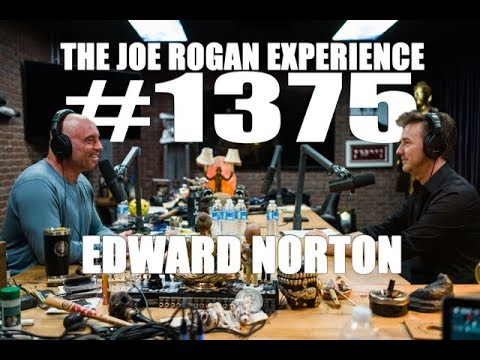
Joe Rogan Experience #1375 - Edward Norton
Joe Rogan (host), Edward Norton (guest), Narrator
In this episode of The Joe Rogan Experience, featuring Joe Rogan and Edward Norton, Joe Rogan Experience #1375 - Edward Norton explores edward Norton Dissects Fame, Craft, Martial Arts, And ‘Motherless Brooklyn’ Edward Norton and Joe Rogan range widely across acting, fame, music, martial arts, and filmmaking. Norton talks about the paradox of acting as “playing dress up,” the influence of icons like Brando and Dylan, and the trap of becoming a persona instead of evolving. They dive deep into jiu-jitsu, Aikido, and calmness under pressure, tying those ideas back to Norton's portrayal of the Hulk. The conversation culminates in Norton detailing the long, challenging journey of creating his noir film ‘Motherless Brooklyn,’ from adapting the book and reconstructing 1950s New York to assembling a heavyweight cast and unconventional score.
Edward Norton Dissects Fame, Craft, Martial Arts, And ‘Motherless Brooklyn’
Edward Norton and Joe Rogan range widely across acting, fame, music, martial arts, and filmmaking. Norton talks about the paradox of acting as “playing dress up,” the influence of icons like Brando and Dylan, and the trap of becoming a persona instead of evolving. They dive deep into jiu-jitsu, Aikido, and calmness under pressure, tying those ideas back to Norton's portrayal of the Hulk. The conversation culminates in Norton detailing the long, challenging journey of creating his noir film ‘Motherless Brooklyn,’ from adapting the book and reconstructing 1950s New York to assembling a heavyweight cast and unconventional score.
Key Takeaways
Acting is powerful precisely because it embraces vulnerability, not macho posturing.
Norton argues that Brando’s legacy isn’t raw toughness but his broken sensitivity and emotional honesty on screen, which shifted male actors’ aspirations from polish to visceral authenticity.
Get the full analysis with uListen AI
Cultural game-changers redefine whole fields and create ‘before and after’ eras.
They frame Marlon Brando, Bob Dylan, Jimi Hendrix, Willie Nelson, Lenny Bruce, and Howard Stern as hinge figures whose choices permanently altered acting, music, comedy, and talk radio.
Get the full analysis with uListen AI
Leaning into a popular persona can imprison artists in their first incarnation.
Using Sam Kinison, Andrew Dice Clay, and others, Norton and Rogan show how audience expectations can lock performers into caricatures, making later growth or change difficult and often painful.
Get the full analysis with uListen AI
True mastery in fighting arts is about calm, breath, and control—not aggression.
Their discussion of Rickson Gracie, Aikido, and early UFC emphasizes mental clarity, breathing, and emotional regulation as core skills that extend beyond combat into everyday life.
Get the full analysis with uListen AI
Audiences still hunger for long-form, adult storytelling despite ‘short attention span’ myths.
They credit Stern, podcasts, and series like ‘Chernobyl’ or ‘The Civil War’ for proving people will engage deeply with complex conversations and narratives when they’re compelling and well made.
Get the full analysis with uListen AI
Making ambitious, adult films requires both vision and a ‘Justice League’ of collaborators.
Norton describes directing ‘Motherless Brooklyn’—with limited budget, complex 1950s sets, car chases, and a Tourettic protagonist—as possible only because top-tier actors and craftspeople aligned with his vision and deferred pay to get it made.
Get the full analysis with uListen AI
Personal evolution should trump staying frozen in the version audiences first loved.
Pointing to Howard Stern’s public shift away from earlier shock tactics, they argue it’s healthier—and ultimately more honest—to let your work reflect who you are now, even if some fans resist.
Get the full analysis with uListen AI
Notable Quotes
“We put on makeup, we put on clothes, we play dress up, and we pretend to be other people.”
— Edward Norton
“Some people relish the opportunity to change the story of who they are.”
— Edward Norton
“Nobody has that kind of sensibility at that age, to go, ‘Everything you’re bringing at me is gonna be bad for me.’”
— Edward Norton, on young Bob Dylan
“You’re a prisoner to your own first incarnation.”
— Joe Rogan
“I certify on the Joe Rogan Experience: there’s not a grownup human being who will not be stoked about this film.”
— Edward Norton, on ‘Motherless Brooklyn’
Questions Answered in This Episode
How can actors and performers consciously avoid becoming trapped by their most famous roles or personas?
Edward Norton and Joe Rogan range widely across acting, fame, music, martial arts, and filmmaking. ...
Get the full analysis with uListen AI
What distinguishes a true ‘before and after’ cultural figure like Brando or Dylan from merely successful artists?
Get the full analysis with uListen AI
In what ways can martial arts training practically improve emotional regulation and decision-making outside of combat?
Get the full analysis with uListen AI
Given the success of podcasts and long-form TV, why are studios still hesitant to finance complex, adult-oriented films for theaters?
Get the full analysis with uListen AI
What ethical responsibilities do creators have to evolve publicly, as Howard Stern did, versus continuing to deliver exactly what fans expect?
Get the full analysis with uListen AI
Transcript Preview
We go. I always know the conversation's gonna get off to a good start when I meet a fellow Lenny Bruce fan, so. (laughs)
Yes. Yeah, that was, uh, uh, and I, I, you know there's that line in Fight Club, "The things you own end up owning you."
Yeah.
And I, I generally am not a stuff guy, but when I came in here, I, I did find myself going, "This is the right kind of place to keep stuff."
Yeah.
And I was, I'd been wandering around lookin' at things and that was, uh, my favorite thing that I saw you have that, a couple of the, of great Lenny Bruce posters.
Yeah.
One of which I've never seen.
Which one? Oh, the Without Tears.
The, the, the one with his, where he-
Yeah.
... it's really wild, he looks like an Indian guru or something-
Yes.
... staring into the middle distance. That's, that's an amazing p- photograph of him.
Yeah, I kinda bought as much vintage Lenny Bruce stuff as I could find and I, uh, this place has sort of evolved into a semi-gallery, you know? It's, it's, uh, I would like to have a house with nothing in it and then have this-
Yeah.
... place just filled with shit.
No, I, I kind of agree with that. Also, I think that it's fun, when you have people come through a space so that you're actually, like, sharing the things, like th- it's sort of like you're lettin' them, someone come in and wander.
Mm-hmm.
And, uh, uh, some of the best museums in the world are people's individual curation. Some of the best art collections ever made are better than any museum 'cause they're put together by someone and you're finding, like, the threads and things, you know?
Yes.
So I, I, I think when you can, when you can assemble, like, things that have meant something to you, but you can put 'em in a space where other people can bump into 'em, it's better than just, like, than letting them just collect dust in your own home where they, you stop looking at them, you know?
You have a very unusual perspective for someone who makes their living as an actor.
What do you mean? How, why do you think so?
You're a very thoughtful person.
(laughs)
Very thoughtful.
I know a lot, I know a-
(laughs)
... lot of thoughtful actors.
I do too, I do too.
Yeah.
But it's not common. You gotta find them, you gotta curate those folks.
Yeah. I, um... It's a funny, it's a funny, it's a funny gig by, like, by definition. It's like, if you think about all the, like, the, the yin yang in it, the paradoxes in it, it's like on the one hand, with guys as actors there'll be a lot of, um, you know, there's a certain kind of, uh, not g- not macho, but there's, like, you know, men'll look to play intense roles and-
Install uListen to search the full transcript and get AI-powered insights
Get Full TranscriptGet more from every podcast
AI summaries, searchable transcripts, and fact-checking. Free forever.
Add to Chrome