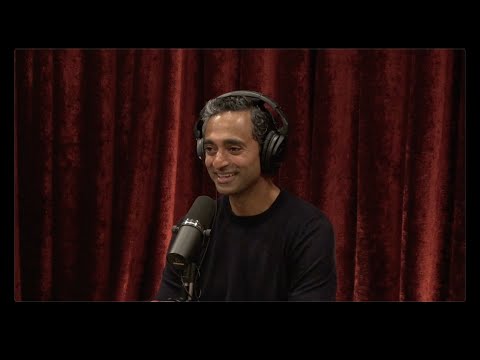
Joe Rogan Experience #2206 - Chamath Palihapitiya
Chamath Palihapitiya (guest), Joe Rogan (host)
In this episode of The Joe Rogan Experience, featuring Chamath Palihapitiya and Joe Rogan, Joe Rogan Experience #2206 - Chamath Palihapitiya explores chamath and Rogan dissect AI, media, health, war, and politics Joe Rogan and Chamath Palihapitiya explore how modern media and engagement-driven algorithms distort information, fuel outrage, and undermine critical thinking, especially among kids immersed in devices and social platforms.
Chamath and Rogan dissect AI, media, health, war, and politics
Joe Rogan and Chamath Palihapitiya explore how modern media and engagement-driven algorithms distort information, fuel outrage, and undermine critical thinking, especially among kids immersed in devices and social platforms.
They dive deeply into AI’s near-term and long-term impacts—from medical diagnostics and new materials to robots, energy, and governance—arguing it can massively uplift humanity if steered away from war and narrow corporate interests.
The conversation links education, ADHD, parenting, food quality, GLP‑1 weight-loss drugs, and drug policy to a broader critique of broken incentives in government, healthcare, and big business, calling for structural reforms rather than more medication.
They finish by framing the 2024 election as a stark choice on war and bureaucracy—separating Trump’s controversial persona from his non-interventionist policies—and warning that nuclear escalation is the one mistake from which nothing else will matter.
Key Takeaways
Outrage-driven algorithms have replaced neutral news with weaponized opinion.
Chamath argues the business model shifted from reporting to engagement farming: platforms and TV reward anger and certainty, not nuance, leaving people polarized and unable to evaluate information or consider opposing views.
Get the full analysis with uListen AI
Parents can reduce ADHD-like behavior by aggressively limiting screens and devices.
Chamath describes his son’s dramatic improvement when iPads, games, and TikTok were tightly rationed and replaced with sports, conversation, and long-form content—highlighting that many attention problems are environmental, not purely medical.
Get the full analysis with uListen AI
AI can radically improve healthcare by augmenting—not replacing—human judgment.
They discuss AI tools that can cut surgical error rates for tumor removal from ~30–40% to near zero, and foresee similar systems across cancers and diagnostics, freeing doctors and teachers to focus on reasoning, empathy, and judgment instead of rote tasks.
Get the full analysis with uListen AI
The coming AI-and-energy era demands a flipped education model.
With “PhD-level assistants” in everyone’s pocket, teaching memorization becomes obsolete; schools must pivot to teaching critical thinking, interpretation, curiosity, and social skills, and society must pay and empower teachers accordingly.
Get the full analysis with uListen AI
America’s food and health incentives are structurally broken and self-canceling.
They note we subsidize sugar-laden, ultra-processed foods (even via food stamps), then spend trillions on diabetes, GLP‑1 drugs, and downstream healthcare; redirecting a fraction of that to real food and fitness would yield better outcomes at lower cost.
Get the full analysis with uListen AI
Prohibition empowers cartels and creates deadlier drug markets than regulated supply.
Rogan describes fentanyl-contaminated party drugs and Mexico’s cartel-fueled political assassinations as direct consequences of illegality; he and Chamath discuss Portugal-style decriminalization and strict regulation as a more rational, if uncomfortable, path.
Get the full analysis with uListen AI
Nuclear war risk and endless foreign entanglements are the paramount political issues.
Chamath insists that domestic policy differences between candidates are relatively narrow compared to the existential stakes of nuclear escalation; he sees Trump’s non-interventionist record and alignment with RFK Jr. ...
Get the full analysis with uListen AI
Notable Quotes
“You can’t set this generation up to compete with a computer. That’s crazy.”
— Chamath Palihapitiya
“If math is racist, we have a real problem, because everything’s math.”
— Joe Rogan
“Killing each other is just so barbarically unnecessary. It doesn’t solve anything.”
— Chamath Palihapitiya
“Whatever flaws Donald Trump has are nothing in comparison to the media’s depictions of him.”
— Joe Rogan
“There is one issue above all where if you get it wrong, nothing matters—and that is nuclear war.”
— Chamath Palihapitiya
Questions Answered in This Episode
How can individuals practically redesign their media diets and online habits to escape the outrage-algorithm trap?
Joe Rogan and Chamath Palihapitiya explore how modern media and engagement-driven algorithms distort information, fuel outrage, and undermine critical thinking, especially among kids immersed in devices and social platforms.
Get the full analysis with uListen AI
What would a realistic, large-scale shift in U.S. education toward teaching judgment and critical thinking actually look like in classrooms?
They dive deeply into AI’s near-term and long-term impacts—from medical diagnostics and new materials to robots, energy, and governance—arguing it can massively uplift humanity if steered away from war and narrow corporate interests.
Get the full analysis with uListen AI
Where should policymakers draw the line between using AI to streamline government and ceding too much power to opaque algorithms?
The conversation links education, ADHD, parenting, food quality, GLP‑1 weight-loss drugs, and drug policy to a broader critique of broken incentives in government, healthcare, and big business, calling for structural reforms rather than more medication.
Get the full analysis with uListen AI
How could the U.S. rapidly redirect food and healthcare spending away from ultra-processed products and GLP‑1s toward prevention, without crushing existing industries overnight?
They finish by framing the 2024 election as a stark choice on war and bureaucracy—separating Trump’s controversial persona from his non-interventionist policies—and warning that nuclear escalation is the one mistake from which nothing else will matter.
Get the full analysis with uListen AI
If foreign-policy and nuclear-risk decisions are the true stakes of 2024, how should voters evaluate candidates beyond media narratives and personal dislike of the messenger?
Get the full analysis with uListen AI
Transcript Preview
(drumbeats) Joe Rogan podcast, check it out. The Joe Rogan Experience. Train by day, Joe Rogan podcast by night, all day. (rock music)
Talking with Bill at live, it's like that- that will live in infamy. (laughs)
(laughs) It is the best clip because he's like a totally different person.
Well, it's what he really is.
What he really is, yeah, exactly.
Yeah, it's like the Ellen thing. You know, it's like... (laughs)
(laughs) I mean, he really did lose his shit there.
Oh, uh, like, weirdly. You know? It wasn't like... I got the Christian Bale one-
Yeah.
... 'cause, like, he's in character, there's an intense scene. Some guy's fucking around in the background-
Yeah.
... like, "Goddammit, stop fucking around!"
Yeah.
I get that.
Yeah, yeah.
Like, he's in this, he's in this frenzy of this intense scene. But what is fucking-
(laughs)
... what is Bill doing? (laughs)
(laughs)
He's, Republican talking points on Fox News and he c-
No, it was before.
That was a different type, Current Affair, right?
It was when he was Current Affair. It's when he's doing like-
Right.
... gossip and stuff.
Oh, that's right!
Yeah.
He was a gossip guy.
Yeah, yeah.
He was like an Entertainment Tonight type guy.
Exactly. Inside Edition.
One of those deals.
Inside Edition.
Oh, is that what it was?
That's what it's called, Inside Edition.
Ah, yeah. And fucking those things.
(laughs)
They never go away. It's, um... It's- it's so- such a weird environment, the- the left and right. There's no, like, centrist news source on television. There's no like a, this is probably what's going on news source.
Yeah.
It's always one or the other, and it's like you're living in a- a bipolar person's brain. You know?
I think, like, part of what's happened is we used to have news and you could make a good living in news. And, you know, journalists were really sort of the top of the social hierarchy in some way, shape, or form because they were this check and balance. And then somewhere along the way, this business model focused people on clicks and nobody told the rest of the world that the underlying incentives were gonna change. And so, that's where you find yourself where there's very little news, I think. There's a lot of opinion. And then the problem with opinion is that feeds the outrage machine and that's the, you know, the clickometer.
Yeah.
The clickometer doesn't go high when you're like, "Hey guys, I studied this equation (laughs) and it shows."
Right. (laughs)
(laughs) There's a 50% chance of this, 50%... Nobody cares about that. It's either like it's totally, totally bad or it's totally, totally good because it just, it amps people up. And that's- that's a real bummer 'cause it, I think, like, you- you don't know what to think anymore.
Install uListen to search the full transcript and get AI-powered insights
Get Full TranscriptGet more from every podcast
AI summaries, searchable transcripts, and fact-checking. Free forever.
Add to Chrome