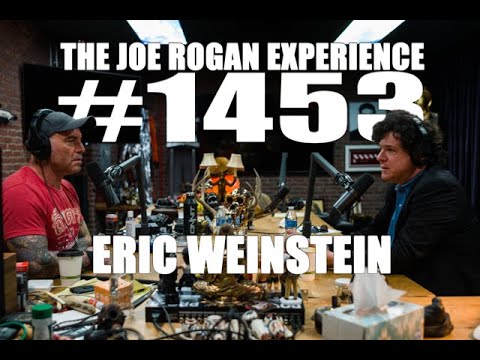
Joe Rogan Experience #1453 - Eric Weinstein
Joe Rogan (host), Eric Weinstein (guest), Narrator, Narrator, Narrator
In this episode of The Joe Rogan Experience, featuring Joe Rogan and Eric Weinstein, Joe Rogan Experience #1453 - Eric Weinstein explores eric Weinstein, COVID, Power, and Physics: From Masks To Multiverse Joe Rogan and Eric Weinstein use the early COVID-19 pandemic as a springboard to critique institutional failure, political leadership, media ecosystems, and global economic dependencies—especially on China.
Eric Weinstein, COVID, Power, and Physics: From Masks To Multiverse
Joe Rogan and Eric Weinstein use the early COVID-19 pandemic as a springboard to critique institutional failure, political leadership, media ecosystems, and global economic dependencies—especially on China.
They argue that America has been in a post‑WWII “Big Nap,” avoiding hard tests while outsourcing risk, production, and even truth‑seeking to fragile or corrupt systems.
The conversation ranges from civil liberties and pandemic response to legacy vs. internet media, social engineering, pornography, art, and the psychology of kayfabe and professional wrestling.
In the final stretch, Weinstein unveils his long‑hidden “Geometric Unity” physics program, which aims to unify fundamental forces and, in his view, could eventually underpin technologies that let humanity escape existential risk on Earth.
Key Takeaways
Pandemics expose the true quality of leadership and institutions.
Weinstein argues that COVID-19 revealed how untested, complacent, and politically driven many institutions are—from hospital administrators to the CDC, WHO, and political leaders—because they optimized for appearance, short‑term economics, and liability rather than readiness.
Get the full analysis with uListen AI
Overreliance on China is a strategic vulnerability, not just an economic choice.
They frame U. ...
Get the full analysis with uListen AI
Social engineering and fear of appearing xenophobic can be literally deadly.
Weinstein claims that early political and media reluctance to restrict travel or warn about COVID—out of fear of seeming racist or alarmist—cost lives and proves that ideology and optics can cripple practical decision‑making in crises.
Get the full analysis with uListen AI
Legacy media still steers institutions even as public trust shifts online.
Despite podcasts and YouTube eclipsing TV in raw attention, Weinstein notes that ‘authoritative sources’—major outlets and agencies—still define what institutions treat as real, which means bad narratives can guide policy even when the public sees through them.
Get the full analysis with uListen AI
Kayfabe explains modern politics and media as layered, performative fakery.
Borrowing from pro wrestling, Weinstein describes politics and cable news as operating on multiple levels of ‘worked shoots’—fake breaks from fakery—where everyone knows some of it’s staged, but the system persists because participants and audiences accept the game.
Get the full analysis with uListen AI
We need ‘war‑footing’ leadership, not steady managers of a broken status quo.
They praise figures like Tulsi Gabbard and Jocko Willink as examples of no‑nonsense, crisis‑competent leadership, contrasting them with ‘steady hands’ who are reliable precisely because they preserve institutional comfort, not public safety.
Get the full analysis with uListen AI
Theoretical physics stagnation may be linked to broader societal stagnation.
Weinstein claims that since the early 1970s, fundamental physics has failed to produce breakthroughs comparable to earlier eras, mirroring economic and institutional stagnation; his ‘Geometric Unity’ is presented as both a technical attempt to unify physics and a symbolic push to restart genuine innovation.
Get the full analysis with uListen AI
Notable Quotes
“This is the end of the nap. We’ve been in a 75‑year nap since 1945, and COVID is the wake‑up call.”
— Eric Weinstein
“China has its hands lovingly around our throat. This is what the BDSM community refers to as breath play, and I don’t like it.”
— Eric Weinstein
“If your top concern is not appearing xenophobic, people will die because you are functionally incompetent.”
— Eric Weinstein
“There’s no real mainstream anymore if a YouTube clip gets five million views and a cable segment gets 500,000. What’s ‘mainstream’ now?”
— Joe Rogan
“We are now gods but for the wisdom.”
— Eric Weinstein
Questions Answered in This Episode
If Weinstein is right about systemic institutional failure, what concrete governance or structural reforms would actually reduce our vulnerability before the next crisis?
Joe Rogan and Eric Weinstein use the early COVID-19 pandemic as a springboard to critique institutional failure, political leadership, media ecosystems, and global economic dependencies—especially on China.
Get the full analysis with uListen AI
How can societies balance legitimate concerns about xenophobia and civil liberties with the need for rapid, decisive action in pandemics or other emergencies?
They argue that America has been in a post‑WWII “Big Nap,” avoiding hard tests while outsourcing risk, production, and even truth‑seeking to fragile or corrupt systems.
Get the full analysis with uListen AI
Given Weinstein’s critique of legacy media, what mechanisms could ensure that more accurate internet-based ‘sense‑making’ actually influences institutional decision‑making?
The conversation ranges from civil liberties and pandemic response to legacy vs. ...
Get the full analysis with uListen AI
What would it take—politically, culturally, and morally—for humanity to seriously pursue Weinstein’s vision of leaving Earth or diversifying off‑planet?
In the final stretch, Weinstein unveils his long‑hidden “Geometric Unity” physics program, which aims to unify fundamental forces and, in his view, could eventually underpin technologies that let humanity escape existential risk on Earth.
Get the full analysis with uListen AI
How should the scientific community evaluate and respond to outsider grand theories like ‘Geometric Unity’ without either reflexive dismissal or uncritical hype?
Get the full analysis with uListen AI
Transcript Preview
What's up, brother? How are you?
Hey, Joe. How are you?
Good. You hanging in there?
I have not been off of my property more or less in two weeks, so it's crazy to see another human being.
Yeah, I don't think this is healthy for us.
I know.
This lockdown shit. Everybody's so weirded out. You wanna run into people walking dogs, like, they don't want the dogs to get close to each other, like, "Hi." Everyone's across the street, "Hi."
And, and I'm a hugger, right?
Me too.
And we're in California, so I'm a hugger in California, and all of my instincts are wrong.
Everything's all messed up. Everyone's confused. The... Here's the big question: how long does it take before we normalize and go back? Like, let's say the end of July, everyone announces, "We got this thing locked down. We have a viable treatment. It's no different than the flu. We get you this chloroquine with, uh, Z-Pak," or whatever the current treatment is.
Yeah.
When do people start hugging again?
What do you mean? It's not... It's gonna be crazy. Yeah, I mean, I think that the idea is we're all so starved for touch-
Yeah.
... that, like, we're gonna have a, uh, a jubilee like you've never seen. People are gonna greet each other with tongues, and we're almost like just acquaintances.
Well, I don't think that's a good idea.
(laughs)
Uh, there's still colds and cooties and all that other stuff.
I know, but I think-
(laughs)
... I think everybody's losing their shit.
They definitely are. I've been talking to a lot of friends that are on the, um, extremely cautious side, let's say that. And, you know, they're not going anywhere, and they're wearing gloves and masks when they step outside their house to go do something in the backyard. And then they put the glove and mask down, and they spray it with Lysol when they come inside and... (breathes deeply)
It's not healthy, and-
Mm-hmm.
... it is also healthy. I mean, the idea that we have not been tested in so long, it's good to remember also that this stuff is live and real, and it has always been live and real. And, you know, if it was possible to live without this stuff, that would be one thing, but the 75-year nap that we've been in since 1945 is itself the greatest threat to all of us.
Right.
And, and, and our preparedness is just a wonderful indicator, um, where you actually get to see, this is the quality of your experts, this is the quality of your leadership, this is what they look like when put under stress.
That's true, right? That is a good... That's a good thing. And I'm impressed with the medical community. I'm impressed with the people that are recognizing that this is a huge problem. Not so impressed with the administration of a lot of these hospitals that haven't prepared in terms of, like, masks and ventilators and a lot of these other things. Not so impressed with politicians, but also, it just seems like everyone, like you said, was in this nap state and hadn't really been tested. And really, globally, no one had been tested since the pandemic of 1918 like this, right?
Install uListen to search the full transcript and get AI-powered insights
Get Full TranscriptGet more from every podcast
AI summaries, searchable transcripts, and fact-checking. Free forever.
Add to Chrome