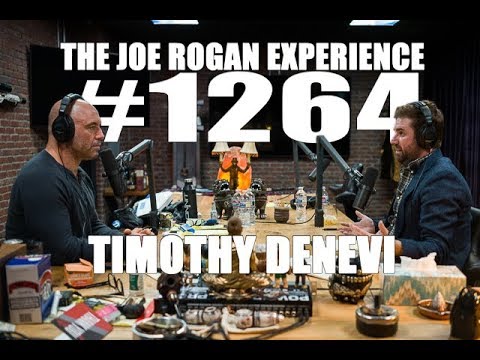
Joe Rogan Experience #1264 - Timothy Denevi
Joe Rogan (host), Narrator, Timothy Denevi (guest), Narrator
In this episode of The Joe Rogan Experience, featuring Joe Rogan and Narrator, Joe Rogan Experience #1264 - Timothy Denevi explores hunter S. Thompson’s Fierce Legacy in Today’s Political Shitstorm Revisited Joe Rogan and author Timothy Denevi discuss Denevi’s book *Freak Kingdom*, which chronicles Hunter S. Thompson’s decade-long battle against what he saw as American fascism, centered on the Kennedy–Nixon era. They explore parallels between Nixon and Trump, how both manipulated media, and why Thompson’s work feels newly urgent in the current political climate. Denevi emphasizes Thompson as a serious investigative journalist and political thinker, not just a drug-fueled caricature, and details the immense personal cost of his work—violence, addiction, and burnout. The conversation also covers Thompson’s craft, his use of drugs like Dexedrine, his failed Aspen sheriff run, his relationships with figures like Nixon and the Hells Angels, and the broader question of what it means to burn yourself out in pursuit of truth.
Hunter S. Thompson’s Fierce Legacy in Today’s Political Shitstorm Revisited
Joe Rogan and author Timothy Denevi discuss Denevi’s book *Freak Kingdom*, which chronicles Hunter S. Thompson’s decade-long battle against what he saw as American fascism, centered on the Kennedy–Nixon era. They explore parallels between Nixon and Trump, how both manipulated media, and why Thompson’s work feels newly urgent in the current political climate. Denevi emphasizes Thompson as a serious investigative journalist and political thinker, not just a drug-fueled caricature, and details the immense personal cost of his work—violence, addiction, and burnout. The conversation also covers Thompson’s craft, his use of drugs like Dexedrine, his failed Aspen sheriff run, his relationships with figures like Nixon and the Hells Angels, and the broader question of what it means to burn yourself out in pursuit of truth.
Key Takeaways
Reassess Hunter S. Thompson as a serious reporter, not just a wild gonzo icon.
Denevi argues that Thompson’s lasting value lies in his deep investigative work and political analysis—on Nixon, Vietnam, civil rights, and police repression—rather than the cartoon version popularized by films and Doonesbury.
Get the full analysis with uListen AI
Study how politicians weaponize media perception rather than just what they say.
Thompson (and modern writers like Matt Taibbi) focused on how administrations stage events, corral the press, and control optics, revealing manipulation strategies that remain relevant in the Trump era.
Get the full analysis with uListen AI
Understand that political violence aims to silence journalists and dissent.
Stories from Chicago 1968, Ruben Salazar’s killing, agent provocateurs, and Khashoggi’s murder illustrate that brutality against reporters and activists is a deliberate tactic to shut down scrutiny and opposition.
Get the full analysis with uListen AI
Recognize the power of local politics as a way to reclaim agency.
Thompson’s Aspen sheriff and mayoral campaigns show how working within local systems—mobilizing youth, challenging developers, contesting policing—can be a meaningful response when national politics feels unresponsive.
Get the full analysis with uListen AI
Use dramatization ethically: show how power feels, but signal what’s fact.
Thompson’s ‘gonzo’ style—first-person, scene-by-scene, sometimes planting rumors like Muskie on Ibogaine—worked because he usually cued readers to the absurdity; the lesson is to make manipulation vivid without misleading your audience.
Get the full analysis with uListen AI
Be honest about the tradeoffs of ‘chemical speed’ and overwork.
Both Thompson’s Dexedrine use and Denevi’s own reliance on Adderall highlight a pattern: stimulants can massively boost focus and output but often shift the cost into health, relationships, and long-term well-being.
Get the full analysis with uListen AI
Don’t romanticize self-destruction as the price of great work.
Rogan and Denevi stress that the decades Thompson spent broken, alcoholic, and diminished far outweighed the brief period where excess looked glamorous; younger writers and creatives should see his life as a warning, not a template.
Get the full analysis with uListen AI
Notable Quotes
““He who makes a beast of himself gets rid of the pain of being a man.””
— Timothy Denevi quoting Hunter S. Thompson’s dedication in *Fear and Loathing in Las Vegas*
“Trump ran on the werewolf. He’s like, ‘No, I’m not gonna hide it. That’s who I am.’”
— Timothy Denevi
“Political violence is effective because it’s used to silence either opposition or journalists.”
— Timothy Denevi
“We’ve mistaken Thompson. We identify him more as a clown… as opposed to a very serious political thinker and serious writer.”
— Timothy Denevi
“The effort is what destroys you. Just because you have a path with the effort to be rich or be successful, that doesn’t mean that’s a good thing.”
— Timothy Denevi
Questions Answered in This Episode
How would Hunter S. Thompson likely write about Trump and today’s media ecosystem if he were in his prime now?
Joe Rogan and author Timothy Denevi discuss Denevi’s book *Freak Kingdom*, which chronicles Hunter S. ...
Get the full analysis with uListen AI
Where is the ethical line between dramatizing politics to reveal deeper truth and simply misleading readers for effect?
Get the full analysis with uListen AI
Are modern journalists repeating Thompson’s ‘chemical speed’ bargain with Adderall and burnout, and what alternatives exist?
Get the full analysis with uListen AI
What can activists and journalists today learn from the state-sanctioned violence of the 1960s–70s about how repression might evolve now?
Get the full analysis with uListen AI
Does working within local politics, as Thompson tried in Aspen, offer a more realistic path to change than fighting at the national level?
Get the full analysis with uListen AI
Transcript Preview
... five. You get less enthusiastic with-
I don't know, maybe.
... after it's been a few times.
(laughs)
You're like, you're not really... We're live? Alright, we're live. What's up, man? How are you?
(laughs) Good.
Thanks for doing this.
Thanks for having me.
My pleasure. Uh, sorry for the false starts. We've been having issues with our equipment. Good to see you though, man. What's up?
Good to be here and talk Hunter Thompson.
My, my pleasure. Um, so your book, Freak Kingdom.
You know, we live in, uh, interesting times right now. It's kind of a, kind of a shit show at every single moment.
Keep this about a fist from your face. Pull that sucker-
Do I-
There you go. Perfect.
What should I do with my hands? Should I put 'em up just like that?
You can do whatever you want with your hands, man.
But I shoot with this one. (laughs) Um-
What is, what is all this, uh, you got a lot of writing.
Well, when I... When I wrote the book, I wanted to make sure my sentences never sounded like Thompson's sentences.
Oh, right, right.
But when... So I didn't write out a lot of his sentences, but this morning before coming on, I went and got some of my favorite quotes and just wrote 'em out longhand to get a sense of what his, uh, what his perspective was and rhythm was again.
Didn't he do that with The Great Gatsby? He-
He did it like a few times.
Yeah.
He did it by hand, he like typed it out.
Yeah. I love that idea that he was trying to find like the rhythm of the words. That's such a fascinating notion because comedians do that. In the early days of comedy, like a lot of guys, um, in, like before they ever start going on stage themselves, they'll imitate their favorite comedian's bits. Like they'll do a Richard Pryor bit, and they'll do it to their friends and they'll get, get a sense of the rhythm and the timing and get those laughs from doing a Richard Pryor bit to their friends, and then they get that bug. It's like part of what infects them.
I mean, that's the hardest thing to steal. We're not plagiarizing, but we're trying to understand what decisions they made-
Yeah.
... to create beautiful work.
Yeah, I'm sure he wasn't plagiarizing, but it is, it's so unfortunate when, when someone does.
Yes.
You know, when, when you have someone, whether it's Hunter or Richard Pryor or anyone who's just got a truly exceptional and unique mind.
Or someone who doesn't, like our president, and decided-
(laughs)
... when he ran in 2016 to plagiarize Richard Nixon's 1968 convention speech in Miami-
Install uListen to search the full transcript and get AI-powered insights
Get Full TranscriptGet more from every podcast
AI summaries, searchable transcripts, and fact-checking. Free forever.
Add to Chrome