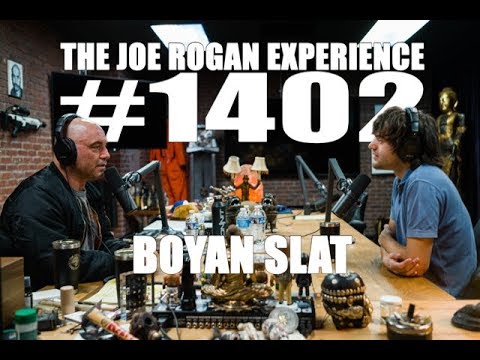
Joe Rogan Experience #1402 - Boyan Slat
Joe Rogan (host), Boyan Slat (guest), Boyan Slat (guest)
In this episode of The Joe Rogan Experience, featuring Joe Rogan and Boyan Slat, Joe Rogan Experience #1402 - Boyan Slat explores boyan Slat Details Bold Plan To Clean Oceans And Rivers Worldwide Boyan Slat explains how The Ocean Cleanup moved from failed early prototypes to successfully capturing tons of plastic from the Great Pacific Garbage Patch and heavily polluted rivers. After structural failures and design setbacks, his team re‑engineered their system so it moves slower than the plastic, enabling effective collection and filling shipping containers within weeks. He also unveils the solar‑powered “Interceptor” for rivers, targeting the 1,000 most polluting waterways that send 80% of plastic to the oceans. Beyond technology, Slat and Rogan discuss funding via products made from recovered plastic, broader environmental ethics, human nature, and how innovation and institutions can realistically drive sustainability.
Boyan Slat Details Bold Plan To Clean Oceans And Rivers Worldwide
Boyan Slat explains how The Ocean Cleanup moved from failed early prototypes to successfully capturing tons of plastic from the Great Pacific Garbage Patch and heavily polluted rivers. After structural failures and design setbacks, his team re‑engineered their system so it moves slower than the plastic, enabling effective collection and filling shipping containers within weeks. He also unveils the solar‑powered “Interceptor” for rivers, targeting the 1,000 most polluting waterways that send 80% of plastic to the oceans. Beyond technology, Slat and Rogan discuss funding via products made from recovered plastic, broader environmental ethics, human nature, and how innovation and institutions can realistically drive sustainability.
Key Takeaways
Iterate quickly and treat failures as engineering data, not dead ends.
The first full‑scale ocean system failed to catch plastic and even broke in two; instead of stopping, Slat’s team rapidly redesigned, modularized the system, reversed the speed problem (making it slower than plastic), and achieved successful collection within months.
Get the full analysis with uListen AI
Target the highest‑leverage pollution sources instead of trying to be everywhere.
Research showed that 1% of the world’s rivers contribute about 80% of ocean plastic, leading to the Interceptor strategy: deploy scalable, plug‑and‑play river barriers and conveyors in a focused set of highly polluting rivers near dense coastal cities.
Get the full analysis with uListen AI
Pair environmental cleanup with a viable business model.
Because vessel days are extremely expensive, The Ocean Cleanup plans to fund operations by recycling the collected plastic into durable, desirable products whose value comes from their story—‘from trash to treasure’—rather than the raw material itself.
Get the full analysis with uListen AI
Design environmental tech to be wildlife‑safe and pragmatically ‘good enough.’
Both the ocean system and Interceptor are designed so currents and animals pass underneath or around non‑permeable barriers, accepting less than 100% capture efficiency in exchange for large‑scale plastic interception with minimal ecological harm.
Get the full analysis with uListen AI
Address legacy pollution and inflow simultaneously for a project with an ‘end.’
Slat’s vision is to clean half the Great Pacific Garbage Patch in five years while also cutting off the main sources via 1,000 Interceptors, so the project is not a perpetual Sisyphean task but a finite problem with a beginning and end.
Get the full analysis with uListen AI
Leverage technology and markets rather than only asking for sacrifice.
He argues that problems like plastic pollution, overfishing, and climate change are best solved by inventing net‑positive technologies and institutions (e. ...
Get the full analysis with uListen AI
Protect your focus: one big problem at a time creates real impact.
Despite having many ideas (from carbon capture to other global issues), Slat deliberately limits himself to The Ocean Cleanup until it’s truly solved, seeing concentrated effort and time (his ‘80,000 hours’) as the most powerful contribution he can make.
Get the full analysis with uListen AI
Notable Quotes
“We want to be this project with a beginning and an end.”
— Boyan Slat
“Rather than trying to change humans, it’s much more effective to change the technology around us.”
— Boyan Slat
“I just don’t think that being against something is very productive. I’d much rather build towards a future that I do agree with.”
— Boyan Slat
“It’s hilarious that you’re talking about the Great Pacific Garbage Patch as a starter problem.”
— Joe Rogan
“There’s seven and a half billion people in the world. We can do more than one thing at the same time.”
— Boyan Slat
Questions Answered in This Episode
How scalable is the Interceptor technology in terms of cost, maintenance, and political cooperation in the 1,000 target rivers?
Boyan Slat explains how The Ocean Cleanup moved from failed early prototypes to successfully capturing tons of plastic from the Great Pacific Garbage Patch and heavily polluted rivers. ...
Get the full analysis with uListen AI
What kinds of products made from ocean plastic would best balance durability, demand, and the risk they themselves ever becoming waste again?
Get the full analysis with uListen AI
How can The Ocean Cleanup guard against ‘moral hazard’—people feeling freer to pollute because there’s a cleanup system in place?
Get the full analysis with uListen AI
What governance or ethical frameworks should guide future high‑impact technologies like carbon capture or AI so they remain ‘net positive’ for humanity?
Get the full analysis with uListen AI
If The Ocean Cleanup succeeds and “finishes” this problem, what types of global challenges should Boyan Slat or similar teams tackle next using the same blueprint?
Get the full analysis with uListen AI
Transcript Preview
... two. What's up, fella? How are you? Good to see you again, man.
Likewise.
I've been reading that you are having some great success with your machine finally. It's, uh, everything's up and running. Last time we talked, you had yet to implement it actually out in the wild, and, uh, now you, e- explain to us what happened. You had some bumps in the beginning, right?
Yes. Yeah. So it's been quite a, quite a few years. Finally something's happening. Um, so we, uh, we launched our first ocean system from San Francisco in, uh, September of last year. And we, we took it out and roughly two months later we fi- we figured that, first of all, it wasn't catching plastic, so what we saw was that the system was moving at roughly the same speed as the plastic. So maybe just take one step back, the, the idea and how, how it works.
Sure. Yeah.
So, so of course, we have this, this great Pacific garbage patch between here and Hawaii, twice the size of Texas, 100 million kilos of plastic doesn't go away by itself. And the idea was to, to have this artificial coastline that is driven by the forces of the ocean. We, we put it in there, and the plastic naturally accumulates against it and kind of stays in there so we can then periodically get it out, because the, the, the, the, the big challenge is that although there's a lot of plastic, it's, it's spread out over this, this vast area. So we first have to concentrate it before we can take it out, because if you were to simply trawl the ocean for plastic with boats and nets, it would just take, um, you know, for- forever really. So, so the idea was to, to, to have those artificial coastlines. We deployed the first one, and then what we saw was that somehow the system was moving at the same speed as the plastic. So you can imagine if, if, you know, this is like a, your, your Pac-Man and this is your, your, you know, your, your catch and it's moving at the same speed, you know, it's not going in, um, and sometimes it did go in but it went out again.
We got a video of it, what it was doing.
Oh, that's great. Yeah. So-
Yeah.
So this is the basic idea. Um, but it wasn't doing that. So, so, and then, you know, we thought, okay, that's, that's all right. We'll learn from it. We'll try and adjust the systems. And then literally, you know, exactly a year ago, uh, the system broke into two and, um, so we had the structural failure forcing us to tow the whole thing back to land and, uh, go back to the drawing board. So, so we didn't have the, the best start of this year.
How much time has been lost? Or how much time has been spent, I should say, um, in the beginning phase, the in- initial-
Install uListen to search the full transcript and get AI-powered insights
Get Full TranscriptGet more from every podcast
AI summaries, searchable transcripts, and fact-checking. Free forever.
Add to Chrome