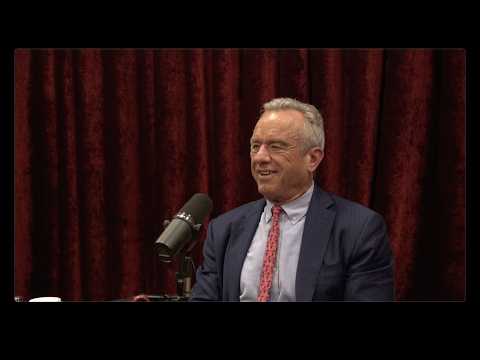
Joe Rogan Experience #2461 - Robert F. Kennedy, Jr.
Joe Rogan (host), Robert F. Kennedy Jr. (guest), Joe Rogan (host)
In this episode of The Joe Rogan Experience, featuring Joe Rogan and Robert F. Kennedy Jr., Joe Rogan Experience #2461 - Robert F. Kennedy, Jr. explores rFK Jr. outlines HHS reforms, health policy, and polarization concerns RFK Jr. describes HHS as a “target-rich environment” plagued by waste, perverse incentives, and a chronic-disease-driven cost explosion, arguing the U.S. excels at acute medicine but performs poorly at preventing illness.
RFK Jr. outlines HHS reforms, health policy, and polarization concerns
RFK Jr. describes HHS as a “target-rich environment” plagued by waste, perverse incentives, and a chronic-disease-driven cost explosion, arguing the U.S. excels at acute medicine but performs poorly at preventing illness.
He alleges massive Medicaid/Medicare fraud—accelerating under the Biden administration due to reduced “program integrity”—and says HHS is now using AI and state audits to curb it, with some blue states resisting corrective actions.
He highlights policy initiatives he attributes to the Trump administration and his team: drug price “most favored nation” (MFN) alignment via “Trump Rx,” hospital price transparency enforcement, easing prior authorization, ending medical-record “information blocking,” and food-system interventions (dietary guidelines, dye removal, SNAP restrictions, UPF labeling).
The conversation repeatedly returns to polarization: social media algorithms, partisan reflexes (e.g., reactions to Tylenol pregnancy warnings), censorship/free speech issues, and the need for long-form, civil dialogue as a corrective.
Key Takeaways
RFK Jr. frames U.S. healthcare as “sick care,” not prevention.
He argues the U. ...
Get the full analysis with uListen AI
He alleges ~$100B/year in Medicare/Medicaid fraud and calls it industrialized.
Examples include durable medical equipment billing schemes and hospice fraud; he claims HHS is now deploying AI and audits to identify and stop large-scale abuse.
Get the full analysis with uListen AI
He attributes fraud growth to policy choices that deprioritized “program integrity.”
He claims states and the federal government shifted staffing away from fraud detection toward enrollment, and that flexible home/community waivers created easy-to-exploit reimbursement pathways.
Get the full analysis with uListen AI
Price transparency is presented as the simplest high-leverage reform.
He says non-enforced transparency rules let identical services vary wildly in price (e. ...
Get the full analysis with uListen AI
He argues incentives, not just funding levels, are the core problem.
He criticizes fee-for-service for rewarding volume and suggests models that reward keeping patients healthy; he also claims insurers and middlemen profit from higher system “volume.”
Get the full analysis with uListen AI
Food policy is positioned as chronic-disease strategy, not lifestyle scolding.
He describes rewriting dietary guidance, changing federally funded food (schools, SNAP/WIC), limiting SNAP purchases of soda/candy, and creating UPF definitions and front-of-pack labels to shift defaults.
Get the full analysis with uListen AI
Regulatory actions can unintentionally create dangerous black markets.
On peptides, he claims moving common compounded peptides to a “do not compound” category shifted demand to uninspected gray-market suppliers, increasing safety risk; he signals possible reclassification.
Get the full analysis with uListen AI
Chemical agriculture is treated as both health risk and dependency trap.
He calls pesticides “poison” yet acknowledges U. ...
Get the full analysis with uListen AI
Psychedelics policy is framed as ‘access with guardrails.’
He expresses support for expanding clinical research and controlled therapeutic use for PTSD/depression/addiction (mentioning MDMA, psilocybin, ibogaine), emphasizing protocols to avoid “Wild West” harms.
Get the full analysis with uListen AI
Polarization and algorithmic outrage are portrayed as direct health-policy barriers.
He and Rogan argue tribal politics drives opposition to otherwise popular measures (fraud control, food reform, school phone bans), and that long-form conversation is a practical countermeasure.
Get the full analysis with uListen AI
Notable Quotes
“We’re the best at medicine in this country, but that’s when people get sick… you’re more likely to be sick here than any place in the world.”
— Robert F. Kennedy Jr.
“We lose just in Medicaid and Medicare $100 billion a year… shocking, blatant fraud where… that’s become industrialized.”
— Robert F. Kennedy Jr.
“You can add vitamins to cyanide, and it’s not going to make it any better for you.”
— Robert F. Kennedy Jr.
“If you have a government that can silence its opponents, it has a license for any kind of atrocity.”
— Robert F. Kennedy Jr.
“It’s like changing deck chairs on the Titanic. Why is nobody focusing on how do we get people healthy?”
— Robert F. Kennedy Jr.
Questions Answered in This Episode
On Medicaid/Medicare fraud: what specific AI methods (anomaly detection, network analysis, identity resolution) are being deployed, and what is the measured reduction so far?
RFK Jr. ...
Get the full analysis with uListen AI
RFK Jr. cites $100B/year in fraud—what audits, public reports, or DOJ case totals substantiate that figure, and how much is ‘improper payment’ vs. criminal fraud?
He alleges massive Medicaid/Medicare fraud—accelerating under the Biden administration due to reduced “program integrity”—and says HHS is now using AI and state audits to curb it, with some blue states resisting corrective actions.
Get the full analysis with uListen AI
Which exact federal/state policy changes during the Biden administration reduced “program integrity,” and what documentation supports the claim that offices were dismantled?
He highlights policy initiatives he attributes to the Trump administration and his team: drug price “most favored nation” (MFN) alignment via “Trump Rx,” hospital price transparency enforcement, easing prior authorization, ending medical-record “information blocking,” and food-system interventions (dietary guidelines, dye removal, SNAP restrictions, UPF labeling).
Get the full analysis with uListen AI
On Tylenol/pregnancy: which highest-quality studies drive the warning, what effect sizes are observed, and how do you separate correlation from confounding?
The conversation repeatedly returns to polarization: social media algorithms, partisan reflexes (e. ...
Get the full analysis with uListen AI
For hospital price transparency: what penalties will be applied, how will ‘bundled’ prices be standardized, and how will surprise billing loopholes be closed?
Get the full analysis with uListen AI
Transcript Preview
Joe Rogan Podcast, check it out!
The Joe Rogan Experience.
Train by day, Joe Rogan Podcast by night. All day. [upbeat rock music] I like them, but if it's just me wearing them, it feels stupid.
Why do you wear them?
I like it because it locks me in. Just locks me in. The only thing I hear is that person's voice, and I, I can't hear Jamie's chair moving. I, I can't hear anything else. And it just, like, makes me really, like, focused on the conversation only.
I have ADHD. I was-- had 11 siblings, and I have seven kids, so I can work.
[laughs]
I can focus.
No matter what?
No matter what.
It's a skill. It's a thing to learn.
[laughs]
You know, if you, if you're the person that can focus without distraction, you're in a good-
I am
... you're a good person to be in the job you're at. [laughs]
Yeah.
What is it like? So since you've been appointed, I, I haven't talked to you-
Um
... uh, on a podcast since.
I know. [laughs]
Yeah.
Um, it, it's the best job I could ever have. I, I feel like I was designed for the job, and I just have so much fun. I mean, it's a, it's a target-rich environment, so there's so many ways that you can effective and, be effective and improve people's lives every single day. And part of that is because the agency was just such a mess. You know, it was, it wasn't doing healthcare. It was doing sick care and just managing the, you know, all of these perverse incentives and have us spending $5 trillion a year on two to three times per capita what any other nation spends, and we have the sickest population in the world. We have the highest chronic disease burden in the world, and you, we're the best at medicine in this country, but that's when people get sick. You'd rather get sick here than any place in the world, um, but you're more likely to be sick here than any place in the world.
[laughs]
And, you know, and then it was just a big political patronage, um, operation, and it still is. And, you know, we're putting an end to that now. I mean, the tr- the amount of fraud that goes through that place, we lose just in Medicaid and Medicare $100 billion a year, and it's all just this really, you know, shocking, blatant fraud where... that's become industrialized. I mean, there, there's foreign nations like Russia, everybody's heard of Somalia, but also Cuba, has this operation in Florida where it's, um, where they open up these little, um... they open up, um, these, these PO boxes for durable medical equipment, as like knee braces and wheelchairs, and then they don't have any knee bl- brace or wheelchairs, but they have patient identification numbers, so they just claim to be shipping them to people. And we found one hotel, it had like 129 rooms, and every one was a different company that was selling durable medical equipment. And we go in and shut them down, and they immediately go back to Cuba, and the whole thing is apparently run by the Cuban government. But Russia's doing the same thing with hospices in-
Install uListen to search the full transcript and get AI-powered insights
Get Full TranscriptGet more from every podcast
AI summaries, searchable transcripts, and fact-checking. Free forever.
Add to Chrome