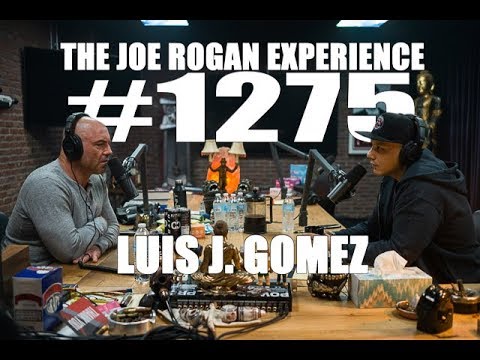
Joe Rogan Experience #1275 - Luis J. Gomez
Luis J. Gomez (guest), Joe Rogan (host), Narrator, Narrator, Narrator, Narrator, Narrator
In this episode of The Joe Rogan Experience, featuring Luis J. Gomez and Joe Rogan, Joe Rogan Experience #1275 - Luis J. Gomez explores luis J. Gomez, comedy, violence, cancel culture, and fighting reality Joe Rogan and Luis J. Gomez have a long-form, freewheeling conversation that bounces between stand-up comedy, fighting, parenting, and culture wars. They talk about how the internet has reshaped comedy communities, the mechanics and dangers of real-world violence, and the climate of outrage and ‘cancel culture’ around jokes and public behavior. Gomez opens up about his abusive upbringing, his father’s murder, and how that informs his extremely gentle approach to raising his son. Throughout, they keep circling back to combat sports, personal responsibility, and the importance of being honest and uncensored in both art and life.
Luis J. Gomez, comedy, violence, cancel culture, and fighting reality
Joe Rogan and Luis J. Gomez have a long-form, freewheeling conversation that bounces between stand-up comedy, fighting, parenting, and culture wars. They talk about how the internet has reshaped comedy communities, the mechanics and dangers of real-world violence, and the climate of outrage and ‘cancel culture’ around jokes and public behavior. Gomez opens up about his abusive upbringing, his father’s murder, and how that informs his extremely gentle approach to raising his son. Throughout, they keep circling back to combat sports, personal responsibility, and the importance of being honest and uncensored in both art and life.
Key Takeaways
The internet flattened the old New York–LA divide in comedy.
Rogan notes that comics now build careers from anywhere (Tennessee, Bisbee, etc. ...
Get the full analysis with uListen AI
Violence is highly contextual, and real fighters are on another level.
Stories about sparring with high-level pros (Bisping, Gracies, elite boxers) underline that most people vastly overestimate their ability to fight and underestimate how easy it is to get seriously injured or killed in a street altercation.
Get the full analysis with uListen AI
Childhood environment strongly predicts adult aggression and crime.
They link high violent-crime rates in poor neighborhoods to normalized abuse, constant exposure to fights, and learned behavior, framing many violent offenders as products of their conditions rather than pure ‘evil.’
Get the full analysis with uListen AI
Breaking cycles of abuse requires conscious, opposite behavior.
Gomez describes his extremely abusive childhood and explains that he intentionally never hits or yells at his son, using conversation and explanations instead, arguing this is why his kid is so well-behaved.
Get the full analysis with uListen AI
Cancel culture incentivizes performative outrage and digital rock-throwing.
They characterize social media as a giant window where everyone has a rock, with people chasing likes and moral status by calling for others to be ‘canceled,’ often over minor or contextless offenses.
Get the full analysis with uListen AI
Comedy needs space to fail; unfinished jokes will sometimes offend.
Both argue that stand-up is an iterative process that happens in front of audiences; jokes—especially about taboo topics—must bomb and be refined, and hecklers or moral scolds short-circuit that creative evolution.
Get the full analysis with uListen AI
Automation and structural shifts will erase many low-skill jobs.
They briefly touch on cashierless Amazon stores and self-service kiosks as early signs of how automation will replace service jobs, fueling conversations like Andrew Yang’s about universal basic income.
Get the full analysis with uListen AI
Notable Quotes
“The internet is essentially the whole world is a big window and everyone has a rock.”
— Joe Rogan
“Jokes, whether they're good or bad, they all come from the same place.”
— Luis J. Gomez (paraphrasing Patrice O’Neal’s idea)
“There are kids that grow up around violence… they’ll pull the trigger. They know they have to pull the trigger because people have pulled the trigger on them.”
— Joe Rogan
“I grew up with a ton of physical and emotional abuse… with my son I’ve never even spanked him. I’ve never even really yelled at my son.”
— Luis J. Gomez
“If everybody likes what you're doing, it fucking stinks.”
— Joe Rogan
Questions Answered in This Episode
How should comedians balance creative risk-taking with the reality that some audience members carry real trauma around topics like violence or rape?
Joe Rogan and Luis J. ...
Get the full analysis with uListen AI
To what extent can individual parenting decisions actually counteract broader neighborhood or cultural influences that normalize violence?
Get the full analysis with uListen AI
Is cancel culture primarily about moral concern, or is it more about status, power, and the addictive nature of online conflict?
Get the full analysis with uListen AI
How will the loss of millions of low-skill jobs to automation reshape concepts of work, dignity, and personal responsibility in the next decade?
Get the full analysis with uListen AI
Can long-form conversations like this meaningfully change minds about hot-button topics (immigration, policing, gender, etc.), or do they mostly reinforce pre-existing worldviews?
Get the full analysis with uListen AI
Transcript Preview
... all this shit.
Four, three, two, one. (sniffs) Pow, Luis Gomez, we are live. We are live, connected through the interwebs, and through a network of comedians, Luis Gomez.
Luis J. Gomez.
Luis J. Gomez. What, why do you-
Don't forget the J.
... like the J, why do you like the J?
'Cause go Google Luis Gomez and watch how many baseball players-
Oh, right, right, right.
... criminals, uh-
(laughs)
... fucking just-
That's a problem, making people use the J. That's very pretentious for a guy like you.
Yeah, I agree. No, no, no, it is, I understand.
You have to.
But it's almost like, well, m- it's almost ironic-
Why don't you give him a nickname?
... because I'm such a piece of garbage, so I would have, like, a middle initial, like, um-
Right, like you're like a, a luminary.
Yeah.
Some important (laughs) some important intellectual.
Yeah. It is.
Hmm.
Uh, but yeah, it does, it separates me as well. But I almost feel like I, I, I've made it a joke at this point to correct everyone that doesn't say the J. So if I didn't correct you-
Oh, I see.
... I wouldn't be being true to myself.
I understand. So, Luis J. Gomez-
Thank you.
... I feel like, um, you know, I've- we've talked about this ad nauseam on the podcast, but I think this is one of the most unique times for, uh, like, networks of comedians, that we're all connected together-
Yeah.
... in a way that we were n- we weren't really before. It was always, like, East Coast versus West Coast for some stupid fucking reason. There was always this debate where the best comics are from and the style of comedy. But that shit seems to be out the window.
Yeah, the internet.
Yeah.
You know, people- the best comics I- Nate Bargatze lives in fucking Tennessee.
Who's that?
He's a great comic.
Is he?
Squeaky clean, squeaky clean, my son's godfather.
Damn.
Just did a Netflix special. Uh-
How do you spell his last name? Oh, f-
B-A-R-G-A-T-Z-E. Brilliant comic.
G-M-A-
T-Z-E.
... T-Z-E.
But he grew up in Tennessee and he was like, "Dude, I don't wanna live in New York or LA."
Good for him, he's smart.
"I wanna buy a big house for $300,000."
Country fella.
"A fucking mansion."
Get ready for the zombies.
Yeah, that's it. (laughs)
Yeah, the zombies, you wanna live in that house like that old dude and his daughter did.
Yeah.
You know? Gonna live out there and have a fucking perimeter protected.
Yeah. Guys like Stanhope, he hasn't been in LA or-
Install uListen to search the full transcript and get AI-powered insights
Get Full TranscriptGet more from every podcast
AI summaries, searchable transcripts, and fact-checking. Free forever.
Add to Chrome