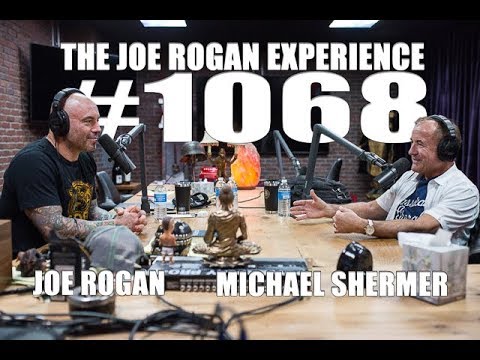
Joe Rogan Experience #1068 - Michael Shermer
Joe Rogan (host), Michael Shermer (guest), Narrator, Narrator
In this episode of The Joe Rogan Experience, featuring Joe Rogan and Michael Shermer, Joe Rogan Experience #1068 - Michael Shermer explores skeptic Michael Shermer Dissects Afterlife Beliefs, Utopias, and Immortality Joe Rogan and Michael Shermer explore themes from Shermer’s book *Heavens on Earth*, examining religious and secular quests for the afterlife, immortality, and perfect societies. They discuss cults, near‑death experiences, psychedelics, transhumanism, cryonics, and why utopian projects so often become authoritarian or abusive. Shermer argues that evidence points to afterlife experiences being brain-based, and that technological immortality faces deep logical and identity problems. Both conclude that meaning and purpose in this life matter far more than speculative afterlives or future uploads.
Skeptic Michael Shermer Dissects Afterlife Beliefs, Utopias, and Immortality
Joe Rogan and Michael Shermer explore themes from Shermer’s book *Heavens on Earth*, examining religious and secular quests for the afterlife, immortality, and perfect societies. They discuss cults, near‑death experiences, psychedelics, transhumanism, cryonics, and why utopian projects so often become authoritarian or abusive. Shermer argues that evidence points to afterlife experiences being brain-based, and that technological immortality faces deep logical and identity problems. Both conclude that meaning and purpose in this life matter far more than speculative afterlives or future uploads.
Key Takeaways
Cults start as idealistic movements, not obvious ‘cults.’
Shermer notes that no one joins a group they think is a cult; they join something that promises to improve their life or the world. ...
Get the full analysis with uListen AI
Near-death and mystical experiences are real experiences, but likely brain-based.
Evidence from high‑G-force pilots, brain stimulation in epilepsy surgery, and psychedelic drugs shows that tunnels, out-of-body sensations, and intense unity/love can be reliably produced by specific brain states. ...
Get the full analysis with uListen AI
Mind uploading and digital immortality face unsolved identity problems.
Shermer argues that copying your “connectome” would create a duplicate with your memories, not *you*—your ongoing point of view stays with your biological brain. ...
Get the full analysis with uListen AI
Religious tax exemptions and broad nonprofit status invite abuse.
Rogan and Shermer criticize the U. ...
Get the full analysis with uListen AI
Many religious narratives may be rooted in altered states and misinterpretation.
They discuss scholarship suggesting biblical events like Moses’ burning bush or early Christian myths may derive from psychedelic plants (DMT, mushrooms), fertility cults, or later edits and allegories, rather than literal history—highlighting how easily mystical experiences become codified as doctrine.
Get the full analysis with uListen AI
Technological progress will likely transform humans before it ‘saves’ them.
From brain‑computer interfaces and AI assistants to potential thought-controlled environments, Rogan and Shermer foresee deep integration with tech long before full uploads or radical life extension. ...
Get the full analysis with uListen AI
A meaningful life is purpose-driven, not pleasure- or afterlife-driven.
Shermer cites research that chasing happiness directly is less fulfilling than pursuing long-term goals and responsibilities, even when they’re hard (e. ...
Get the full analysis with uListen AI
Notable Quotes
“No one joins a cult. They join a group they think is going to do good.”
— Michael Shermer
“We don't live in the afterlife. We live in this life.”
— Michael Shermer
“The problem isn’t that we don’t know—it's people saying that they know.”
— Joe Rogan
“If you can solve Alzheimer’s or these things, that’s great—but don’t be so focused on the next life you miss out on this one.”
— Michael Shermer
“There’s beauty in temporary things. You don’t want to see a movie that’s a hundred hours long.”
— Joe Rogan
Questions Answered in This Episode
If near-death experiences and psychedelic visions feel *identical* to people, does it matter—practically or ethically—whether they’re ‘only’ brain events or portals to another realm?
Joe Rogan and Michael Shermer explore themes from Shermer’s book *Heavens on Earth*, examining religious and secular quests for the afterlife, immortality, and perfect societies. ...
Get the full analysis with uListen AI
At what point does the pursuit of radical life extension become a harmful obsession that actually reduces the quality of life right now?
Get the full analysis with uListen AI
How should societies draw a fair line between legitimate charities and religious or political organizations that exploit tax-exempt status?
Get the full analysis with uListen AI
Would you willingly upload your mind or freeze your body if it meant a serious risk that the resulting ‘you’ is only a copy with your memories but not your consciousness?
Get the full analysis with uListen AI
If humans eventually develop technology to read or record thoughts, what legal and moral safeguards would be absolutely essential to prevent abuse?
Get the full analysis with uListen AI
Transcript Preview
Four, three, two, one. Ladies and gentlemen, Michael Shermer. And Heavens on Earth.
Yeah.
The Scientific Search for the Afterlife, Immortality, and Utopia. Did you find-
L- ... anything? (laughs)
(laughs)
No. (laughs) Sorry.
(laughs)
Nothing? Well, I found interesting, uh, journeys that people use to try to get there, from both the religious perspective and the scientific perspective. Um, so I do deal with, uh, the monotheism's versions of the afterlife and heaven, you know, Judaism, Christianity, and Islam, but the core of the book is, you know, the radical life extensionists, the cryonicists, trans-humanists-
Mm-hmm.
... the extropians, the mind uploaders, the people that take all the supplements and all, all the, the whole range there. I find it incredibly interesting. I call it afterlife for atheists, you know?
It is, right?
Yeah.
I mean, when, when you think about some of the people that are really, like, over the top hope... Did you go to that 2045 thing in New York a few years back? There was a futurist convention with all these people that, for whatever reason, they have this arbitrary date of 2045.
Yes.
They decided-
Like you s- It's been getting pushed back. This is the-
(laughs)
... when the singularity come-
Yeah.
... is gonna co... Was 2030, then 2040, now 2045, um-
Yeah.
Y-
Kurzweil is a-
Ray Kurzweil, yeah.
... big... He's like the, the Grand Poobah-
He is. No, a- a- and, uh-
... of the download your brain.
And when he gets on stage, now he's not preternaturally dynamic like a preacher, but he starts talking about, you know, "We're gonna h- You are gonna live forever, you're gonna have your mind uploaded." And people are just like, "Oh my God, we are the generation that's gonna do it."
Hmm.
"This is it, first time." And the moment, you know, I used to be religious when, in my youth, and I thought, "Man, this is like being back in church again."
When did you stop being religious?
Uh, I started in high school and stopped in graduate school, so it was-
Interesting.
... about seven years.
You started being religious in high school?
Yeah.
So it wasn't something that your family introduced you to?
No, my, my parents were, um, pretty secular. They, uh, d- they weren't anti-religious, it wa- that wasn't a thing then. Uh, but this is 1971 when I was in high school when the, in the sort of nascent born again movement was starting. And there was no religious affiliation, it was just like, "It's me and Jesus." That's it. It's just-
Hmm.
... you and, you and the Lord.
There's a lot of these, um, very charismatic, hip, young preachers that are doing sort of a thing like that, where they, they don't even have their own church, they'll like rent time in a church and-
Install uListen to search the full transcript and get AI-powered insights
Get Full TranscriptGet more from every podcast
AI summaries, searchable transcripts, and fact-checking. Free forever.
Add to Chrome