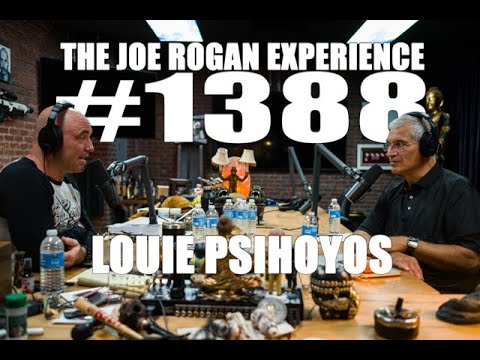
Joe Rogan Experience #1388 - Louie Psihoyos
Joe Rogan (host), Louie Psihoyos (guest), Narrator, Narrator
In this episode of The Joe Rogan Experience, featuring Joe Rogan and Louie Psihoyos, Joe Rogan Experience #1388 - Louie Psihoyos explores dolphins, Dying Oceans, and Reinventing Food: A Planet in Peril Louie Psihoyos, director of *The Cove* and *Racing Extinction*, explains how his shift from still photography to undercover filmmaking exposed the brutal dolphin hunts in Japan and broader oceanic collapse. He and Joe Rogan discuss marine intelligence—especially dolphins and whales—as well as overfishing, mercury contamination, coral bleaching, and sewage and plastic pollution. They explore how industrial fishing, factory farming, and cheap plastics are driving a human-caused mass extinction and degrading ecosystems before we even understand them. The conversation ends on possible solutions: large marine reserves, rethinking seafood and meat via plant-based and lab-grown alternatives, decarbonizing transport, using powerful media to spur action, and changing personal consumption.
Dolphins, Dying Oceans, and Reinventing Food: A Planet in Peril
Louie Psihoyos, director of *The Cove* and *Racing Extinction*, explains how his shift from still photography to undercover filmmaking exposed the brutal dolphin hunts in Japan and broader oceanic collapse. He and Joe Rogan discuss marine intelligence—especially dolphins and whales—as well as overfishing, mercury contamination, coral bleaching, and sewage and plastic pollution. They explore how industrial fishing, factory farming, and cheap plastics are driving a human-caused mass extinction and degrading ecosystems before we even understand them. The conversation ends on possible solutions: large marine reserves, rethinking seafood and meat via plant-based and lab-grown alternatives, decarbonizing transport, using powerful media to spur action, and changing personal consumption.
Key Takeaways
Dolphins and whales are extraordinarily intelligent and socially complex, yet treated as commodities.
Their brains have extensive cortical folding, rich emotional circuitry, and sophisticated long-range communication, but societies still justify slaughter and captivity for food and entertainment.
Get the full analysis with uListen AI
Industrial fishing is pushing key species toward collapse and making seafood increasingly toxic.
Bluefin tuna populations are down to a few percent of historic levels, Japan was caught massively exceeding tuna quotas, and large fish often carry mercury levels dozens of times above safe limits.
Get the full analysis with uListen AI
We are in a human-driven mass extinction, erasing biodiversity before we understand it.
Habitat destruction for agriculture, overconsumption, pollution, and invasive species are wiping out wildlife; Psihoyos frames it as burning the planetary “library” before reading the books.
Get the full analysis with uListen AI
Ocean ecosystems are being assaulted simultaneously by warming, acidification, runoff, and direct pollution.
The Great Barrier Reef has lost over half its coral in recent years, Florida reefs are being bathed in semi-treated sewage, and coastal snorkeling now often reveals underwater “deserts” instead of vibrant reefs.
Get the full analysis with uListen AI
Cheap, non-recyclable plastics and weak regulation externalize costs onto rivers and oceans.
Most ocean plastic is funneled through a small number of Asian rivers where there’s little recycling infrastructure; virgin plastic remains too cheap, giving no economic incentive to recover or redesign it.
Get the full analysis with uListen AI
Current meat and dairy systems are ethically and ecologically untenable, pushing us toward alternatives.
Factory farms, mercury-laden seafood, and livestock-driven land use can’t scale to feed 10–15 billion people; plant-rich diets, cultured meat, and regenerative practices are emerging as likely paths forward.
Get the full analysis with uListen AI
Media and spectacle can materially change policy and behavior when they target the right pressure points.
*The Cove* helped slash dolphin killings in Japan by over 90% by exposing both cruelty and mercury risk; large-scale projections like Racing Extinction’s Empire State Building and Vatican shows generated billions of media impressions and political attention.
Get the full analysis with uListen AI
Notable Quotes
“We're burning down the Library of Congress before we have a chance to know what the books read.”
— Louie Psihoyos
“When you’re watching a dolphin show, you’re watching a spectacle of dominance. You’re watching slaves.”
— Louie Psihoyos
“I think history, when all’s said and done, we’re gonna look at this as some insane slaughter of what’s basically like water people.”
— Joe Rogan
“This is the last generation that we have that can actually do something about it because we’re seeing it disappear on our watch.”
— Louie Psihoyos
“If an orca wasn’t real and someone described it to you, it would be like some incredible mythical creature.”
— Joe Rogan
Questions Answered in This Episode
If we accept dolphins and whales as “water people,” how should that change our laws and ethics around captivity, hunting, and ocean use?
Louie Psihoyos, director of *The Cove* and *Racing Extinction*, explains how his shift from still photography to undercover filmmaking exposed the brutal dolphin hunts in Japan and broader oceanic collapse. ...
Get the full analysis with uListen AI
What specific policies—such as taxing virgin plastic or banning certain fisheries—would most quickly reduce ocean collapse without causing humanitarian crises?
Get the full analysis with uListen AI
How realistic is E.O. Wilson’s Half-Earth proposal politically, and where would the first 50% of protected land and sea most strategically be located?
Get the full analysis with uListen AI
At what point do lab-grown meat and plant-based substitutes become not just viable but preferable for mainstream consumers, and what trade-offs will they entail?
Get the full analysis with uListen AI
How can filmmakers, artists, and communicators design stories that avoid “eco-fatigue” and instead drive sustained, large-scale behavior and policy change?
Get the full analysis with uListen AI
Transcript Preview
All right, here we go. How are you?
Good.
What's happening? Good to see you.
Good to see you.
Hey, how'd you get involved with The Cove? What was the, the history behind that?
I'm gonna give you the long version.
Sure.
Um, there's a, a good friend of mine, Jim Clark, the guy that started Netscape, Silicon Graphics, WebMD. I wanted to film... I was doing a story for Geographic back in 1995, I think it came out. Uh, it was on the information revolution and Jim Clark was sort of the, (sighs) y- you know, the Steve Jobs of my generation, right? And he, uh, h- he didn't wanna be photographed. He was just too busy. And then I started working for Fortune Magazine and he had built a boat, had the world's tallest mast I think at that point, and I was... went over to Amsterdam to film him. And, uh, we hit it off and, y- you know, he said, "Would you teach me how to be a, a good photographer?" And, you know, he'd made three companies from scratch b- worth over a billion dollars and I said, "Well, if you teach me how to be a billionaire, I'll teach you how to be a great photographer." (laughs) And, um, then we would travel all over the world taking pictures for about the next 10 years, and, uh, we did mostly underwater photography. He built the best underwater camera ever made by an order of magnitude. It was just a, a piece of work, 'cause Jim doesn't do anything half-ass, and every time we would go to a dive site and come back to it, he would see this shifting baseline where there's less fish, there's less coral. In fact, he, he took me to this place in Papua New Guinea, he said, "Louie, I'm gonna take you to the best place I've ever seen. It's in, in, in Papua New Guinea." We flew over there, all day to get there, a day and a half to sail. We'd dive on the GPS coordinates and it's rubble, it's completely gone. And this would happen, not all the time, but a lot. We don't know what the, you know, the insults were. It could have been dynamite fishing, could have been, uh, it, it could have been anything. Who knows what it was? But the... I think it was the third time that we were in the Galapagos, Jim turned to me and said something like, you know, "Somebody should do something about this." We saw a fisherman illegally f- fishing in a marine sanctuary. And sort of empowered by the success that he's had in business and seeing how he could change the world and his businesses, uh, I said, "How about you and I?" He said, "What do you mean?" I said, "We'll use your money and my eye and we'll make films." And the first... well, (laughs) then I, you know... So I'm jumping careers at this stage. I'm going from, uh, being a fairly successful, you know, s- still photographer, really busy, to, uh, a career where I had really no business doing it. I'd never really made a film before, not even, really, a short film. And, uh, and so I'm, you know, nervous, I'm feeling sort of full of myself like I'm gonna start this great career, and we're down in the Caribbean on a, on a boat and my kid starts... with Jim, on vacation with our families, and my kid starts playing on the beach with, uh, another kid. It happens to be Steven Spielberg's kid. So Steven comes over onto the boat to meet Jim and I. He, he made Jurassic Park using Jim's computers, you know, Silicon Graphics, and after I had Steven alone for a few seconds, I said, "Do you have any advice for a first-time filmmaker?"
Install uListen to search the full transcript and get AI-powered insights
Get Full TranscriptGet more from every podcast
AI summaries, searchable transcripts, and fact-checking. Free forever.
Add to Chrome