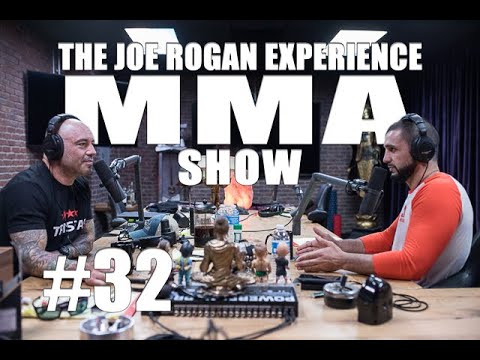
JRE MMA Show #32 with Firas Zahabi
Joe Rogan (host), Firas Zahabi (guest)
In this episode of The Joe Rogan Experience, featuring Joe Rogan and Firas Zahabi, JRE MMA Show #32 with Firas Zahabi explores firas Zahabi Explains Longevity Training, Fighter Mindset, And Reality Joe Rogan and MMA coach Firas Zahabi spend the first half discussing recovery tools, injury prevention, body mechanics, and how to train for performance and longevity instead of burnout. They cover mobility, strength and conditioning, nutrition, body types, sparring philosophy, and specific examples from Georges St‑Pierre’s career. In the second half, the conversation shifts into philosophy of training volume vs. intensity, critiques of CrossFit and overtraining culture, and then into deep philosophical territory: determinism, free will, science, and the nature of reality and consciousness. Zahabi argues that most of what we call scientific ‘laws’ are narratives about patterns, contrasts science with logical certainty, and explores how free will and determinism might both be true from different perspectives.
Firas Zahabi Explains Longevity Training, Fighter Mindset, And Reality
Joe Rogan and MMA coach Firas Zahabi spend the first half discussing recovery tools, injury prevention, body mechanics, and how to train for performance and longevity instead of burnout. They cover mobility, strength and conditioning, nutrition, body types, sparring philosophy, and specific examples from Georges St‑Pierre’s career. In the second half, the conversation shifts into philosophy of training volume vs. intensity, critiques of CrossFit and overtraining culture, and then into deep philosophical territory: determinism, free will, science, and the nature of reality and consciousness. Zahabi argues that most of what we call scientific ‘laws’ are narratives about patterns, contrasts science with logical certainty, and explores how free will and determinism might both be true from different perspectives.
Key Takeaways
Prioritize alignment and loose muscles to prevent injuries and extend your training life.
Zahabi leans heavily on Kelly Starrett’s framework: keep joints in good positions (e. ...
Get the full analysis with uListen AI
Train mostly at 70–80% effort so you can train more often and accumulate more skill.
He argues that going to exhaustion regularly is counterproductive; instead, stay in a ‘flow’ zone where sessions are challenging but not crushing, so you’re not sore, can train daily, and rack up far more quality hours over years.
Get the full analysis with uListen AI
Use hard sparring sparingly; most work should be light, technical, and playful.
Drawing from Thai boxing, Cuban boxing, and wrestling systems, Zahabi recommends that ~80% of sparring be light and flowy, reserving brief, carefully timed hard phases near fights or occasionally to test and expose weaknesses.
Get the full analysis with uListen AI
Strength work should emphasize speed and power, not grinding maximal lifts.
Referencing Michael Colgan, Louie Simmons, and plyometric principles, he suggests using 65–80% loads moved explosively, plus jumps and sprints, to build ‘Ferrari’ athletes rather than ‘tow trucks’—powerful in sport‑specific timeframes without excessive joint damage.
Get the full analysis with uListen AI
Volume of smart practice beats intensity of brutal sessions for mastery.
Using Russian and Cuban systems as examples, he explains that athletes who train intelligently every day (without destroying themselves) accumulate far more live rounds and technical reps than those who crush themselves a few times a week.
Get the full analysis with uListen AI
Diet, inflammation, and genetics interact strongly; copy‑pasting another athlete’s diet rarely works.
Rogan and Zahabi note how sugar and processed foods drive inflammation and pain, and how someone like GSP can stay lean on junk that would make others fat—highlighting individual differences in carbohydrate tolerance and body types (ecto/meso/endomorph).
Get the full analysis with uListen AI
Our confidence in ‘laws’ of nature rests on patterns, not absolute certainty.
In the philosophical segment, Zahabi argues that gravity, randomness, and even ‘matter’ are conceptual labels for regularities we observe, not logically undeniable truths—contrasting scientific hypotheses with mathematical certainty and first‑person conscious experience.
Get the full analysis with uListen AI
Notable Quotes
““Training should be addictive. If it’s not fun, you’re not going to do a lot of it, and if you don’t do a lot of it, you’re never going to reach mastery.””
— Firas Zahabi
““Do you want to train like a tow truck or like a Ferrari?””
— Firas Zahabi
““Consistency over intensity. Intensity, by nature, entails you need to take a break, because there’s no way around it.””
— Firas Zahabi
““Everybody’s looking for a pattern. When somebody does something to me a second or third time, I see it. Personally, I feel like I’m perceiving it slower.””
— Firas Zahabi
““Science is the faith that the future will behave like the past.””
— Firas Zahabi
Questions Answered in This Episode
How could everyday athletes practically apply Zahabi’s 70–80% ‘flow’ training model without feeling like they’re slacking?
Joe Rogan and MMA coach Firas Zahabi spend the first half discussing recovery tools, injury prevention, body mechanics, and how to train for performance and longevity instead of burnout. ...
Get the full analysis with uListen AI
Where is the line between intelligent hard sparring for fight prep and unnecessary risk of brain trauma, especially at the amateur level?
Get the full analysis with uListen AI
How might strength and conditioning programs look different if coaches fully embraced Zahabi’s critique of fatigue‑seeking workouts and CrossFit‑style programming?
Get the full analysis with uListen AI
If scientific ‘laws’ are narratives about patterns rather than absolute truths, how should that change the way we talk about certainty in nutrition, performance, or training science?
Get the full analysis with uListen AI
Can the coexistence of determinism and free will, as Zahabi describes, meaningfully influence how we coach fighters in terms of accountability, mindset, and personal change?
Get the full analysis with uListen AI
Transcript Preview
Three, two, one. Boom. I don't wanna start off like this is a commercial, dude, but this fucking thing you have, this TIM TAM thing.
(laughs)
This is incredible.
It's sick, huh? It's amazing.
I've never... I've seen some of these different ones online, people using them, Thera things, you know, I don't know what they call them, uh, Theragun I think. But this fucking thing is amazing.
This is the most powerful one. It has the, the highest travel, and it's the, the best price. So I mean it's-
Out of all the different ones of these things online?
Yeah, this is the best one.
So what this is, folks, we took the battery out. I'm, I'll pop the battery back in real quick.
You want to pop it in?
I'll pop it in real quick.
Go for it.
Just so people can see. That's how impressed I am by this thing. So I've had this nagging muscle in my hip, and then, like, instantaneously (tim tam buzzes) this fucking thing... You, you hold it, folks, and you get it, like, right on a spot. For me it's, like, right here. I can go... (tim tam buzzes) And it just loosens that motherfucker up, like... This is so much more powerful than any of those massagers that you get, like, from a store.
Exactly. No, no. There's no massager more powerful than this one on the market.
Oh.
Like, this is not for Mom and Dad, you know. This is for the guy doing, uh, you know, playing soccer, football, MMA, CrossFit. Like, that's for the hardcore athletes.
And you invented this?
I, I started the company. I started the company. I bought one of those DMS. I don't know if you've ever heard of those. It's called deep muscle stimulator. It's kind of sim-
We were talking about that before, and I said-
Yeah.
... "Save this, save this."
Yeah, yeah, exactly.
Uh, so what is that?
It's a... The deep muscle stimulator, it's like a stainless steel high-powered massager that you have to plug in. It cost me three grand. I bought it. It... I had a really bad sciatica for two years. Like, I almost stopped training. Like, I almost had to take a, like, a-
I've got a problem with that right now.
Really? Sciatica?
Yeah, yeah.
Okay, this is gonna help you out big time.
It comes and goes.
Big time.
Yeah.
Because I had... I mean, I was, I was so bad I couldn't sleep. Like, I could not sleep because I was in so much pain.
Does yours go all the way... I get mine in my calf sometimes.
Really? Oh, I'm lucky then.
Yeah. It goes all the way down to the calf for some weird reason.
Install uListen to search the full transcript and get AI-powered insights
Get Full TranscriptGet more from every podcast
AI summaries, searchable transcripts, and fact-checking. Free forever.
Add to Chrome