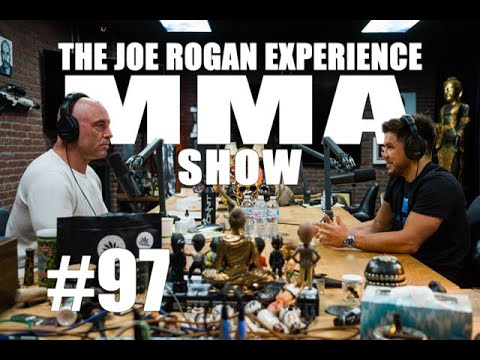
JRE MMA Show #97 with Henry Cejudo
Joe Rogan (host), Henry Cejudo (guest), Narrator
In this episode of The Joe Rogan Experience, featuring Joe Rogan and Henry Cejudo, JRE MMA Show #97 with Henry Cejudo explores henry Cejudo Breaks Down Greatness, Retirement, And Combat Evolution Henry Cejudo joins Joe Rogan to reflect on his retirement, his historic achievements across Olympic wrestling and UFC championships, and the mindset and systems that drove his success. He explains his ‘heart and ability’ framework, the role of adversity and upbringing, and how he rebuilt his career after early MMA setbacks. The conversation dives deeply into game-planning, modern MMA tactics like calf kicks, science-driven training, and his custom-built coaching team. They also explore psychedelics, immigration, police protests, and possible future moves for Cejudo in MMA, boxing, pro wrestling, and life after fighting.
Henry Cejudo Breaks Down Greatness, Retirement, And Combat Evolution
Henry Cejudo joins Joe Rogan to reflect on his retirement, his historic achievements across Olympic wrestling and UFC championships, and the mindset and systems that drove his success. He explains his ‘heart and ability’ framework, the role of adversity and upbringing, and how he rebuilt his career after early MMA setbacks. The conversation dives deeply into game-planning, modern MMA tactics like calf kicks, science-driven training, and his custom-built coaching team. They also explore psychedelics, immigration, police protests, and possible future moves for Cejudo in MMA, boxing, pro wrestling, and life after fighting.
Key Takeaways
Align ‘heart’ and ‘ability’ to reach true elite performance.
Cejudo argues greatness requires both obsessive will (heart) and high-level skill (ability); most have one without the other, and the real work is honestly closing the gap between the two.
Get the full analysis with uListen AI
Treat training camps as a science project, not just hard work.
He uses daily heart-rate diagnostics, periodized intensity (rating sessions 1–10), tailored nutrition, and advanced recovery (altitude pods, infrared, stem cells) to avoid overtraining and peak on fight night.
Get the full analysis with uListen AI
Game plans must be fully opponent-specific and drilled in realistic simulations.
For each opponent, he builds a custom team of sparring partners who mimic that fighter’s size, stance, and style, re-enacts full walkouts with music and referees weekly, and even uses code words in empty arenas.
Get the full analysis with uListen AI
Technical details and adaptability win fights more than size and power.
Examples include chopping Dominick Cruz’s legs instead of chasing his head, adjusting mid-fight against Marlon Moraes, and leveraging wrestling to nullify Demetrious Johnson’s rhythm.
Get the full analysis with uListen AI
Adversity and upbringing can be powerful engines for mental toughness—if channeled.
Growing up poor, often hungry, in a large immigrant family with an absent, deported father gave Cejudo a high pain tolerance and drive; he stresses consciously turning anger and hardship into constructive goals.
Get the full analysis with uListen AI
Psychedelics can catalyze deep self-audit and emotional healing.
Both men describe 5-MeO-DMT and DMT experiences as ego-dissolving mirrors that force you to see your flaws, traumas, and performative behaviors, which can enable genuine behavioral change if you’re willing to fix them.
Get the full analysis with uListen AI
Cutting too much weight and training ‘harder’ is often counterproductive.
Cejudo nearly quit after a disastrous early UFC weight cut; he later found more success moving up in weight and prioritizing feeling healthy and fast over being the larger man in the cage.
Get the full analysis with uListen AI
Notable Quotes
“To be the one percent of the one percenters, your heart and your ability both have to match.”
— Henry Cejudo
“The only thing I know how to do is know how to win.”
— Henry Cejudo
“You’re not gonna like it, but psychedelics let you look at yourself honestly. Just don’t get mad you have flaws—fix them.”
— Joe Rogan
“I’m not saying I’m the best fighter in the world, but if you combine Olympic gold and two UFC belts, that’s where ‘greatest combat athlete’ comes in.”
— Henry Cejudo
“A man who can do what you’ve done can do anything.”
— Joe Rogan
Questions Answered in This Episode
If Cejudo applied his ‘heart and ability’ framework outside of combat, what fields could he dominate next and how would he structure that pursuit?
Henry Cejudo joins Joe Rogan to reflect on his retirement, his historic achievements across Olympic wrestling and UFC championships, and the mindset and systems that drove his success. ...
Get the full analysis with uListen AI
How might widespread adoption of Cejudo’s science-based, simulation-heavy training approach change injury rates and performance across MMA?
Get the full analysis with uListen AI
What are the ethical and safety boundaries of using powerful psychedelics like 5-MeO-DMT as tools for athletes dealing with trauma, ego, and retirement transitions?
Get the full analysis with uListen AI
Does Cejudo’s story support the idea that early-life adversity is an advantage for elite competitors, or could similar resilience be built without hardship?
Get the full analysis with uListen AI
How will the rise of techniques like calf kicks and specialist wrestlers like Cejudo shape the next generation’s striking and defensive fundamentals in MMA?
Get the full analysis with uListen AI
Transcript Preview
Henry Cejudo! How are you, sir?
Oh, I'm doing good, Joe.
Good to see you, man.
Thank you for having me. Thank you for having me.
What does it feel like? What does it feel like having stepped back, you step away, you get to look at it from a fresh perspective. What does this feel like?
Uh, it, it feels good, man. It, it feels, uh... I think the biggest thing with me, Joe, is there's satisfaction in my life. You know what I'm saying? I've done so much in the sport, and I can compare myself a little bit to Daniel. You know? If Daniel would have beat Stipe Miocic and he would have retired on top, now, he, he, he could almost say he retired as a two-division world champ. And, uh, I don't feel like I have that chip on my shoulder. You know, as a wrestler, I, I retired from the Olympics at a very young age. You know, decided to come back three years later, but, you know what I mean? It was, it was already done, you know what I mean? I retired at the age of 21. And then now at the age of 33, I'm, I'm, I'm truly calling it quits unless there's, there's a couple fights that if I do come back.
I like that word unless.
(laughs)
I like that word.
Yeah. And as you know, and, and, and, and a little bit it's... Before it was about the money a little bit with the UFC. And obviously, you know, everybody does have a price. But I think there's, there's, there's a fight that I, that I would really like in the UFC, and that would be against Oleksandr Volkanovski.
Really?
Yeah. If they're-
45?
At 45. If they were to give me an opportunity to go up and obviously be compensated, then that would be a fight that would really, uh, that would really wake me up in the morning and be like, "Hey, man, this is, this is a challenge. This is a whole new mountain." You know?
A chance to be a three-division world champion.
A chance to be a three-division world champion. As you know, a lot of people have counted me out against Demetrious, against TJ, against Marlon. That, and may- maybe it was you too, Joe.
No, no, no, no, no.
And, and, and I think that's what I love about it.
You can't find any evidence of me counting you out, sir.
(laughs)
Never.
So I love that. I love challenges. Since I was a kid, I knew I was, I knew I was different. I knew I was special. And, uh, these are the things-
What is it that you knew? Like, what, what separates you?
Oh my God, I think it's, I think it's, it's a couple things. If I was to explain it to you, like, what's, what's made me successful and... And I've seen it, you know, being at the Olympic Training Center, uh, as a high school kid and living out there for four years. That's actually where I met Daniel. And I was a 16-year-old kid when I first met these guys, and I was able to analyze a lot of the greats, like, you know, uh, Stephen Abbess, Daniel Cormier, a lot of the Olympic team. And, uh, what I've learned now at the age of 33, I learned that there's been two things that have separated me from, from the rest of the pack. It's, it's, it's two things with what I call heart and ability. And I was actually able to tell this story to, uh, to Chatri, you know, the, the founder and CEO of ONE FC. And, uh, you know, so it's two things. I call it heart and ability. What is your heart? Your heart is your passion, your will, your desire, your determination. Your heart is something that you're willing to suffer for in order to obtain. Now, the next one is ability. You know, ability is, is a gift that you have since, since, you know, it's a coordination. It's, it's something that you've repped over time where you become a master at it. And what happens is a lot of time, it's, I, I always tell people, "It's good to question one or the other." It's good to question the mind, I'm sorry, I'm sorry, the heart or, or the ability. Because to be the 1% of the one percenters, like, both these things have to match. What happens is a lot of people have heart, but their ability is, like, way down here. You know, their ability doesn't match their heart, or their ability is up here and they're just a little lazy and can't really-
Install uListen to search the full transcript and get AI-powered insights
Get Full TranscriptGet more from every podcast
AI summaries, searchable transcripts, and fact-checking. Free forever.
Add to Chrome