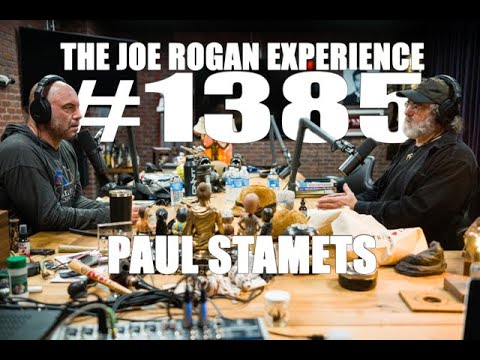
Joe Rogan Experience #1385 - Paul Stamets
Joe Rogan (host), Paul Stamets (guest)
In this episode of The Joe Rogan Experience, featuring Joe Rogan and Paul Stamets, Joe Rogan Experience #1385 - Paul Stamets explores mushrooms, Bees, Brains, and Psychedelics: Paul Stamets Redefines Medicine Paul Stamets discusses how specific mushrooms and their mycelium can radically improve bee health, potentially reversing aspects of the global pollinator and insect decline, and outlines his citizen-science bee feeder project to crowdsource data worldwide.
Mushrooms, Bees, Brains, and Psychedelics: Paul Stamets Redefines Medicine
Paul Stamets discusses how specific mushrooms and their mycelium can radically improve bee health, potentially reversing aspects of the global pollinator and insect decline, and outlines his citizen-science bee feeder project to crowdsource data worldwide.
He explains emerging research showing that medicinal mushrooms like turkey tail, reishi, lion’s mane, and others have strong antiviral, neurogenic, and immunomodulating effects—in animals, humans, and especially bees—often outperforming single-molecule pharmaceuticals.
Stamets dives into the changing scientific and cultural landscape around psilocybin: FDA-approved clinical trials, microdosing, neurogenesis data, and legal, non-psychoactive analogs that may reduce anxiety and improve cognition without causing a traditional “high.”
The conversation broadens into the social, political, and spiritual implications of psychedelic and medicinal fungi—how they may help address addiction, depression, PTSD, ecological collapse, and even political polarization by making people “nicer, more creative, and more connected.”
Key Takeaways
Certain wood conk mushrooms dramatically reduce deadly bee viruses.
Stamets’ Nature-published research shows amadou (Fomes fomentarius) and reishi mycelial extracts can cut deformed wing virus by ~800x and Lake Sinai virus by ~45,000x in honeybees, offering the first effective antiviral approach for bee colonies.
Get the full analysis with uListen AI
Citizen scientists can actively help save bees using mushroom-infused feeders.
Stamets is giving away 10,000 ‘BeeMushroomed’ feeders that deliver mushroom extracts via sugar water to wild bees; future versions will use solar-powered sensors and LTE to upload pollinator activity data globally, building baselines to monitor ecosystem health.
Get the full analysis with uListen AI
Mycelium often has stronger medicinal effects than the mushroom fruit body.
For species like turkey tail, reishi, and lion’s mane, the mycelium expresses more genes and produces different bioactive compounds—some strongly antiviral, neurogenic, or immunomodulating—especially when grown on specific substrates like birch wood or rice.
Get the full analysis with uListen AI
Lion’s mane and psilocybin (or analogs) together may strongly boost neurogenesis.
In vitro work with human pluripotent stem cells shows lion’s mane mycelium increases neurite outgrowth; when combined with legal psilocybin analogs, the effect is synergistic, not just additive, suggesting a powerful stack for brain health and learning.
Get the full analysis with uListen AI
Microdosing psychedelics may support cognition, mood, and trauma processing.
Animal studies and anecdotal human data suggest low, sub-perceptual doses of psilocybin can enhance neurogenesis and extinction of conditioned fear more effectively than higher ‘macro’ doses, prompting Stamets’ microdose. ...
Get the full analysis with uListen AI
Legal psilocybin analogs could treat anxiety and depression without a ‘trip.’
Stamets describes an N=1 monitored trial with baeocystin (a natural analog) that reduced severe situational anxiety without producing a psychedelic experience; he argues such compounds may form a new class of non-psychoactive, mushroom-derived anxiolytics if validated in larger studies.
Get the full analysis with uListen AI
Psilocybin experiences appear to reduce violence, addiction, and existential distress.
Meta-analyses and population studies correlate a single psilocybin experience with lower partner violence and criminality; clinical trials (e. ...
Get the full analysis with uListen AI
Notable Quotes
“Psilocybin mushrooms make nicer people.”
— Paul Stamets
“A natural product can have a broader bioshield of benefits than a pure pharmaceutical.”
— Paul Stamets
“The loss of bees is a threat to our national security.”
— Paul Stamets
“When you get the message from the phone, hang it up.”
— Paul Stamets (quoting Terence McKenna/Alan Watts)
“This is a people’s revolution… How dare we make a species illegal?”
— Paul Stamets
Questions Answered in This Episode
How scalable and economically viable is it to deploy mushroom-based antivirals for bees at the level needed to meaningfully impact global agriculture?
Paul Stamets discusses how specific mushrooms and their mycelium can radically improve bee health, potentially reversing aspects of the global pollinator and insect decline, and outlines his citizen-science bee feeder project to crowdsource data worldwide.
Get the full analysis with uListen AI
What mechanisms most likely explain the superior neurogenic effects observed at microdose versus macrodose levels of psilocybin in animal models?
He explains emerging research showing that medicinal mushrooms like turkey tail, reishi, lion’s mane, and others have strong antiviral, neurogenic, and immunomodulating effects—in animals, humans, and especially bees—often outperforming single-molecule pharmaceuticals.
Get the full analysis with uListen AI
How should regulators distinguish between whole-fungus preparations (with complex analogs and entourage effects) and isolated psilocybin when designing medical and legal frameworks?
Stamets dives into the changing scientific and cultural landscape around psilocybin: FDA-approved clinical trials, microdosing, neurogenesis data, and legal, non-psychoactive analogs that may reduce anxiety and improve cognition without causing a traditional “high.”
Get the full analysis with uListen AI
Could large-scale citizen-science platforms like the bee feeder network and microdose.me become credible substitutes or complements to traditional clinical and ecological research?
The conversation broadens into the social, political, and spiritual implications of psychedelic and medicinal fungi—how they may help address addiction, depression, PTSD, ecological collapse, and even political polarization by making people “nicer, more creative, and more connected.”
Get the full analysis with uListen AI
What safeguards and screening protocols are essential to prevent adverse outcomes (e.g., in people predisposed to psychosis) as psychedelic therapy and microdosing become more mainstream?
Get the full analysis with uListen AI
Transcript Preview
... three, two, one. And we're live. Hello, Paul.
Hey there.
What's happening? How are you, sir?
I'm very well. How are you?
And you have newfangled mushroom hats. These are surprisingly durable. So the thing about these mushroom hats, they're ... h- you would think, "Oh, it's gonna fall apart in your fingers." But no, it's got like... It's quite pliable.
It's quite pliable, and it's known as German felt. And this, um, allowed the Ice Man, Otzi, to be able to travel into the Alps. It was a firestarter mushroom.
Really?
And this r- actually revolutionized warfare because it helped flint spark guns ignite the gunpowder.
Really?
So ... And so amadou and, uh ... It comes from a birch polypore mushroom, which is the subject of much of our research these days.
Now, when this grows in the wild, what does it look like? 'Cause this is, uh ... You, you've fashioned it into this hat.
Well, some-
Or had someone fashion it.
Some ladies-
That's what it looks like?
Yeah, some ladies in Transylvania.
Can I see that?
Yeah. It's called, uh, Fomes fomentarius.
Mm.
It allowed for the portability of fire. There's no doubt we all came from Africa, and we went north and we discovered winter. This allowed for fire to be carried for days, and so your clan was absolutely dependent upon fire starting in order to survive the winter. And this mushroom allowed and enabled people to survive.
Wow. It's very light. Um, is it edible?
Excellent question. Um, Hippocrates first described it in 400, uh, BCE, um, as a tre- ... as an antiinflammatory. So in teas, yes, but, uh, you know, that's very, very tough. When you put it in ash and water, it delaminates into mycelium. And so some ladies in Transylvania still make these and as a fabric that you pull. N- That mushroom there will become, uh, one hat or maybe more.
Really?
'Cause it just keeps on elongating and it's made of mycelium and, um-
So, like, explain the process. How would you take this slab of mushroom that I have that looks like ... sort of like a ... an enormous Hershey's Kiss, and then you would put that ...
In water with ash from a fire, from a fire. And wh-
Now, why, why ash? What is that ash good for-
'Cause it's highly alkaline.
Mm-hmm.
And then it helps it separate. It begins to delaminate.
Mm-hmm.
And literally, you start pulling this, and it's a fabric that you keep on felting.
Ah.
And so it's called German felt, and it's been used for literally thousands of years. And, uh, beekeepers actually use this for smoking hives. It ... We could, but it would be kind of ... It would be kind of bizarre. We, we could da- ... flick a Bic and you'd b- burn up one of these things. And there's a ... It's just amazing how much this is a fuse, and one spark on this, you know, can ignite this entire thing over 15, 20 minutes.
Install uListen to search the full transcript and get AI-powered insights
Get Full TranscriptGet more from every podcast
AI summaries, searchable transcripts, and fact-checking. Free forever.
Add to Chrome