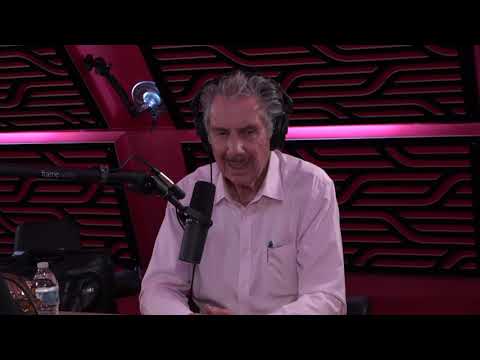
Joe Rogan Experience #1612 - Robert Bigelow
Robert Bigelow (guest), Joe Rogan (host)
In this episode of The Joe Rogan Experience, featuring Robert Bigelow and Joe Rogan, Joe Rogan Experience #1612 - Robert Bigelow explores billionaire UFO Researcher Robert Bigelow Probes Aliens, Afterlife, Consciousness Joe Rogan interviews aerospace entrepreneur and UFO investigator Robert Bigelow about his lifelong involvement with unexplained phenomena, from family sightings and personal experiences to government-linked research and space habitats.
Billionaire UFO Researcher Robert Bigelow Probes Aliens, Afterlife, Consciousness
Joe Rogan interviews aerospace entrepreneur and UFO investigator Robert Bigelow about his lifelong involvement with unexplained phenomena, from family sightings and personal experiences to government-linked research and space habitats.
They discuss landmark UFO cases, pilot encounters, Bob Lazar’s claims, and why Bigelow believes some crash debris and possibly bodies are secretly held by corporations and government.
The conversation then shifts into consciousness, psychic phenomena, remote viewing, near‑death experiences, and Bigelow’s new institute and essay contest seeking the best evidence for life after death.
Throughout, Bigelow contrasts humanity’s rapidly accelerating technology with what he sees as stagnant spiritual maturity, warning of risks if our ethics and understanding of consciousness don’t keep pace.
Key Takeaways
Personal and family experiences can drive lifelong high‑risk research agendas.
Bigelow’s grandparents’ dramatic 1947 close encounter and his own childhood experiences seeded a decades‑long obsession that later guided how he deployed his real‑estate fortune into UFO research, aerospace, and now consciousness studies.
Get the full analysis with uListen AI
Patterns across independent UFO witnesses and data make outright dismissal harder.
Cases like Betty and Barney Hill, Travis Walton, Kenneth Arnold, the Phoenix Lights, and modern military pilot reports share recurring features (shapes, behaviors, lack of propulsion signature) across eras and cultures, which Bigelow argues collectively challenge purely conventional explanations.
Get the full analysis with uListen AI
Crash‑retrieval and materials claims hinge on secrecy and corporate custody.
Bigelow suggests that some anomalous alloys and possibly intact hardware and bodies are held in a mix of government and corporate hands, periodically re‑examined as technology advances, but treated as ultra‑sensitive ‘national treasure’ rather than openly studied science assets.
Get the full analysis with uListen AI
Humanity’s technological curve is steep; its spiritual curve may be flatlining.
He frames a graph where tech advances explode upward while spiritual maturity and ethical development stay nearly flat, warning that powerful tools in the hands of an immature species create systemic risk—akin to giving ‘Klingon‑level’ weapons to an emotionally unstable civilization.
Get the full analysis with uListen AI
Remote viewing and psi research are taken seriously by some insiders.
Bigelow recounts hiring remote viewers, referencing Cold War CIA/Army programs, and citing classic figures like Ingo Swann and Joe McMoneagle as evidence that at least some non‑local perception experiments produced results that convinced parts of the intelligence community.
Get the full analysis with uListen AI
Bigelow is investing heavily to formalize the afterlife question.
Through the Bigelow Institute for Consciousness Studies, he launched a high‑dollar essay contest asking credentialed researchers to present the strongest evidence that consciousness survives bodily death, aiming to aggregate and publicly share the best arguments and data.
Get the full analysis with uListen AI
Ego reduction appears central to both mystical and psychedelic insights.
Rogan’s psychedelic experiences and Bigelow’s afterlife-literature survey converge on the idea that abandoning ego is fundamental to deeper understanding, better learning, and potentially a smoother transition—whether in intense altered states or in whatever follows physical death.
Get the full analysis with uListen AI
Notable Quotes
““We’re still working with fire engines, and if even some of this UFO stuff is true, it’s night and day compared to what’s out there.””
— Robert Bigelow
““I wouldn’t bet against the truth of the majority of what Bob Lazar has said.””
— Robert Bigelow
““You’ve got one line for technology that’s almost vertical, and another line for spiritual maturity that’s practically flatlined.””
— Robert Bigelow
““Human beings might be some sort of biological caterpillar that gives birth to an electronic butterfly.””
— Joe Rogan
““The subject of whether aspects of your consciousness survive bodily death is just as much a Holy Grail as ‘Are we alone?’.””
— Robert Bigelow
Questions Answered in This Episode
If corporations and governments do possess crash‑retrieved materials or bodies, what concrete mechanism—legal, political, or scientific—could realistically force transparent, independent study?
Joe Rogan interviews aerospace entrepreneur and UFO investigator Robert Bigelow about his lifelong involvement with unexplained phenomena, from family sightings and personal experiences to government-linked research and space habitats.
Get the full analysis with uListen AI
How should we weigh anecdotal but recurring patterns in abduction reports and near‑death experiences against the lack of lab‑grade, repeatable proof?
They discuss landmark UFO cases, pilot encounters, Bob Lazar’s claims, and why Bigelow believes some crash debris and possibly bodies are secretly held by corporations and government.
Get the full analysis with uListen AI
What kind of experimental design would satisfy both skeptics and believers in testing claims of remote viewing or psychic mediumship?
The conversation then shifts into consciousness, psychic phenomena, remote viewing, near‑death experiences, and Bigelow’s new institute and essay contest seeking the best evidence for life after death.
Get the full analysis with uListen AI
Could accelerating spiritual or ethical development at scale ever realistically catch up with technological growth, and what institutions would drive that change?
Throughout, Bigelow contrasts humanity’s rapidly accelerating technology with what he sees as stagnant spiritual maturity, warning of risks if our ethics and understanding of consciousness don’t keep pace.
Get the full analysis with uListen AI
If consciousness does survive bodily death, how might that reshape our views on risk, meaning, and the urgency (or danger) of pursuing technologies like AI and human‑machine integration?
Get the full analysis with uListen AI
Transcript Preview
(drumbeats) Joe Rogan podcast, check it out. The Joe Rogan Experience.
Train by day, Joe Rogan podcast by night, all day. (rock music plays) Hello, Mr. Bigelow.
Hello. Good morning.
Good-
Or good afternoon.
... afternoon. Yeah, pleasure to meet you, pleasure to get to talk to you, and I, I really appreciate you coming on here. It mean-
My-
It means-
My pleasure.
... a lot to me. Um, you and I have, uh, some shared interests, clearly, in the world of, uh, UFOs, but I wanna talk... M- most people know of you because of Bigelow Aerospace. They know that you're this billionaire investor and you're a s- very successful businessman, but you have a, a deep fascination with UFOs.
Yeah. Yeah, sure do.
How did this all get started?
Um, back when my, uh, when I was about three years old, which would be about 1947, in actually May of that year, my grandparents had a, um, very close encounter. It was dramatic. And, um, they were taking a, an afternoon, evening drive in the late afternoon up into the mountains and then coming on back down to, to Las Vegas and they saw, um, what appeared to be at first an airplane on fire. (clears throat) And, um, i- the object became closer and closer, uh, to them and they pulled off to the side of the road and at one point then it filled up the wi- windshield and they thought they were gonna die. And at the last second, uh, it shot off and, and, uh, disappeared and, um... (clears throat) I learned of this story when I was probably 10 years old and... 'cause I was three at the time and, uh, my mother had told me this story. So I approached my grandfather and he wouldn't talk about it. Now after all these years, like seven years have gone by 'cause I was intrigued with it and, uh, (clears throat) so I went to my grandmother and she on- only would say a few words, but she wouldn't talk, so I got the story from my mom and, um, and they had... My grandfather had to sit on the side of the road there in the car for a while to, um, (clears throat) recompose himself and, uh, uh, because they thought they were, they were gonna die and, uh, and then fin- he finally was able to drive on back to Las Vegas. So that was the beginning for me.
Did he ever describe what... Y- you said it looked like a plane on fire, but like w- what was the shape of it as it got closer?
I, I don't recall any kinda shape that was, that was, uh-
Disguised?
... that my mother described. I don't recall that. Um-
But they just knew it wasn't a plane. They knew it was something-
Install uListen to search the full transcript and get AI-powered insights
Get Full TranscriptGet more from every podcast
AI summaries, searchable transcripts, and fact-checking. Free forever.
Add to Chrome