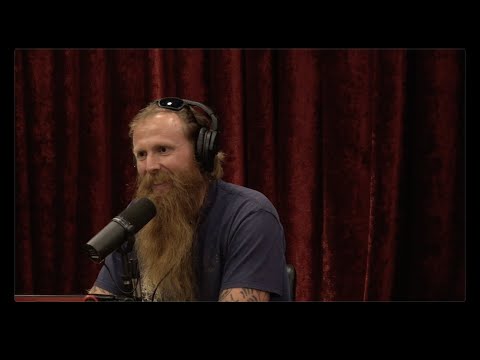
Joe Rogan Experience #2358 - Chadd Wright
Narrator, Joe Rogan (host), Chadd Wright (guest), Narrator, Narrator, Narrator, Narrator, Narrator
In this episode of The Joe Rogan Experience, featuring Narrator and Joe Rogan, Joe Rogan Experience #2358 - Chadd Wright explores ex–Navy SEAL Chadd Wright, Faith, Wilderness, Death, And Modern Decay Joe Rogan and Chadd Wright move from light talk about tobacco, toxic agriculture, and city life into a deep exploration of wilderness, hunting, and self-reliant off-grid living. Wright describes his intense love of squirrel dogs, longbow and rifle hunts, and why small game and wild meat matter in a fragile food system. The conversation then pivots into mortality: sitting with a dying mentor, witnessing “deathbed visions,” and near‑death experiences as evidence that consciousness may continue beyond death. Finally, Wright lays out his dramatic conversion story from hard‑living SEAL to devout Christian, while Rogan probes the tension between faith, logic, scripture, and human fallibility.
Ex–Navy SEAL Chadd Wright, Faith, Wilderness, Death, And Modern Decay
Joe Rogan and Chadd Wright move from light talk about tobacco, toxic agriculture, and city life into a deep exploration of wilderness, hunting, and self-reliant off-grid living. Wright describes his intense love of squirrel dogs, longbow and rifle hunts, and why small game and wild meat matter in a fragile food system. The conversation then pivots into mortality: sitting with a dying mentor, witnessing “deathbed visions,” and near‑death experiences as evidence that consciousness may continue beyond death. Finally, Wright lays out his dramatic conversion story from hard‑living SEAL to devout Christian, while Rogan probes the tension between faith, logic, scripture, and human fallibility.
Key Takeaways
Industrial farming is efficient but depletes soil life and locks society into fragile, chemical‑dependent systems.
Rogan and Wright contrast dead, pale industrial soil with rich regenerative soil, underscoring how hard and time‑intensive it is to restore land while still feeding dense urban populations.
Get the full analysis with uListen AI
Living close to nature radically changes your baseline for health, noise, and what “normal” feels like.
Wright describes being physically bothered by city air, noise, and homelessness after long stretches on his 700 rural acres—highlighting how acclimated urban dwellers are to stress they don’t notice.
Get the full analysis with uListen AI
Wild game and small game hunting are practical survival skills, not just recreation.
Wright argues that in any real crisis, deer and elk disappear fast; those who can consistently take squirrel, raccoon, rabbit, and birds with dogs will actually eat.
Get the full analysis with uListen AI
True skill and gear mastery come from long, incremental evolution, not sudden leaps.
Their deep dive on Land Cruisers, old diesels, and Hoyt bows shows how incremental engineering improvements, testing, and quality control over decades create tools that feel ‘magical’ today.
Get the full analysis with uListen AI
Facing death up close can radically reorder your values and beliefs.
Wright’s weeks reading scripture at his dying mentor’s bedside, watching him find strength and describe what he seemed to see beyond, forced him to confront mortality, meaning, and what he truly believes happens after death.
Get the full analysis with uListen AI
Wright frames his Christian faith as an unearned transformation that changed his desires, not just his behavior.
He describes a ‘before and after’ shift from drunken, reckless SEAL to someone who suddenly lost his appetite for porn, gossip, and cruelty—arguing that no amount of willpower or logic had ever produced that kind of overnight change.
Get the full analysis with uListen AI
Voluntary adversity—hard training, hunting, jiu‑jitsu, ultra races—acts as a stabilizer for success and mental health.
Both men emphasize that physical hardship humbles the ego, reveals capability, and makes fame, stress, and modern chaos more manageable; without it, people often drift into anxiety, delusion, and fragility.
Get the full analysis with uListen AI
Notable Quotes
“Humans have the propensity to stoop lower than an animal.”
— Chadd Wright
“Everybody thinks in the apocalypse you're gonna be eating deer and elk. You're gonna be eating squirrel, buddy.”
— Chadd Wright
“If you ever have the opportunity to go and see someone who is the best in the world at what they do, take that opportunity.”
— Chadd Wright
“Death is the great foe that sits above mankind and scoffs at our wisdom.”
— Chadd Wright
“Some of the most miserable, anxiety‑ridden people that I know have no belief system.”
— Joe Rogan
Questions Answered in This Episode
How convincing do you find Wright’s story of demonic activity in the barracks as a catalyst for his faith—is it spiritual reality, stress psychology, or both?
Joe Rogan and Chadd Wright move from light talk about tobacco, toxic agriculture, and city life into a deep exploration of wilderness, hunting, and self-reliant off-grid living. ...
Get the full analysis with uListen AI
Can modern societies realistically move away from industrial agriculture without causing mass food insecurity, and what trade‑offs are we willing to accept?
Get the full analysis with uListen AI
Do deathbed visions and near‑death experiences provide real evidence of an afterlife, or are they best explained as neurological phenomena in extreme states?
Get the full analysis with uListen AI
How should thinking people balance healthy skepticism with openness to faith when logic and scriptural claims seem to conflict?
Get the full analysis with uListen AI
In your own life, what form of voluntary adversity—physical, mental, or spiritual—has most changed your character, and what would happen if you removed it?
Get the full analysis with uListen AI
Transcript Preview
(Drums playing) Joe Rogan podcast. Check it out. The Joe Rogan Experience.
Train by day, Joe Rogan podcast by night. All day. (Rock music plays)
Yeah, I do too, man. I chew tobacco pretty much since I was about 13 years old.
(laughs)
But, you know, as you get older, you start to try to optimize everything because, uh, the world tells you everything's gonna kill you.
Is chewing tobacco gonna kill you?
Well, you know-
I've heard people getting mouth cancer.
... a very bi- Yeah, that's the main thing is mouth cancer.
Yeah.
And it- it's pre- mouth cancer's pre- a pretty nasty form- all forms of cancer are pretty nasty, but mouth cancer can really screw you up. And I think it's the, uh, the, you know, like the chemicals that they spray on the tobacco when they're growing the tobacco. So I don't know, maybe if you grew tobacco organically and then you chewed it, it wouldn't give you mouth cancer.
Probably makes sense.
I- I don't know.
Well, I was just reading something that 100% of California wines that they've tested had glyphosate on them, 100%.
Yeah, I believe it.
Which is just nuts.
You know, yeah, that stuff is everywhere. I mean, it's not-
Everywhere.
It's never gonna go anywhere because, you know, uh, when I was in the Navy, I lived in Virginia, and we moved out to a rural community. And, um, they grew corn and soybeans primarily in the fields, and nothing else would grow in that dirt. Like, you could walk the rows of those crops, you know, and there would not be a single weed growing in the field. Nothing would grow except for the genetically modified seed or whatever they put out there.
Yeah.
You know what I mean? And how long does that stay in the soil? Like, does that ever come- can you ever get that out of the dirt so that other things could or would actually thrive there again? I- I guess after many, many years you could.
Yeah, it's many, many years. I had Will Harris from- he's from Georgia, uh, White Oaks Pastures. You ever heard of that guy?
I- I actually listened to that episode that you did with him, man, because I've ordered a- a pile of meat from them.
He's great.
He is.
He's great.
That was a great episode.
And it's a great episode to educate people on like how much time it takes to take a- an industrial farm and convert it to regenerative agriculture.
Yeah.
It's not easy. It's a long grind, super costly, not nearly as profitable, and, you know, he did it over the course of 20 years. And we have two, uh, jars of soil out there that he gave us, and one of them is a soil from his neighbor's farm, which is an industrial farm, and the other one is his. And his is like a dark brown, rich, alive soil.
Install uListen to search the full transcript and get AI-powered insights
Get Full TranscriptGet more from every podcast
AI summaries, searchable transcripts, and fact-checking. Free forever.
Add to Chrome