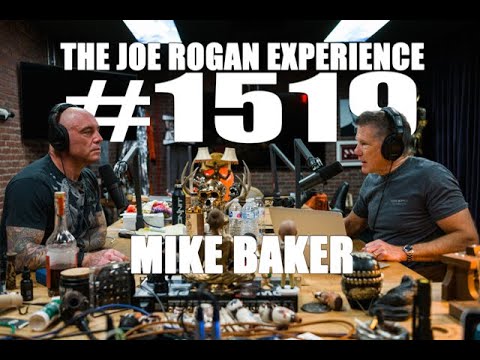
Joe Rogan Experience #1519 - Mike Baker
Joe Rogan (host), Mike Baker (guest), Narrator
In this episode of The Joe Rogan Experience, featuring Joe Rogan and Mike Baker, Joe Rogan Experience #1519 - Mike Baker explores cIA Vet Mike Baker Dissects COVID, Protests, Media, and Conspiracies Joe Rogan and former CIA officer Mike Baker spend nearly three hours unpacking COVID-19, media polarization, the 2020 election, and civil unrest in Portland and Seattle. They argue that partisan media and political hatred are amplifying pandemic confusion, including over treatments like hydroxychloroquine and mask-wearing. The conversation then turns to policing, Black Lives Matter, and how legitimate protests have been hijacked by violent extremists and opportunists. They finish with deep dives into China, CIA programs like MKUltra and remote viewing, UFO disclosures, gun ownership, and the structural failures of American politics and media.
CIA Vet Mike Baker Dissects COVID, Protests, Media, and Conspiracies
Joe Rogan and former CIA officer Mike Baker spend nearly three hours unpacking COVID-19, media polarization, the 2020 election, and civil unrest in Portland and Seattle. They argue that partisan media and political hatred are amplifying pandemic confusion, including over treatments like hydroxychloroquine and mask-wearing. The conversation then turns to policing, Black Lives Matter, and how legitimate protests have been hijacked by violent extremists and opportunists. They finish with deep dives into China, CIA programs like MKUltra and remote viewing, UFO disclosures, gun ownership, and the structural failures of American politics and media.
Key Takeaways
Pandemic information is being filtered through partisan politics, undermining trust.
Baker and Rogan argue that COVID coverage and debates over treatments like hydroxychloroquine are heavily shaped by attitudes toward Trump, making it difficult for the public to know what to believe and eroding confidence in public health messaging.
Get the full analysis with uListen AI
You can believe the science and still criticize the politics around it.
Baker repeatedly stresses that it’s possible to take COVID seriously, follow data, and support masks while simultaneously condemning media spin, political opportunism, and inconsistent messaging from both the White House and its critics.
Get the full analysis with uListen AI
Police reform requires concrete structural changes, not symbolic gestures.
They argue that meaningful improvement in policing comes from better vetting, continuous training, and stronger discipline systems, not from “defund the police” slogans or toppling statues, which feel good but don’t fix operational problems.
Get the full analysis with uListen AI
Extremists and opportunists are hijacking legitimate protests for their own aims.
Using Portland, Seattle and CHAZ/CHOP as examples, they describe how anarchists/Antifa-style groups and bored, unemployed people latch onto BLM protests, shifting focus from police accountability to attacks on courthouses, businesses, and historical monuments.
Get the full analysis with uListen AI
Modern journalism prioritizes narrative and speed over investigation and objectivity.
Baker laments that reporters rarely dig into mugshots, funding, or organizational links behind unrest; instead, audiences get headline-level, partisan interpretations, often fed by social media and incentive structures that reward outrage over accuracy.
Get the full analysis with uListen AI
Historical context matters when judging past figures and government programs.
They argue that you can condemn slavery or MKUltra-like abuses while acknowledging the Cold War and 18th–19th century norms that shaped decisions, rather than applying today’s moral standards in a simplistic, ahistorical way.
Get the full analysis with uListen AI
Geopolitical rivals like China pose long-term strategic and ethical challenges.
The discussion of Hong Kong, Uyghur camps, tech bans (TikTok, Huawei), cyber warfare, and potential genetic or technological “super soldiers” highlights a slow-moving cold war where China is willing to do things the U. ...
Get the full analysis with uListen AI
Notable Quotes
“Two things can be true. You can believe the science and also believe we’re fucked because of the politics.”
— Mike Baker
“If we can’t come together as a country during a fucking public health crisis, what the hell is wrong?”
— Mike Baker
“You made a worse version of America in six blocks.”
— Joe Rogan (on Seattle’s CHAZ/CHOP zone)
“You’re never going to be pure enough for the self‑righteous mob, no matter where they are on the spectrum.”
— Mike Baker
“I don’t think the government is capable of keeping secrets for the long term—certainly not of this magnitude.”
— Mike Baker (on UFO crash/retrieval claims)
Questions Answered in This Episode
How can public health communication be insulated from partisan politics so that treatments and data aren’t reflexively accepted or rejected based on who endorses them?
Joe Rogan and former CIA officer Mike Baker spend nearly three hours unpacking COVID-19, media polarization, the 2020 election, and civil unrest in Portland and Seattle. ...
Get the full analysis with uListen AI
What specific, measurable reforms in hiring, training, and discipline would most effectively reduce police brutality while maintaining public safety?
Get the full analysis with uListen AI
Where should societies draw the line between re-evaluating historical figures and erasing history, and who should make those decisions?
Get the full analysis with uListen AI
Given China’s trajectory on human rights, technology, and military power, what combination of pressure and engagement is realistic for the U.S. and its allies?
Get the full analysis with uListen AI
If objective, non-partisan journalism is economically and culturally hard to sustain, what alternative information models (independent creators, transparency tools, AI, etc.) might fill that role?
Get the full analysis with uListen AI
Transcript Preview
Hello, Mike Baker.
(sighs) Hello, Joe Rogan.
Brought your laptop this time, huh?
Look at that. Laptop, I got a- a- a-
You're prepared.
... pad of paper, I got a pen. Uh, what-
There's many issues, there's many things-
Thank you for my COVID test.
Oh, yeah, we needed that.
Yeah. Yeah, yeah.
We're doing them every week now.
(sighs) Yeah.
I've- I've- I don't even know how many times I've been tested, but it's good to know.
It's good to know. It's- it's- it's odd that you can travel across the country and find that some places, it takes you 10 days to get a response. Sometimes it takes 20 minutes to get a response. I- I- I... That's part I don't understand.
Yeah. Well, those super-duper ones they have at the White House, they can get those in 20 minutes.
(laughs)
The ones we have here, you can get the... Well, a 10-minute one, see, the antibody blood test will show you in 10 minutes whether or not you have an... This is the FDA-approved ones that we use here. They show you whether or not you have active antibodies, meaning a recent infection, you're probably currently fighting off the virus, or whether or not it's an old infection, so you've had the virus and beat it, and then the nose swab will say definitively if you've got it in your system.
Mm-hmm. Now, if they come back during the course of this show and say that I've got it, am I quarantined in the studio, or-
Yeah, well, there, the antibody already is negative, is already negative.
Okay.
So most likely, you don't have it.
Oh, good. Okay, good. Might feel better.
There you go.
Well-
How'd you... Turn- turn this thing towards you, will ya?
Yeah, yeah. Sorry.
There you go. No worries.
Yeah, that's better.
So how do you, how do you feel about all this? Are you weirded out? Like-
No.
You haven't been here since COVID, right?
Um, yeah, we were, uh... I think the last time, it was- it was before then, just before then it started to settle in.
Yeah.
Uh, and then I- I traveled last, was, uh, mid-February. I was in New York City. And it was starting to... People were starting to be aware, right?
Mm-hmm.
And- and- and they were talking about it a little bit, but there were really no changes in behavior. Uh, and then it, then it really hit, and everybody went into- into a hurry lockdown, and- and, uh, you know, the good thing is pandemics don't last, right? So we're gonna get past this. This is not like the zombie apocalypse. So I'm not one of those people that, you know, is hiding in my bunker, even though I like my bunker. Um, but-
Install uListen to search the full transcript and get AI-powered insights
Get Full TranscriptGet more from every podcast
AI summaries, searchable transcripts, and fact-checking. Free forever.
Add to Chrome