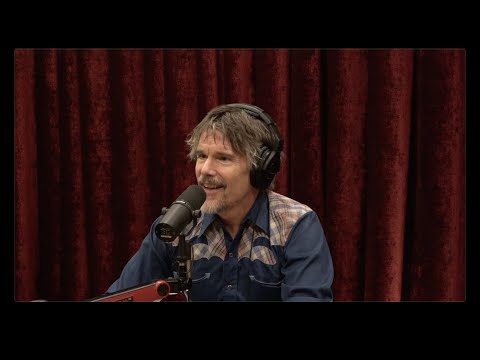
Joe Rogan Experience #2425 - Ethan Hawke
Joe Rogan (host), Ethan Hawke (guest), Joe Rogan (host), Narrator
In this episode of The Joe Rogan Experience, featuring Joe Rogan and Ethan Hawke, Joe Rogan Experience #2425 - Ethan Hawke explores ethan Hawke On Fame, Craft, Guardians, and Becoming Truly Present Ethan Hawke walks Joe Rogan through his unconventional journey from 12-year-old theater kid to long-haul working actor, emphasizing how early failure and a slow build of fame probably saved him. He contrasts the poison of childhood stardom and celebrity with the deeper rewards of treating acting as a lifelong craft and spiritual practice. Throughout, they explore how mentors, parenting, technology, and intense preparation shape character—whether in acting, fighting, or everyday life. The conversation repeatedly returns to presence, humility, and using fear, ego, and success as fuel for inner development rather than as ends in themselves.
Ethan Hawke On Fame, Craft, Guardians, and Becoming Truly Present
Ethan Hawke walks Joe Rogan through his unconventional journey from 12-year-old theater kid to long-haul working actor, emphasizing how early failure and a slow build of fame probably saved him. He contrasts the poison of childhood stardom and celebrity with the deeper rewards of treating acting as a lifelong craft and spiritual practice. Throughout, they explore how mentors, parenting, technology, and intense preparation shape character—whether in acting, fighting, or everyday life. The conversation repeatedly returns to presence, humility, and using fear, ego, and success as fuel for inner development rather than as ends in themselves.
Key Takeaways
Early failure can be more protective than early success.
Hawke’s first big film flopped, which crushed his teen fantasy of instant stardom but later grounded him; by the time Dead Poets Society hit, he was braced for failure and focused on the work itself instead of the outcome.
Get the full analysis with uListen AI
Child stardom and fast fame can severely distort development.
He likens early fame to bad concrete that sets wrong: once it hardens, you can’t re-mix the ingredients. ...
Get the full analysis with uListen AI
The real task in acting is presence, not performance.
Great acting feels like hypnosis: everyone on set disappears into a shared imaginative reality. ...
Get the full analysis with uListen AI
Humility—“I don’t know”—unlocks real learning and longevity.
A formative director forced Hawke to admit he’d “done nothing” and didn’t know what he was doing, which opened him to being taught; he frames beginner’s mind as essential not just in acting, but in any craft or new pursuit.
Get the full analysis with uListen AI
Mentors and heroes are fuel, not deities.
Hawke studies people like Jodie Foster, Jeff Bridges, Kris Kristofferson, and others who’ve aged well in their art, using them as models for integrity and balance while consciously avoiding unhealthy hero worship.
Get the full analysis with uListen AI
Fear and nerves are necessary ingredients of peak performance.
Drawing parallels to fighters like Mike Tyson, Hawke argues that anxiety before a role or scene is useful energy; the key is to acknowledge it and channel it, not pretend you’re fearless or above it.
Get the full analysis with uListen AI
Social media and criticism must be stripped of their power.
Both men describe how online comments and reviews can wreck confidence but ultimately reflect more about the commenter than the subject; Hawke urges learning to give them “no space” in your mind while still developing a thicker skin.
Get the full analysis with uListen AI
Notable Quotes
“Celebrity is like a tiny drop of mercury—it’s poison for your brain.”
— Ethan Hawke
“The method is an invitation to find out for yourself what will unlock your imagination.”
— Ethan Hawke
“Most people, if you’re an actuary, you’re an actuary. I get to be a World War II vet one month and a jazz musician the next.”
— Ethan Hawke
“The most important thing is to be your own best friend, and this [phone] is a slight obstacle to it.”
— Ethan Hawke, paraphrasing Richard Linklater
“You have to be nervous. If you’re not nervous, you’re not gonna perform well.”
— Joe Rogan
Questions Answered in This Episode
How do you practically cultivate “beginner’s mind” once you’ve already had success in your field?
Ethan Hawke walks Joe Rogan through his unconventional journey from 12-year-old theater kid to long-haul working actor, emphasizing how early failure and a slow build of fame probably saved him. ...
Get the full analysis with uListen AI
What specific practices or routines does Hawke use before a role to shift from self-consciousness into that hypnotic, present state?
Get the full analysis with uListen AI
Where is the line between healthy ambition and the kind of ego-chasing that corrupts art or sport?
Get the full analysis with uListen AI
How might parents realistically balance giving kids access to technology and social media with protecting their attention and mental health?
Get the full analysis with uListen AI
What can non-actors borrow from Hawke’s approach to mentors and criticism to navigate their own careers more sanely?
Get the full analysis with uListen AI
Transcript Preview
(drumbeats) Joe Rogan podcast, check it out. The Joe Rogan Experience. Train by day, Joe Rogan podcast by night. All day. (instrumental music plays)
Nathan Hawke, ladies and gentlemen.
Nice to meet you. (laughs) Great to meet you, man. Mm-hmm. It's weird when you see someone in so many fucking movies and then you meet them in real life. You're like, "Okay, just a regular person, right there."
Yeah, staring me in the face.
Yeah, right there.
He just took a leak, yeah. (laughs)
(laughs) Um, dude, you've been in some fucking banger movies, man. It's like, you've had an incredible career.
Yeah.
Pull that sucker, uh, pull that microphone up, yeah.
Yeah, like, pull it towards me?
Yeah, just r-
All right, very good. Yeah, it's been a long, strange trip.
It's been a wild one, huh?
Yeah.
When did you start acting? How old were you?
All right. So, um, like, 12 years old, I don't have a winter sport. My mother doesn't know what to do with me, and, uh, my next door neighbor, he lived, like, four houses down, and he took an acting class at the Paul Robeson Center of Performing Arts. And so, my mother signed me up so that I could get picked up by his mom, you know, taken to acting class in the winter and get dropped off, you know, and be at home. And I went there, and this head of a local theater company came by to teach an improv seminar, kind of thing. I'm 12 years old, right? And afterwards, in the parking lot, he said, um, "Hey, you wanna be in a play?" I said, "What do you mean?" He says, "I got a part of a guy who's a knight. He gets to, you get to have a sword." And I said, "Will I have any lines?" He said, "You'll have one line." I said, "All right, cool." And I asked my mom, and she said, "Do I have to pay?" You know? (laughs)
(laughs)
And I said, "I don't think so. I think they're gonna pay me." So I went and I did this play, and it was George Bernard Shaw's Saint Joan at the McCarter Theatre in New Jersey. And-
Oh, it's a real play.
Yeah, it was a, it was a proper play.
Wow.
And it was an incredible experience, to be honest with you, because my parents hated their jobs, you know? They would go to work, and their life happened on the periphery of their employment.
Mm-hmm.
You know, my mom would take the train to New York, and so she wouldn't get home till 7:30 something. She would leave at dawn. And, um, she was just miserable, uh, at work, I mean. And, um, I went to this rehearsal and everyone was having, they were talking about whether or not God existed. They were talking about what they believed in. They would dress up in these crazy outfits, and then we did the play, and they got a standing ovation. And it was, uh, it was so much fun. And I, it was the first time I saw, it was like, "This, you could do this for a living?"
Install uListen to search the full transcript and get AI-powered insights
Get Full TranscriptGet more from every podcast
AI summaries, searchable transcripts, and fact-checking. Free forever.
Add to Chrome