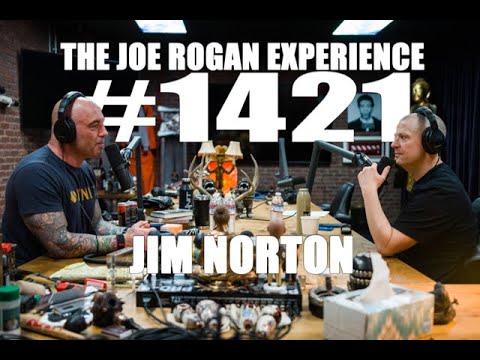
Joe Rogan Experience #1421 - Jim Norton
Joe Rogan (host), Jim Norton (guest), Narrator, Narrator, Narrator, Narrator
In this episode of The Joe Rogan Experience, featuring Joe Rogan and Jim Norton, Joe Rogan Experience #1421 - Jim Norton explores joe Rogan and Jim Norton Revisit Comedy, Controversy, and Combat Sports Joe Rogan and Jim Norton spend a long, free‑form conversation reminiscing about their early stand‑up days, Opie & Anthony radio chaos, and how comedy and media have changed. They discuss cancel culture, online outrage, and the psychology behind social media dog‑piling, drawing on examples like Ari Shaffir’s Kobe Bryant joke and historical firings from radio. Norton is unusually candid about childhood sexual experiences, addiction, shame, and how radical honesty in public has helped some listeners feel less alone. The back half of the podcast pivots heavily into UFC talk: fighter safety, CTE fears, match‑ups like Jones vs. Reyes, Khabib vs. Ferguson, and the terrifying power of Francis Ngannou.
Joe Rogan and Jim Norton Revisit Comedy, Controversy, and Combat Sports
Joe Rogan and Jim Norton spend a long, free‑form conversation reminiscing about their early stand‑up days, Opie & Anthony radio chaos, and how comedy and media have changed. They discuss cancel culture, online outrage, and the psychology behind social media dog‑piling, drawing on examples like Ari Shaffir’s Kobe Bryant joke and historical firings from radio. Norton is unusually candid about childhood sexual experiences, addiction, shame, and how radical honesty in public has helped some listeners feel less alone. The back half of the podcast pivots heavily into UFC talk: fighter safety, CTE fears, match‑ups like Jones vs. Reyes, Khabib vs. Ferguson, and the terrifying power of Francis Ngannou.
Throughout, they weave in discussions of UFO skepticism vs. belief, trans issues, aging, gratitude, and how fame and success can distort behavior and expectations.
Key Takeaways
The “shock comic” trap forces constant escalation.
Rogan and Norton note that when a comic builds a persona on saying the most outrageous thing (e. ...
Get the full analysis with uListen AI
Cancel culture often rewards bullying disguised as virtue.
They argue that many online pile‑ons are driven less by moral concern than by the high of attacking someone; people who fear being targeted themselves pre‑emptively join mobs and throw ‘rocks’ on social media without facing the person as a human being.
Get the full analysis with uListen AI
Radical honesty about taboo sexuality can reduce shame for others.
Norton’s graphic honesty about early sexual behavior, trans attraction, and kink has prompted private messages from men who felt less broken or alone, showing that candid self‑disclosure can normalize stigmatized experiences.
Get the full analysis with uListen AI
Childhood sexual behavior is often rooted in unremembered or diffuse trauma.
Norton describes extensive sexual activity with peers from age five and hazy hints of adult involvement; Rogan notes that memory around early abuse is often fragmented or blocked, and that imprinting can shape later orientation or compulsions even without clear recall.
Get the full analysis with uListen AI
Success can make people lose perspective and sabotage good situations.
They recall colleagues who destroyed lucrative gigs by fixating on pay inequality, and athletes like Iran Barkley who went broke trying to match others’ lifestyles—illustrating how comparison blinds people to how good they already have it.
Get the full analysis with uListen AI
CTE and head trauma risk are real, even for ex‑fighters who feel fine.
Rogan worries about his own accumulated damage from martial arts and a recent ski concussion, and they discuss Aaron Hernandez’s extreme CTE as a warning that repeated head impacts can radically alter behavior and mental health.
Get the full analysis with uListen AI
Fighter match‑ups hinge on style, psychology, and timing—not just records.
Their UFC breakdowns emphasize factors like reach, leg kicks, wrestling pedigree, recent wars (e. ...
Get the full analysis with uListen AI
Notable Quotes
“Most kids don’t blow their friends.”
— Jim Norton
“Hurt people hurt people. When you see a mob online, every one of those people is damaged and afraid it’ll come back to them.”
— Joe Rogan
“Anything I have, I know can be yanked immediately.”
— Jim Norton
“I don’t know a single funny person that’s not crazy.”
— Joe Rogan
“We’re a culture that likes to scold each other… it’s vicious, it’s fake‑polite.”
— Jim Norton
Questions Answered in This Episode
How should comedians balance the freedom to be shocking with the responsibility not to traumatize grieving audiences?
Joe Rogan and Jim Norton spend a long, free‑form conversation reminiscing about their early stand‑up days, Opie & Anthony radio chaos, and how comedy and media have changed. ...
Get the full analysis with uListen AI
To what extent should childhood sexual experiences—especially among kids—be framed as abuse versus experimentation, and how does that framing impact adult mental health?
Throughout, they weave in discussions of UFO skepticism vs. ...
Get the full analysis with uListen AI
Is social media outrage ever an effective tool for justice, or does it almost always devolve into performative bullying and virtue signaling?
Get the full analysis with uListen AI
Given what we know about CTE, where should the line be drawn between an athlete’s autonomy and the sport’s duty to protect them from themselves?
Get the full analysis with uListen AI
What evidence around UFOs and Bob Lazar would skeptics need to see to reconsider, and how can believers check their own desire to believe?
Get the full analysis with uListen AI
Transcript Preview
Three, two, one. Vancouver, April 20th, we're doing a 4/20 show. Cheeto Santino, Andrew Santino, Tony Hinchcliffe, and me at some big-ass arena. Go to joerogan.com. We're doing, uh, every year... Hi, Jimmy Norton.
Hi, buddy.
I do a 4/20 show. No headphones? You wanna do headphones or no headphones?
I don't mind doing it-
Casual?
No, I don't, uh, I don't mind doing it.
You do that weird thing with one in, one out.
Well, I, well, I have to. I'm claustrophobic.
Really?
Yeah, it feels weird.
You feel like the headphones are trapping you?
I don't know. I, uh, I feel like I'm underwater. Like, I don't like the way that sounds, and now I know... Uh, that's better. I look like an asshole-
Oh.
... but it, it feels better.
A lot of people do that.
Yeah.
A lot of musicians do that, they'll do, like, one in, one out.
It's the air, it's feeling the air. I don't know why. The pressure of the headphones, I just don't like it.
I like to be trapped.
You do?
Trapped in the headphones.
No, I don't care for it at all.
Yeah. I like, uh, hearing the other person's voice right next to mine so I don't talk louder than they talk, we don't talk over each other.
That's-
That's what it does.
That's professional, but I can't... Like, Howard, I heard, would do it where like, uh, they wouldn't even look at each other. Like, I have to be in the room looking at the person's mouth. Like, I, I don't like to do it.
You wouldn't look at each other? What do you mean?
No, I mean, uh, the way they were set up for the cameras, sometimes you're facing both kinda the same way because of the cameras. They weren't always-
Oh.
... I don't think face to face. If you looked at his old setup, wasn't, like, Artie sitting behind him at one point?
Yeah, Artie was sitting to the side of him, and, um, and then, uh, the guest was, like, over there. Yeah.
Yeah, I could never do that.
Well, you know, Howard also runs a board. That's a difference. Like, he's got a bunch of shit in front of him.
Yeah.
He's actually a trained radio guy. He knows all the Jamie shit. He knows all them switches, all that fancy stuff over there.
Yeah.
Yeah, and I have no idea what the fuck's going on over there.
I can basically set... I can, I can start and stop, but I hate, I hate running the board. It's distracting-
Hmm.
... and I don't like doing it. It just, it doesn't feel fun.
You know what's crazy is they have full setups now for podcasts, like a b- a podcast board that you buy. Like, it's set up for podcasts. You just plug mics into it, and it's all kinda there. 'Cause they, they have audio compression on those things too?
Install uListen to search the full transcript and get AI-powered insights
Get Full TranscriptGet more from every podcast
AI summaries, searchable transcripts, and fact-checking. Free forever.
Add to Chrome