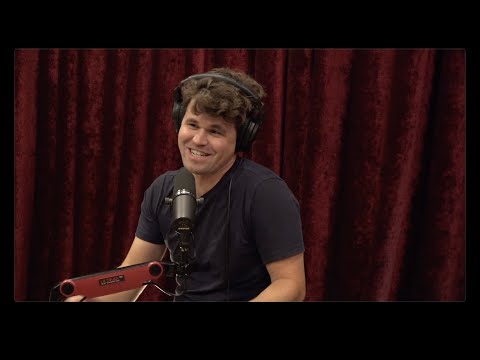
Joe Rogan Experience #2275 - Magnus Carlsen
Narrator, Narrator, Joe Rogan (host), Magnus Carlsen (guest), Narrator, Narrator, Joe Rogan (host), Narrator
In this episode of The Joe Rogan Experience, featuring Narrator and Narrator, Joe Rogan Experience #2275 - Magnus Carlsen explores magnus Carlsen on cheating, obsession, and surviving chess in AI era Magnus Carlsen discusses his early introduction to chess, how sibling rivalry and genuine obsession (rather than rigid discipline) drove him to become world champion, and why he still genuinely loves the game. He and Joe Rogan dive into the high-profile chess cheating scandal, the plausibility of different cheating methods, and how engines and AI have fundamentally changed both preparation and paranoia at the top level. Carlsen explains how modern players train with powerful engines and neural networks, how that has reshaped opening theory and playing style, and why formats like Chess960/freestyle are becoming more attractive. They also explore mindset, flow states, aging in chess, physical and cognitive optimization, and Magnus’s surprisingly relaxed, “lazy but obsessed” approach compared with other elite professionals.
Magnus Carlsen on cheating, obsession, and surviving chess in AI era
Magnus Carlsen discusses his early introduction to chess, how sibling rivalry and genuine obsession (rather than rigid discipline) drove him to become world champion, and why he still genuinely loves the game. He and Joe Rogan dive into the high-profile chess cheating scandal, the plausibility of different cheating methods, and how engines and AI have fundamentally changed both preparation and paranoia at the top level. Carlsen explains how modern players train with powerful engines and neural networks, how that has reshaped opening theory and playing style, and why formats like Chess960/freestyle are becoming more attractive. They also explore mindset, flow states, aging in chess, physical and cognitive optimization, and Magnus’s surprisingly relaxed, “lazy but obsessed” approach compared with other elite professionals.
Key Takeaways
Obsession beats rigid discipline for long-term mastery.
Carlsen never liked structured homework or six-hour study blocks; instead, he constantly thought about and played chess because he loved it. ...
Get the full analysis with uListen AI
Once someone is caught cheating in chess, trust is almost impossible to fully restore.
Magnus notes that admitted online cheating permanently contaminates over-the-board perception; top players will always wonder, “Is he cheating now? ...
Get the full analysis with uListen AI
Modern engines and neural networks have reshaped how top players understand chess.
Tools like Stockfish and Leela (inspired by AlphaZero) led to a re-evaluation of decades of opening theory and positional principles. ...
Get the full analysis with uListen AI
Security against cheating lags far behind the technological threat.
Carlsen explains that hidden earpieces, signaling spectators, or even just occasional engine guidance can make a strong player nearly unbeatable, while current tournament security often can’t provide a clear ‘smoking gun. ...
Get the full analysis with uListen AI
Preparation efficiency matters as much as volume at the elite level.
Magnus is known as ‘lazy’ by chess standards because he doesn’t grind all day; he prefers short, focused prep and enters games with a fresh mind. ...
Get the full analysis with uListen AI
Flow state in chess requires mental freshness more than maximal information.
Carlsen performs best when he’s well-rested, not drowning in prep, and fully present at the board. ...
Get the full analysis with uListen AI
AI-driven parity is pushing chess toward new formats and faster time controls.
With everyone having access to top engines and cloud analysis, classical opening preparation has become standardized and exhaustive. ...
Get the full analysis with uListen AI
Notable Quotes
“If you want to be great at something, you have to be obsessed with it.”
— Magnus Carlsen
“I just understand the game better than the others. I don’t calculate necessarily as far, but my intuition is better.”
— Magnus Carlsen
“Once someone admits that they cheated a game, especially a game that has a lot of trust in it like chess, you’re always going to think: ‘Is he cheating now?’”
— Magnus Carlsen
“I’m rarely happy after I play. There are always avoidable mistakes that I’m still making.”
— Magnus Carlsen
“I don’t believe in psychology. I believe in good moves.”
— Bobby Fischer (quoted by Magnus Carlsen)
Questions Answered in This Episode
How should chess governing bodies redesign rules and security to meaningfully deter sophisticated cheating in the age of ubiquitous engines?
Magnus Carlsen discusses his early introduction to chess, how sibling rivalry and genuine obsession (rather than rigid discipline) drove him to become world champion, and why he still genuinely loves the game. ...
Get the full analysis with uListen AI
Given how much AI has improved human understanding of chess, what might be the next major conceptual shift we haven’t yet discovered?
Get the full analysis with uListen AI
Is there an ethical line where using engines for preparation becomes too close to ‘assisted play,’ or is it simply part of modern professionalism?
Get the full analysis with uListen AI
How can aspiring players balance the need for obsessive practice with maintaining long-term mental health and avoiding burnout?
Get the full analysis with uListen AI
Would a widespread shift to formats like Chess960 fundamentally change who the best players are, or would the current elite still rise to the top?
Get the full analysis with uListen AI
Transcript Preview
(drum roll) Joe Rogan podcast. Check it out.
The Joe Rogan Experience.
Train by day, Joe Rogan podcast by night, all day. (rock music) All right, we're up and rolling. Magnets crossed, ladies and gentlemen. You want some coffee?
No. Oh, this is water. Yeah, excellent.
We, uh, tell Jeff we're bringing the coffee. Forgot to bring in the coffee.
No, no, I'm good with water.
Well, I need coffee. I wanna keep up with you, buddy. (laughs)
(laughs)
And of course, Tony Hinchcliffe is here, who's a, a gigantic chess fan, and d- just creamed his pants yesterday when I told him you were coming in. And then immediately, I said, "You gotta come with me." And so-
Yeah.
... Tony's here as well. It's an honor to meet you, man. Um, I, I, I'm always fascinated by people that are at the top of something that's insanely difficult, like chess. And I'm always wondering, like, how much time is involved? How much, how often do you play? And whe- when did you start? How old were you when you first started playing?
I think my dad... My dad is an avid chess player, so I think he, uh, t- thought that I might have some talent, so he thought... He taught me pretty early, at r- around five years old. But at that time, I wasn't that interested. Uh, I was mostly into LEGOs and I was into maths and, like, sports stats, and I had my little flag book with all, um, all the countries in the world, their flags and their inhabitants and area and everything. And I sort of... That w- that's what I did (laughs) uh, generally, just, um, taking in all the s- all the stats that I could also with, with sports, reading the sports section every day. And I didn't find chess that fun. Uh, a couple of years later, uh, my older sister is a year and a half older than me. She had a... She did a lot of chess with, with my dad. I started sitting in on them a bit, and, um, I, I started liking it. I really, really wanted to beat my sister as well at generally everything.
(laughs)
And, uh, yeah, from there on, it really just became, um, became my thing, and it's, you know, been my main hobby and, uh, eventually work as well since.
Yeah, obviously. (laughs)
Yeah.
It's fu- It's so funny though. A spark, a competitive spark with your sister is really what ignited you to get going with it.
Yeah, the, the funny thing is, like, she's not competitive at all.
(laughs)
So she hated the fact that I, like... I wanted to play, especially when I, I, I realized that I could beat her. Uh, and she, she, she liked chess, but she stopped for, for a while and only started when I had become, like, good enough that there wasn't a competition. So it turned like, like... My dad was right after all. I just needed, um, I just needed that, um, that extra push.
Install uListen to search the full transcript and get AI-powered insights
Get Full TranscriptGet more from every podcast
AI summaries, searchable transcripts, and fact-checking. Free forever.
Add to Chrome