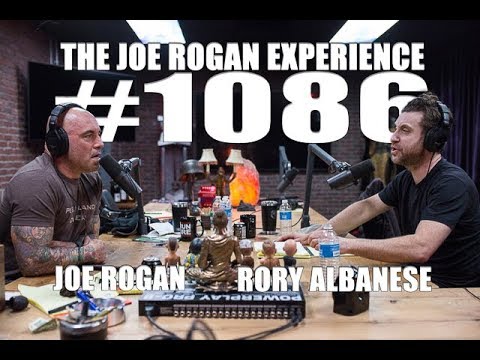
Joe Rogan Experience #1086 - Rory Albanese
Joe Rogan (host), Rory Albanese (guest), Jamie Vernon (guest), Narrator, Guest (guest), Guest (guest), Guest (guest), Narrator
In this episode of The Joe Rogan Experience, featuring Joe Rogan and Rory Albanese, Joe Rogan Experience #1086 - Rory Albanese explores dogs, drugs, language, and tech: Rogan and Albanese riff relentlessly Joe Rogan and Rory Albanese freewheel through a wide range of topics, starting with genetically engineered weed, dog cloning, and the ethics and risks of adopting shelter dogs. They segue into how humans have bred and decorated dogs, the treatment of animals in other cultures, and the moral inconsistencies in which animals we eat. From there they dive into food ethics (especially eggs), farming and chickens, shifts in language and political correctness, and how social media and smartphones are reshaping public discourse and outrage.
Dogs, drugs, language, and tech: Rogan and Albanese riff relentlessly
Joe Rogan and Rory Albanese freewheel through a wide range of topics, starting with genetically engineered weed, dog cloning, and the ethics and risks of adopting shelter dogs. They segue into how humans have bred and decorated dogs, the treatment of animals in other cultures, and the moral inconsistencies in which animals we eat. From there they dive into food ethics (especially eggs), farming and chickens, shifts in language and political correctness, and how social media and smartphones are reshaping public discourse and outrage.
They also hit on guns and gun laws, government competence versus conspiracy theories, historic U.S. scandals, and how much of what looks like conspiracy is often just human error and bureaucracy. The conversation detours into ancient civilizations, pyramids, lost knowledge, strange medical practices like lobotomies and human‑pig hybrids, and how fragile and recent modern civilization really is.
Throughout, they return to stand‑up, writers’ rooms, and the role of comics in pushing boundaries despite rising sensitivity, while touching on career topics like getting a special released in today’s content-saturated, algorithmic platforms.
Key Takeaways
Adopting shelter dogs is noble but requires realistic assessment and training.
Rogan and Albanese describe how long-sheltered or abused dogs can become highly aggressive, especially with other dogs, and stress that rehabilitation requires time, skill, and often professional help—so potential adopters should be honest about their capacity before taking on traumatized animals.
Get the full analysis with uListen AI
Humans have radically reshaped dogs—and often misuse them as accessories.
They trace how selective breeding turned wolves into everything from guard dogs to lap dogs, then criticize extreme grooming and dyeing that turn poodles into “pandas” or “snails,” arguing this is essentially abuse and a sign people got dogs for vanity, not companionship.
Get the full analysis with uListen AI
Our food taboos are culturally arbitrary, and eggs are an underused ethical protein.
They note Americans are outraged by cultures that eat dogs but unbothered by industrial pork and chicken, and argue unfertilized eggs—especially pasture-raised—offer highly nutritious, relatively “karma-light” food since no animal has to die, challenging strict vegetarian logic to at least consider eggs.
Get the full analysis with uListen AI
Language policing often overshoots, but some shifts force useful self-reflection.
Through examples like being told not to say “auction” at a Black charity event or the evolution of “gay” from ‘happy’ to slur, they show how over-sensitivity can become absurd while also acknowledging that rethinking casual terms (e. ...
Get the full analysis with uListen AI
Modern outrage is amplified by easy living and constant connectivity.
They argue that because daily survival is relatively easy and we’re saturated with smartphones and social media, people have the time and tools to fixate on micro-offenses, blog about forbidden words, and wage culture wars online instead of dealing with harder, material problems.
Get the full analysis with uListen AI
Government disasters often stem from incompetence and incentives, not master conspiracies.
Using Iraq’s WMD intelligence, Barry Seal/Iran‑Contra, and botched gun operations, they suggest many “conspiracies” are a mix of mid-level cowboy behavior, bad incentives, and bureaucratic sloppiness—undermining the notion of a hyper-competent all-controlling state while acknowledging real damage.
Get the full analysis with uListen AI
Comics see it as their job to push lines, even as norms tighten.
They describe older writers’ rooms as ruthless hazing environments that produced sharp material and contrast this with today’s mix of diverse, sometimes more easily offended voices, arguing that stand‑up still needs room for absurd, offensive experimentation or it risks becoming bland and didactic.
Get the full analysis with uListen AI
Notable Quotes
“It’s not just that a pound dog doesn’t have a home. You might be taking on an abused organism.”
— Joe Rogan
“People are such assholes. You got a dog and turned it into a panda. That’s as bad as hitting a dog, in my opinion.”
— Rory Albanese
“Eggs are one of the most karma‑free things. The chicken’s gonna lay them anyway.”
— Joe Rogan
“It’s a strange thing to be able to dictate to someone else how they’re supposed to live. I feel that way about abortion, gay marriage…about everything.”
— Rory Albanese
“We have such an easy life now we have time to come up with bullshit—like starting a blog about words you shouldn’t say.”
— Joe Rogan
Questions Answered in This Episode
How should adopters realistically evaluate whether they’re equipped to rehabilitate a traumatized shelter dog, rather than just acting on emotion?
Joe Rogan and Rory Albanese freewheel through a wide range of topics, starting with genetically engineered weed, dog cloning, and the ethics and risks of adopting shelter dogs. ...
Get the full analysis with uListen AI
Where do you personally draw the ethical line on which animals are acceptable to eat, and how much of that is pure cultural conditioning?
They also hit on guns and gun laws, government competence versus conspiracy theories, historic U. ...
Get the full analysis with uListen AI
At what point does language policing become more harmful than helpful, and who should get to decide which words are off-limits?
Throughout, they return to stand‑up, writers’ rooms, and the role of comics in pushing boundaries despite rising sensitivity, while touching on career topics like getting a special released in today’s content-saturated, algorithmic platforms.
Get the full analysis with uListen AI
If government missteps are more about incompetence than conspiracy, how should that change the way we respond to scandals and demand accountability?
Get the full analysis with uListen AI
Given today’s sensitivities, what responsibilities do comedians have, if any, to adjust their material versus continuing to push boundaries regardless of backlash?
Get the full analysis with uListen AI
Transcript Preview
Boom, and we're live. What happened? You took your hat off? You going f-
Yeah.
You getting crazy.
(laughs) I'm trying to feel, you know, I wanna feel at home.
It's that West Coast marijuana, dude.
Yeah.
It hits you hard, right?
(laughs) It does.
Right?
Hard and fast, man.
Woo! It's no joke.
Yeah, it's no joke.
These chemists, or whatever they are.
Yeah.
Botanists, these fucking science dorks.
Yeah.
They've done a wonderful job.
They've figured it out. Yeah.
Jesus Christ. It's not even the same thing anymore.
No. It's a-
You know?
... it's, it's a, uh, it's a, it's, uh, it's GMO all the way. (laughs)
(laughs)
Yeah, it's like, "Hey, hey, hey."
Yeah.
"Have you guys tested this on people yet?" I know it's crazy.
(laughs)
I'm like, "I know you took the seeds out of watermelon, but what the f-" (laughs)
Yeah. How the fuck did they do that?
I don't know.
How did that even happen?
I don't know.
You-
I just read that, uh, Barbra Streisand cloned her dogs. Did you read that?
I heard about that. Jamie told me. (laughs) Jesus Christ.
(laughs) It's like the weirdest thing, dude. She has two dogs from one.
Mm. That's weird.
She made two clones of her f- favorite dog.
That is like the polar opposite of adopt, don't shop.
Yeah. Yeah.
It's like you can't get any further.
Yeah.
It costs like $100,000.
Oh my God.
Of course, of course it does. Yeah.
She can't have a different shape. It's impossible.
Nope.
Can't be a different dog.
Mm-mm.
It's impossible.
Yeah. It's a, it's a weird, it's a weird move. (laughs)
So far, I c- man, I'm, if you really believe that personality comes from that, if it's the same thing, like if it just looks the same? You don't want it to just look the same, do you?
No. It's supposed to be, uh, an identical clone of your original dog.
What if it's-
So it's-
... really, really-
It really kinda would answer-
... stupid.
But it- (laughs)
What if it's your favorite dog-
Like multiplicity? (laughs)
... but this time, it just shit all over the place and walking into walls.
We've got bad news, Joe.
Ruff.
It doesn't have an asshole.
Ruff.
Yeah. (laughs)
(laughs) It just, it just didn't work all the way.
Yeah. We got it-
It worked most of the way. It looks like him.
Like 94% your dog, and then, you know, it's missing an asshole.
Yeah. It's 30% as smart as your last dog.
Install uListen to search the full transcript and get AI-powered insights
Get Full TranscriptGet more from every podcast
AI summaries, searchable transcripts, and fact-checking. Free forever.
Add to Chrome