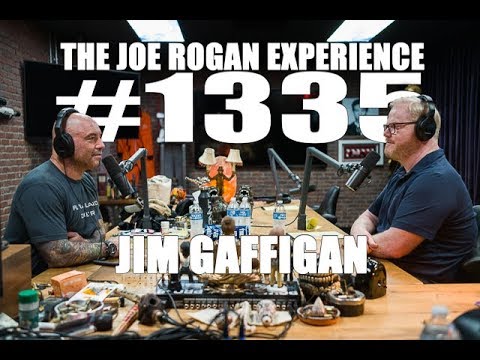
Joe Rogan Experience #1335 - Jim Gaffigan
Joe Rogan (host), Jim Gaffigan (guest), Narrator, Narrator, Narrator, Narrator
In this episode of The Joe Rogan Experience, featuring Joe Rogan and Jim Gaffigan, Joe Rogan Experience #1335 - Jim Gaffigan explores jim Gaffigan, Streaming Wars, and Why Authentic Comedy Still Wins Joe Rogan and Jim Gaffigan discuss how standup specials have shifted from HBO dominance to Netflix and now Amazon, and what that means for exposure, ownership, and numbers transparency.
Jim Gaffigan, Streaming Wars, and Why Authentic Comedy Still Wins
Joe Rogan and Jim Gaffigan discuss how standup specials have shifted from HBO dominance to Netflix and now Amazon, and what that means for exposure, ownership, and numbers transparency.
They explore the business and craft of comedy: how specials function as long-form “infomercials” for a comedian’s sensibility, the importance of authenticity, and the grind of constantly generating new A‑level material.
The conversation widens into media, politics, and culture—covering cancel culture, identity politics, the collapse of traditional criticism, and why people are fatigued by nonstop political discourse.
They end up comparing comedy, fighting, and hunting as difficult, discipline-heavy pursuits, while Gaffigan contrasts life in New York versus LA and why he structures his career around standup and family first.
Key Takeaways
Diversifying platforms gives comics leverage but adds uncertainty.
Gaffigan moved beyond Netflix—releasing one special independently and the next with Amazon—because Netflix’s crowded ‘pool’ can bury a special, and alternative platforms or self-release can offer better data, ownership, and audience reach.
Get the full analysis with uListen AI
Specials now act as global calling cards, not just one-night events.
Both note that a special is deeply personal but also serves as a long-form ad for a comedian’s sensibility; reach across multiple services and territories matters more than a single big TV premiere.
Get the full analysis with uListen AI
Metrics transparency is becoming a key bargaining chip with streamers.
Netflix famously withholds detailed numbers, while Amazon and independent distributors promise (or at least claim) to share viewership data—information comics increasingly want for strategy and negotiating power.
Get the full analysis with uListen AI
Authenticity beats manufactured personas across comedy and TV.
They point to Impractical Jokers and podcasts (including Rogan’s) as examples where real friendships, unpolished conversation, and non-packaged personalities are what audiences respond to most.
Get the full analysis with uListen AI
Audiences are burned out on politics and often want an escape.
Gaffigan notes that after 2016, political material that once worked everywhere suddenly hit a wall—people on both sides were exhausted and came to shows for a break, not reinforcement of the news cycle.
Get the full analysis with uListen AI
Cultural critique and identity politics are warping how art is reviewed.
Gaffigan describes reviews of a film he did where critics filtered a small indie comedy through heavy race and gender politics, often ignoring intent or story structure to satisfy current ideological checklists.
Get the full analysis with uListen AI
Long-form conversations are reshaping how public figures are understood.
Rogan argues podcasts expose the real person in a way late-night TV or debates can’t—citing Bernie Sanders on his show as an example of someone seen as a caricature elsewhere but humanized in a multi-hour, uninterrupted talk.
Get the full analysis with uListen AI
Notable Quotes
“Netflix is a swimming pool full of floaties; you get one week where people can actually find yours.”
— Jim Gaffigan
“Specials are very personal for us, but they also indirectly serve as an infomercial for our sensibility.”
— Jim Gaffigan
“The narrative's no longer being controlled by media… The people decide now. It’s really a meritocracy in that way.”
— Joe Rogan
“Humans think we have it figured out in every generation, and that suredness of people makes me concerned.”
— Jim Gaffigan
“Comedy, UFC fighters, and hunters all have in common that they're doing difficult things.”
— Joe Rogan
Questions Answered in This Episode
How will the next wave of platforms (Disney+, HBO Max, Apple, etc.) change the way standup is produced, owned, and discovered?
Joe Rogan and Jim Gaffigan discuss how standup specials have shifted from HBO dominance to Netflix and now Amazon, and what that means for exposure, ownership, and numbers transparency.
Get the full analysis with uListen AI
If audiences increasingly want authenticity, how should comics balance personal vulnerability with the pressure to be ‘on brand’ or politically correct?
They explore the business and craft of comedy: how specials function as long-form “infomercials” for a comedian’s sensibility, the importance of authenticity, and the grind of constantly generating new A‑level material.
Get the full analysis with uListen AI
What are the long-term implications of critics and executives filtering every story through race, gender, and identity metrics?
The conversation widens into media, politics, and culture—covering cancel culture, identity politics, the collapse of traditional criticism, and why people are fatigued by nonstop political discourse.
Get the full analysis with uListen AI
Could transparent viewing data from streamers fundamentally shift the power balance between platforms and high-profile comedians?
They end up comparing comedy, fighting, and hunting as difficult, discipline-heavy pursuits, while Gaffigan contrasts life in New York versus LA and why he structures his career around standup and family first.
Get the full analysis with uListen AI
How might political fatigue reshape standup over the next decade—will more comics avoid politics, or will new, better ways of talking about it emerge?
Get the full analysis with uListen AI
Transcript Preview
Dun-dun-dun. Ladies and gentlemen, (claps) one of the greats, Jim Gaffigan.
Oh.
How are you, sir?
Thank you, thank you. It's great to be here.
Great to see you, man. I'm excited that you're doing a special on Amazon.
Yeah.
I think it's important that there's a, a bunch of other platforms for all of us-
Right.
... to do specials on. And when a guy like you goes over to Amazon, legitimizes it, makes it a big deal, it's exciting.
Yeah, and it, it's, uh, it's fascinating how the, the outlets for specials has changed so dramatically.
Yeah.
'Cause when we were, when we were kids, it was just HBO.
Yep.
And then Comedy Central, when, uh, I released Beyond the Pale, it was, uh, that perfect moment where, uh, in every dorm room in America, Comedy Central was on.
Yep.
You know, it w- it had shifted from MTV to Comedy Central bec- probably 'cause of Chappelle and, and Jon Stewart. And so, but it shifts. You know, it's like, then Netflix was big, and, um, and we see these other platforms coming out. So it'll be, it'll be interesting. If I can convince people, 'cause everyone goes to Amazon.
Mm-hmm.
Or someone in their family does. So if I can convince them the next time they're buying paper towels-
(laughs)
... and socks-
(laughs)
... to just go over to Prime, 'cause they, everyone has a Prime membership.
Yeah, that's a weird part about it, right? It's like-
Yeah.
... it's shopping, but it's also, like, the same as iTunes.
It, y- yeah, people have asked me, they're like, "What if, uh," you know, well, one person asked me, they were like, "What if someone doesn't have a Prime membership?" And I'm like, "Then they're-"
Who are you?
"... probably not on the Internet."
Yeah, who are you?
Right? They probably can't afford even, uh, you know, high-speed Internet.
(laughs)
(laughs) So it's like, but I don't know. It is gonna be interesting. I've watched stuff on Prime, but it's like, it's like every time you, you know... I think comedians, we like the, we like to explore and do things different. You know, even, uh, you know, r- new rooms and stuff like that. We, we kind of are risk-averse, but there is always the possibility of... Like, I don't know.
Right.
I mean, it comes out Friday. Um, there is d- some support, but I don't know, and I know that Amazon is this enormous company, but I don't know. I don't know, they could... I mean, in the grand scheme of things, you know, my special is really not that big. It's not as important as the toothpicks they sell on Amazon.
(laughs)
So I don't know if they're gonna-
Install uListen to search the full transcript and get AI-powered insights
Get Full TranscriptGet more from every podcast
AI summaries, searchable transcripts, and fact-checking. Free forever.
Add to Chrome