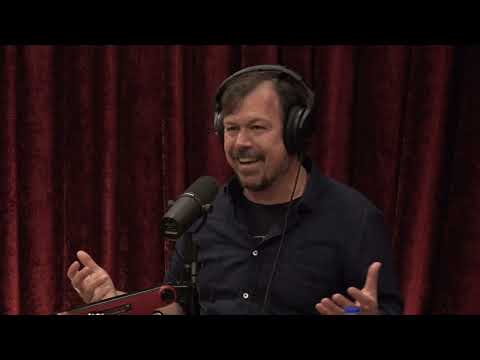
Joe Rogan Experience #1988 - James Reed
Narrator, Joe Rogan (host), James Reed (guest), Narrator
In this episode of The Joe Rogan Experience, featuring Narrator and Joe Rogan, Joe Rogan Experience #1988 - James Reed explores inside Chimp Empire: Filming Our Violent, Cooperative Primate Cousins Up-Close Joe Rogan interviews filmmaker James Reed about creating the Netflix series *Chimp Empire*, a four-part documentary embedded with the unusually large Ngogo chimpanzee community in Uganda.
Inside Chimp Empire: Filming Our Violent, Cooperative Primate Cousins Up-Close
Joe Rogan interviews filmmaker James Reed about creating the Netflix series *Chimp Empire*, a four-part documentary embedded with the unusually large Ngogo chimpanzee community in Uganda.
Reed explains how decades of scientific habituation allowed his team to film chimps from within the group over 400 shooting days, capturing intimate social dynamics, politics, hunting, patrols, and violence in unprecedented detail.
They discuss chimp intelligence, mysterious non-vocal coordination, meat-sharing politics, patrol behavior, tool use, and striking individuals like Pinza, a chimp with human-like white sclera whose cooperative and reproductive success intrigued scientists.
The conversation also explores the technical, ethical, and narrative challenges of organizing massive volumes of observational footage into a coherent, character-driven story without disturbing the chimps’ natural behavior.
Key Takeaways
Long-term scientific habituation is the foundation for deep wildlife storytelling.
Reed’s access was only possible because scientists spent ~30 years calmly following Ngogo chimps until they accepted humans as neutral observers, enabling a film crew to literally walk within the group without altering behavior.
Get the full analysis with uListen AI
Chimp societies are politically complex, with status built through alliances, grooming, and meat-sharing.
Alphas and high-ranking males maintain power by managing alliances—particularly via grooming and who gets meat after hunts—making access to meat a highly charged, political resource rather than just nutrition.
Get the full analysis with uListen AI
Chimp hunting of monkeys is frequent, cooperative, and not purely about survival.
Ngogo chimps are fruit specialists but hunt monkeys often; Reed and scientists suspect hunting also serves social and cooperative functions, and chimps appear to derive excitement and political leverage from successful hunts.
Get the full analysis with uListen AI
Chimp territorial patrols reveal a mysterious, largely silent coordination system.
Groups move in silence toward borders, seemingly reading each other’s intentions without obvious vocal cues; patrol leaders like Rollins and formerly Ellington and Damian often initiate and structure these risky excursions.
Get the full analysis with uListen AI
Individual variation among chimps can significantly shape group dynamics and scientific questions.
Characters like Pinza (with unusually white eye sclera and many offspring), Gus (socially awkward adolescent), and Burgle (bold young orphan) show distinct social strategies, forcing researchers to reconsider assumptions about communication, cooperation, and reproductive success.
Get the full analysis with uListen AI
Editing observational nature footage is an intensive sculpting process guided by data-rich logging.
Every shot was logged with which chimps appeared, what they were doing, and contextual details, allowing editors to query hundreds of hours of footage by individual and behavior to build clean, chronological storylines.
Get the full analysis with uListen AI
Ethical non-interference and disease precautions are central to modern primate fieldwork.
The crew followed strict rules—masks, minimum 7–10 meter distance, no visible food, staying out of fights—accepting that even when witnessing lethal violence, intervening would corrupt the science and endanger both chimps and humans.
Get the full analysis with uListen AI
Notable Quotes
“It's like a chimp was carrying around a camera.”
— Joe Rogan
“We had 400 filming days… we wanted to be observing them in detail from within the group.”
— James Reed
“They hunt [monkeys] regularly… it’s not sport, but it’s not purely for survival. There’s something else there.”
— James Reed
“We don’t know exactly how those patrols are instigated and how the chimps involved know that they’re on patrol. We do not know that.”
— James Reed
“I feel like I learned more watching those chimps from your documentary than anything… out of all the animals human beings have ever studied, none of them are as fascinating as chimpanzees.”
— Joe Rogan
Questions Answered in This Episode
What might chimpanzee patrol behavior and silent coordination reveal about the evolutionary roots of human warfare and group strategy?
Joe Rogan interviews filmmaker James Reed about creating the Netflix series *Chimp Empire*, a four-part documentary embedded with the unusually large Ngogo chimpanzee community in Uganda.
Get the full analysis with uListen AI
How could future technology (e.g., better low-light cameras or on-animal sensors) deepen our understanding of non-vocal chimp communication without increasing interference?
Reed explains how decades of scientific habituation allowed his team to film chimps from within the group over 400 shooting days, capturing intimate social dynamics, politics, hunting, patrols, and violence in unprecedented detail.
Get the full analysis with uListen AI
What are the ethical boundaries of non-interference when observers witness extreme intra-species violence in highly intelligent animals like chimps?
They discuss chimp intelligence, mysterious non-vocal coordination, meat-sharing politics, patrol behavior, tool use, and striking individuals like Pinza, a chimp with human-like white sclera whose cooperative and reproductive success intrigued scientists.
Get the full analysis with uListen AI
Could traits like Pinza’s white sclera and cooperative tendencies represent early steps toward human-like gaze signaling, and how might researchers rigorously test that?
The conversation also explores the technical, ethical, and narrative challenges of organizing massive volumes of observational footage into a coherent, character-driven story without disturbing the chimps’ natural behavior.
Get the full analysis with uListen AI
If *Chimp Empire* continues, what long-term changes in the split Central and West Ngogo groups might most alter our current models of chimp social and political organization?
Get the full analysis with uListen AI
Transcript Preview
(drumming) Joe Rogan podcast, check it out. The Joe Rogan Experience.
Train by day, Joe Rogan podcast by night, all day. (rock music) How are you, sir? What's going on, man?
Very good. (laughs)
What a incredible piece of work you put together. I mean, that was... I'm so impressed, and I, I loved it so much. I mean, I don't even know where to begin.
(laughs) Um, well, um, very pleased you liked it. Uh, you, you tell me, where do you want to begin?
Where did it... How did it start? Like, how long did it take, first of all, to get embedded to the point where they allowed you to be around them like that?
Okay, so, I mean-
We should tell everybody, it's, uh, Chimp Empire.
It's Chimp Empire, yeah.
Yeah.
So four-part series, chronic- chronicling the, this unusual period in the Ngogo chimpanzees' lives, right. Um, so we, we are very, very lucky. Basically, there's, there's a scientific project out there that's been working at Ngogo for almost 30 years now. So scientists, when they first arrived, the, the chimpanzees were not habituated to humans at all. So they kind of came knowing there was a big group of chimps out there, um, but they, but they didn't know anything about how many there were or who they were, and, and they had to go through this process of ha- habituation, which, which basically means sort of following them around and getting them used to humans observing them. So in those early days, the chimps would just run off. They'd have total fear for, for humans, so they weren't even able to, to see them, let alone study them. But that, that sort of... They gradually overcame that fear, and, and to the point where the scientists can just arrive with their notebooks and gently follow them around, kind of within the group every day. So after years of doing that, it ma- it makes it possible for a film crew to, to come in and kind of literally walk in their footsteps. So, so that, that process of actually being accepted into the chimpanzees' group was sort of... We, we had this, we had this previous scientific project that enabled us to do that. Um, and in terms of for the, for the series, um, we had like 400 filming days. We knew that we wanted to be sort of observing them from, in detail and from sort of within the group. And yeah, we, we were able to do that with a great crew, lightweight equipment, and sort of followed them around constantly for about 400 days.
Wow. I mean, the footage you guys acquired, it's, it's, it's really amazing. It's... I've never seen anything like it. I mean, it's like, it's like a chimp was carrying around a camera.
(laughs)
I mean, was there any moment where they interacted with you guys, where you thought, like, maybe you were threatened or in danger?
Install uListen to search the full transcript and get AI-powered insights
Get Full TranscriptGet more from every podcast
AI summaries, searchable transcripts, and fact-checking. Free forever.
Add to Chrome