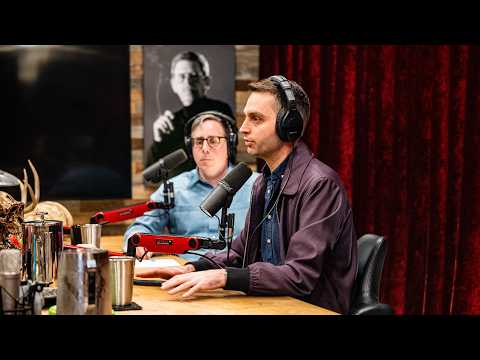
Joe Rogan Experience #2466 - Francis Foster & Konstantin Kisin
Joe Rogan (host), Konstantin Kisin (guest), Francis Foster (guest)
In this episode of The Joe Rogan Experience, featuring Joe Rogan and Konstantin Kisin, Joe Rogan Experience #2466 - Francis Foster & Konstantin Kisin explores rogan with Foster and Kisin on war, media, AI, truth Joe Rogan, Francis Foster, and Konstantin Kisin argue the world feels unusually unstable, focusing on the U.S./Israel–Iran conflict, fears of escalation, and how little reliable information the public actually has in real time.
Rogan with Foster and Kisin on war, media, AI, truth
Joe Rogan, Francis Foster, and Konstantin Kisin argue the world feels unusually unstable, focusing on the U.S./Israel–Iran conflict, fears of escalation, and how little reliable information the public actually has in real time.
They explore how “hot take culture,” propaganda, and selective reporting fuel conspiracy theories, using alleged false flags, shifting headlines, and the Mamdani-related bombing coverage as examples of narrative shaping.
The discussion broadens into domestic second-order effects (oil prices, cost-of-living pressure, political radicalization, civil liberties rollback) and the tension between needing security and preserving free speech/anonymity online.
They end with a deep concern that AI-generated content and robotics are rapidly collapsing the boundary between real and fake, potentially undermining journalism, democratic debate, and human “apex” status—while also touching on combat sports and media authenticity as a contrast to the broader “reality crisis.”
Key Takeaways
Information vacuums reliably breed conspiracies.
They argue that when governments and institutions provide limited or contradictory facts, people fill the gap with speculation—making false-flag narratives and sweeping blame claims spread faster than verified details.
Get the full analysis with uListen AI
Most confident “expert” takes are guesses during fast-moving conflict.
Kisin emphasizes that even insiders may not know outcomes; the public certainty is often performative, driven by tribal identity and the demand for immediate conclusions.
Get the full analysis with uListen AI
Regime change is easy to start and hard to finish.
Foster outlines how removing leadership can fracture states with armed factions and entrenched security forces (IRGC, secret police), risking Libya/Iraq-style disintegration rather than clean transitions.
Get the full analysis with uListen AI
The plausible ‘best case’ in Iran is not liberal democracy.
Kisin’s optimistic scenario is a “regime adjustment” toward a less expansionist, more economically focused authoritarian model—closer to Gulf monarchies than Western democratic ideals.
Get the full analysis with uListen AI
Energy prices can decide domestic politics and radicalize societies.
They connect oil spikes to immediate voter backlash (U. ...
Get the full analysis with uListen AI
Extremism is mirrored: Islamists and Christian end-times ideologues both distort policy.
They distinguish Islamism from mainstream Muslims, while also warning about a “kooky” strain of Christian nationalism that frames Middle East conflict as prophecy and treats catastrophe as desirable.
Get the full analysis with uListen AI
Media framing isn’t just bias—it can change perceived perpetrators and victims.
Their CNN example (“normal day… then arrested for throwing homemade bombs”) is used to argue that wording choices can soften terrorism, shift sympathy, and implicitly recast who initiated violence.
Get the full analysis with uListen AI
AI is collapsing trust in evidence faster than institutions can adapt.
From disputed protest images to robot videos that look real, they argue we’re entering an era where authentic footage is indistinguishable from synthetic—threatening journalism, accountability, and public consensus.
Get the full analysis with uListen AI
Bot farms and monetized outrage create ‘synthetic consensus.’
They claim engagement metrics are increasingly shaped by paid posters, AI accounts, and foreign influence—making public opinion look more extreme and more popular than it truly is.
Get the full analysis with uListen AI
Crisis-driven security policies rarely roll back fully.
They cite the Patriot Act and airport restrictions as examples of temporary measures becoming permanent, warning that major attacks could be used to justify digital ID, surveillance expansion, and speech limits.
Get the full analysis with uListen AI
Notable Quotes
“We don't know a fucking thing about what's going on—the coin is in the air.”
— Konstantin Kisin
“When you have an absence of information… that’s where conspiracies naturally flourish.”
— Francis Foster
“You can't go boots on the ground, man. You can't.”
— Konstantin Kisin
“That’s what scares the shit out of me… we’re living in a world where we can’t tell what’s real.”
— Joe Rogan
“If AI has a survival instinct… we are not going to be its number one priority.”
— Konstantin Kisin
Questions Answered in This Episode
On what specific evidence do analysts base the ‘false flag’ claims around Aramco or Cyprus, and what would falsify those claims?
Joe Rogan, Francis Foster, and Konstantin Kisin argue the world feels unusually unstable, focusing on the U. ...
Get the full analysis with uListen AI
What does a realistic U.S. ‘end state’ in Iran look like if liberal democracy is off the table—who governs, and how is stability enforced?
They explore how “hot take culture,” propaganda, and selective reporting fuel conspiracy theories, using alleged false flags, shifting headlines, and the Mamdani-related bombing coverage as examples of narrative shaping.
Get the full analysis with uListen AI
How would an Iran conflict plausibly stay limited if oil infrastructure or the Strait of Hormuz is threatened—what are the off-ramps?
The discussion broadens into domestic second-order effects (oil prices, cost-of-living pressure, political radicalization, civil liberties rollback) and the tension between needing security and preserving free speech/anonymity online.
Get the full analysis with uListen AI
What’s the strongest argument that Gulf states were already aligned against Iran, making “dragging them in” via false flags unnecessary?
They end with a deep concern that AI-generated content and robotics are rapidly collapsing the boundary between real and fake, potentially undermining journalism, democratic debate, and human “apex” status—while also touching on combat sports and media authenticity as a contrast to the broader “reality crisis.”
Get the full analysis with uListen AI
Which media incentives most drive misleading framing: political bias, engagement economics, legal risk, or editorial culture?
Get the full analysis with uListen AI
Transcript Preview
Joe Rogan Podcast, check it out.
The Joe Rogan Experience.
Train by day, Joe Rogan Podcast by night. All day. [upbeat rock music]
Okay, so when we scheduled this, like, there was nothing happening.
[chuckles]
The world was so peaceful.
Every time we're here-
[laughs]
... something crazy is going on, man.
Yeah, uh, maybe we manifest it. I don't know.
To be honest, it did s- 2026 did start with a bang.
Yeah.
Yeah.
Yeah. Well, a lot of things, you know... It's just nothing seems stable everywhere. Everywhere in the world seems fucked right now. Like, this is the like, in all of my years, this seems the most unstable globally. Like, I never worried that the UK was gonna be, like, complete chaos-
Mm
... arresting 12,000 people for social media posts-
Mm
... and, uh, abandoning trial by jury, all that, all that shit. I never thought the Ukraine-Russia war would go on this long.
Mm.
Never thought.
Mm.
Never thought they would just continue bombing Gaza, and then what's happening now? They just sort of stop, and now they're talking about putting a resort there.
[laughs]
[laughs]
What? Are you...
[laughs]
Like, you hear that, and you go, "Are you fucking serious?"
Right.
Tim Dillon has a g- I wanna, I wanna, I won't give the bit away. He has a fucking phenomenal bit about staying in that resort. [laughs]
[laughs]
[laughs]
Yeah, and you boys have been busy as well, Joe.
Yeah, and then, you know, I was gonna get to that.
[laughs]
The embarrassing part. Uh, uh, w- in the middle of Ramadan, you take out the leader of a Muslim country, and, uh-
They're hangry already, and you're fucking with it.
Well, no.
[laughs]
[laughs]
They're... Really, yeah.
They're hangry.
They can't even drink water.
Right.
Yeah.
And then, you know, uh, I was listening to Tim Dillon's podcast today. Uh, he's got a great podcast with, uh, Ryan Grim and one other gentleman. But one of the things that they br- brought up was that some of these drone attacks, it doesn't even seem like they're from Iran, some of these drone attra- attacks on Gulf states.
Mm.
Like that, the, one of them, um... I, I don't wanna speak out of tune, 'cause, out of turn, 'cause I don't, I'm don't, I'm not exactly sure which ones they're talking about, but they're talking about one of them on, um, either it's a oil refinery, I think it is an oil refinery, that it doesn't seem like it came from Iran.
Mm.
So, okay-
Where did it come from?
That's a good question.
One of their proxies?
That's a good question.
Mm-hmm.
Well, the, the fear is a false flag.
Mm.
That's the fear.
Mm, mm.
Like, if you really wanted to get really scared of what we were dragged into-
Mm
... you're dragged into an ally that's not telling you the truth and is also doing some other stuff.
Install uListen to search the full transcript and get AI-powered insights
Get Full TranscriptGet more from every podcast
AI summaries, searchable transcripts, and fact-checking. Free forever.
Add to Chrome