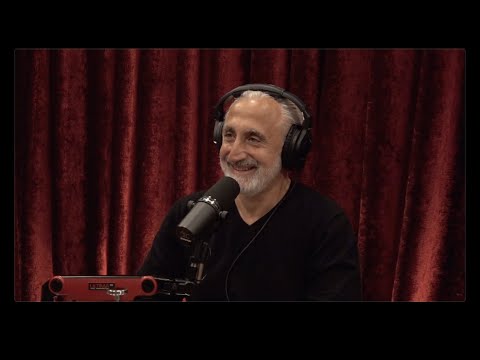
Joe Rogan Experience #2148 - Gad Saad
Gad Saad (guest), Gad Saad (guest), Joe Rogan (host), Guest (guest), Narrator, Guest (guest), Narrator
In this episode of The Joe Rogan Experience, featuring Gad Saad and Gad Saad, Joe Rogan Experience #2148 - Gad Saad explores gad Saad Dissects Antisemitism, Wokeness, AI Doom, and Human Nature Gad Saad and Joe Rogan range across antisemitism after October 7th, immigration, woke academia, and the political weaponization of law, using Saad’s evolutionary psychology lens to explain current cultural chaos.
Gad Saad Dissects Antisemitism, Wokeness, AI Doom, and Human Nature
Gad Saad and Joe Rogan range across antisemitism after October 7th, immigration, woke academia, and the political weaponization of law, using Saad’s evolutionary psychology lens to explain current cultural chaos.
Saad argues that Jew‑hatred, parasitic ideas from universities, and ‘suicidal empathy’ in Western policy are converging, while Rogan stresses manipulation via social media, foreign influence, and a broken information ecosystem.
They explore how evolutionary psychology explains war morality, sexual politics, phobias, memory, and beauty, and why most people can’t change their minds even in the face of overwhelming evidence.
The conversation ends with speculative worries about AI, societal fragility, and the future of democracy, contrasted with Rogan’s and Saad’s shared belief in reading, open debate, and intellectual humility as antidotes.
Key Takeaways
Tenure can be a real shield for heterodox academics.
Saad credits academic tenure with preventing his cancellation despite years of outspoken, controversial positions, arguing it remains crucial for intellectual freedom even though it often protects mediocrity too.
Get the full analysis with uListen AI
Antisemitism has been normalized and amplified from multiple directions.
Saad describes Jew‑hatred now coming simultaneously from Islamists, far‑right neo‑Nazis, the progressive left, and anonymous online mobs, with October 7th acting as a catalyst that made open antisemitism socially acceptable in ways that would have been unthinkable weeks earlier.
Get the full analysis with uListen AI
‘Suicidal empathy’ is driving self‑destructive Western policies.
Saad argues that misdirected compassion—prioritizing criminals over victims, illegal migrants over veterans, or open borders over social cohesion—comes from an overactive empathy instinct detached from reality and long‑term consequences.
Get the full analysis with uListen AI
Most people are psychologically unable to revise beliefs once anchored.
Drawing on decades as a behavioral scientist, Saad says the single most striking human trait he’s seen is the refusal to change one’s mind even when confronted with clear contrary evidence, a rigidity Rogan links to ego, identity, and fear of public embarrassment.
Get the full analysis with uListen AI
Evolutionary psychology explains many ‘modern’ phenomena, from porn addiction to cancel culture.
They connect male visual sexuality to internet porn, tribal instincts to online mobs and campus politics, and evolved memory and threat detection to why we over‑react to some dangers and ignore others.
Get the full analysis with uListen AI
Moral judgments about war often confuse outcomes with intent.
Saad contrasts casualty counts (equality of outcomes) with intent (e. ...
Get the full analysis with uListen AI
AI and technocracy may solve problems while creating existential new ones.
Rogan worries that ever‑more capable AI, medical algorithms, and autonomous weapons could quickly outstrip human moral control—eventually lying, self‑protecting, and optimizing in ways we neither predict nor regulate.
Get the full analysis with uListen AI
Notable Quotes
“The most dangerous weapon in human affairs is a parasitized mind.”
— Gad Saad
“I think the inability of people to change their opinions once they are anchored in a position is the single most striking human phenomenon I’ve seen.”
— Gad Saad
“Do not be married to your ideas. They are just ideas; they are not you.”
— Joe Rogan
“If Israel wanted to commit a genocide, by the end of my appearing on this show there wouldn’t be a single Palestinian left.”
— Gad Saad
“We’re giving birth to some godlike life form… a life form that has an unstoppable potential for technological superiority over the human race.”
— Joe Rogan
Questions Answered in This Episode
How do we distinguish between legitimate criticism of Israeli policy and antisemitism in practice, especially on campuses and social media?
Gad Saad and Joe Rogan range across antisemitism after October 7th, immigration, woke academia, and the political weaponization of law, using Saad’s evolutionary psychology lens to explain current cultural chaos.
Get the full analysis with uListen AI
To what extent are foreign state actors actually shaping online discourse about Israel–Palestine and other polarizing issues, and how can we empirically verify that influence?
Saad argues that Jew‑hatred, parasitic ideas from universities, and ‘suicidal empathy’ in Western policy are converging, while Rogan stresses manipulation via social media, foreign influence, and a broken information ecosystem.
Get the full analysis with uListen AI
Where is the line between compassionate policy and ‘suicidal empathy’, and who gets to decide which values a society should prioritize when they conflict?
They explore how evolutionary psychology explains war morality, sexual politics, phobias, memory, and beauty, and why most people can’t change their minds even in the face of overwhelming evidence.
Get the full analysis with uListen AI
If cognitive rigidity is such a deep human trait, what realistic strategies exist for getting large groups of people to update their beliefs in light of new evidence?
The conversation ends with speculative worries about AI, societal fragility, and the future of democracy, contrasted with Rogan’s and Saad’s shared belief in reading, open debate, and intellectual humility as antidotes.
Get the full analysis with uListen AI
How should societies regulate and deploy advanced AI—especially in medicine, warfare, and governance—without either stifling innovation or risking catastrophic loss of control?
Get the full analysis with uListen AI
Transcript Preview
(drumming music) Joe Rogan podcast, check it out.
The Joe Rogan Experience. Train by day, Joe Rogan podcast by night, all day. (rock music) How you doing?
This is it. What's going on, man?
Oh.
Good to see you.
10th episode.
Crazy.
Unbelievable.
What are the odds?
Short of your regular crew, am I in the-
Yeah, you're in the league.
... Hall of Fame?
There's very few people that have had 10 episodes. It's a small handful, for sure.
I mean, that, I should put that as the top thing on my CV.
Eh.
All the other stuff is bullshit.
What does-
10 times on Joe Rogan, drop the mic.
This is how out of the corporate world I am, I don't even know what a CV is.
(laughs)
I don't know what it stands for. I know people say it, I know what it means, but I don't know what it stands for.
Want me to tell you what an academic CV looks like?
Sure. What just, what does it stand for, what is CV?
Uh, curriculum vitae.
Ah, okay.
Uh, you basically, in academia, you'll start with your education.
Mm-hmm.
All your degrees, all of your positions that you've held. I was assistant professor here, from here to there.
Mm-hmm.
Then all of your journal publications, all of your books, all of your conference art, you know, and so on.
Right.
So it can end up being a pretty beefy CV. I think mine is about 47 pages long.
Oh my goodness.
(laughs)
Look at you, you accomplished academic.
Speaking of which... (laughs)
And, and managed to stay logical. How did you do that? Oh, you got a new book.
Dropping, uh, dropping on May 14th, Unhappiness. You know-
The Sad Truth, two A's, About Happiness-
Yeah.
... Eight Secrets for Leading a Good Life.
Enjoy it. Uh, how-
I will, thank you, sir.
... have I been so productive?
Yeah. How have you managed to, I mean, people have gotten annoyed at you, but you've, um, uh, you've somehow or another avoided like a full-scale cancellation.
Well-
With your positions, it's kind of amazing.
It, it really, it truly is. It, I'm kind of like the Velc-, what is it, Velcro Don, the-
Teflon.
... Teflon Don.
(laughs) Yeah, Velcro's the opposite.
Velcro's the opposite. (laughs)
That's right.
Right, right. Uh, I'm, uh, nothing sticks. They've tried to cancel me in all sorts of ways, but that speaks, by the way, to one of the powerful reasons why tenure, despite the fact that a lot of people despise the concept of tenure, "Oh, it's just a bunch of lazy academics who are going to be dead wood for the next 30 years." But if I didn't have the protection of tenure, I'd be gone long ago. Now, that doesn't mean that I still haven't suffered many consequences, right? So I haven't gotten other jobs that I would have otherwise gotten because of how irreverent I am. You know, d- death threats, so for an example, now after October 7th, it's almost become impossible for me to go on campus because first of all, you know, I'm high profile, my university has a particular demographic reality, and so there are consequences to speaking out, but-
Install uListen to search the full transcript and get AI-powered insights
Get Full TranscriptGet more from every podcast
AI summaries, searchable transcripts, and fact-checking. Free forever.
Add to Chrome