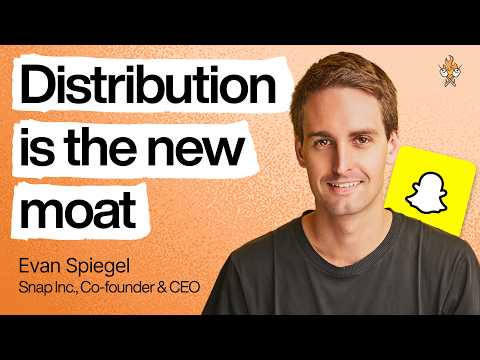
Snapchat CEO: Why distribution has become the most important moat | Evan Spiegel
Lenny Rachitsky (host), Evan Spiegel (guest)
In this episode of Lenny's Podcast, featuring Lenny Rachitsky and Evan Spiegel, Snapchat CEO: Why distribution has become the most important moat | Evan Spiegel explores evan Spiegel on distribution moats, design velocity, and AR hardware future Spiegel argues that most consumer founders over-index on product-market fit while underestimating distribution, which is increasingly the decisive constraint for new social products.
Evan Spiegel on distribution moats, design velocity, and AR hardware future
Spiegel argues that most consumer founders over-index on product-market fit while underestimating distribution, which is increasingly the decisive constraint for new social products.
Snap’s early breakthrough was prioritizing “close friends” utility over sheer network size, creating value by connecting users to the right people rather than all people.
After learning that “software is not a moat” due to constant cloning, Snap pursued more defensible moats via ecosystems (creators, developers, AR platform) and vertically integrated hardware.
Snap’s innovation engine relies on a tiny, flat design team with extremely high output and critique velocity, with design intentionally serving as a bottleneck to ensure cohesion.
Spiegel frames 2025 as a “crucible moment” to prove profitability and business durability while launching Specs, and he warns AI adoption will be constrained by human comfort and societal pushback.
Key Takeaways
Distribution is the bottleneck most consumer teams misjudge.
Spiegel claims teams fixate on product-market fit but fail to plan for how users will discover and adopt the product in a world where people download fewer new apps.
Get the full analysis with uListen
“Right people” beats “more people” in social value creation.
Snap grew by optimizing for connection with close friends (best friend/partner) rather than trying to out-scale incumbents on total network size.
Get the full analysis with uListen
Assume features will be copied; build moats around ecosystems and platforms.
Snap shifted toward creator/developer ecosystems (e. ...
Get the full analysis with uListen
Hardware can be a defensibility strategy when paired with a vertically integrated stack.
Specs is positioned not as a notification HUD but as world-anchored AR that enables new interaction patterns, and the stack depth makes fast-follow copying harder.
Get the full analysis with uListen
Innovation at scale requires two org “modes” and leadership that mediates them.
Citing Loonshots, Spiegel describes the need to balance a structured, operational org for reliability with a flat, risk-tolerant group for invention—then actively manage the tension between them.
Get the full analysis with uListen
Design velocity is a force multiplier for originality.
Snap’s tiny design team produces hundreds of ideas weekly; Spiegel’s mantra is “If you wanna have a good idea, you have to have lots of ideas,” reinforced by constant critique.
Get the full analysis with uListen
Make design an intentional bottleneck to preserve product coherence.
Even if it slows shipping, requiring design approval helps avoid a fragmented experience caused by siloed teams optimizing local surfaces without a cohesive through-line.
Get the full analysis with uListen
Talk to customers deeply, but don’t build exactly what they request.
Spiegel rejects “don’t talk to users,” arguing long-form conversations yield insight; Stories emerged by interpreting “send all” requests and social pressure signals into a different solution.
Get the full analysis with uListen
AI increases creative throughput, but scaling requires guardrails and workflow-level agents.
Snap is enabling designers to ship code while using automated review, bug detection, and debugging agents; they also organize AI transformation via jobs-to-be-done to keep experimentation tied to outcomes.
Get the full analysis with uListen
AI strategy should prioritize humanity and adoption constraints, not just capability.
Spiegel predicts societal resistance if AI deployments ignore comfort, norms, and human goals, making “humanity first” a competitive and ethical necessity.
Get the full analysis with uListen
Notable Quotes
“People don't spend nearly enough time thinking about distribution and figuring out distribution.”
— Evan Spiegel
“Fifteen years ago, we essentially learned that software is not a moat, which is something that everyone is discovering today with AI.”
— Evan Spiegel
“If you wanna have a good idea, you have to have lots of ideas.”
— Evan Spiegel
“Design actually has always operated as like a bottleneck at the company... that’s what results in a cohesive customer experience.”
— Evan Spiegel
“Humanity is far more important, because humanity dictates how technology is adopted.”
— Evan Spiegel
Questions Answered in This Episode
If distribution is the biggest moat, what concrete distribution “plays” would you recommend to a new consumer startup with no existing network?
Spiegel argues that most consumer founders over-index on product-market fit while underestimating distribution, which is increasingly the decisive constraint for new social products.
Get the full analysis with uListen AI
On the ‘close friends’ insight: what specific product mechanics made Snapchat feel close-friend-first, and what common mistakes cause new apps to feel broadcasty?
Snap’s early breakthrough was prioritizing “close friends” utility over sheer network size, creating value by connecting users to the right people rather than all people.
Get the full analysis with uListen AI
You said ecosystems are harder to copy than features—what were the most important early steps Snap took to make AR lenses a true platform (not just a feature)?
After learning that “software is not a moat” due to constant cloning, Snap pursued more defensible moats via ecosystems (creators, developers, AR platform) and vertically integrated hardware.
Get the full analysis with uListen AI
Specs avoids notification HUD use cases; what are the 2–3 killer multi-player or world-anchored experiences you believe will drive repeat daily use?
Snap’s innovation engine relies on a tiny, flat design team with extremely high output and critique velocity, with design intentionally serving as a bottleneck to ensure cohesion.
Get the full analysis with uListen AI
How do you decide what belongs in software vs what must be solved through hardware/vertical integration to be defensible?
Spiegel frames 2025 as a “crucible moment” to prove profitability and business durability while launching Specs, and he warns AI adoption will be constrained by human comfort and societal pushback.
Get the full analysis with uListen AI
Transcript Preview
You guys have a billion monthly active users. Why is it so freaking hard to build a durable, lasting social consumer product?
So much of consumer technology focuses on, do I have product market fit? People don't spend nearly enough time thinking about distribution and figuring out distribution.
I feel like Snap has always been punching above its weight in terms of just how much new stuff comes out of your team. Stories, AR glasses, swipe-based navigation.
We have a very, very small design team that is constantly innovating and, and creating new things. Your first day that you join the design team, you present work. You're making things. If you wanna have a good idea, you have to have lots of ideas.
People copy you. As a human, how does it feel just to see this consistently happen?
Fifteen years ago, we essentially learned that software is not a moat, which is something that everyone is discovering today with AI.
You describe this coming year as the crucible moment.
It's a real turning point. We're in an industry where so much of the conversation is focused on technology. Humanity is far more important, because humanity dictates how technology is adopted. Technology leaders think that folks will just blindly adopt new technology as it comes out. There's gonna be a huge amount of societal pushback on a lot of the changes that are coming with AI. [gentle music]
Today my guest is Evan Spiegel, CEO and co-founder of Snap. Evan is one of the very few humans in the world who has successfully built and scaled a lasting consumer social app. In the 15 years since Snapchat launched, there are essentially zero social consumer apps that have launched and stuck around. Snapchat has over one billion monthly active users, is generating over six billion dollars a year in revenue, people post over eight billion AR lens photos a day on Snapchat. And over the years, Evan and his team have invented the concept of Stories, they had the first AR glasses product in the market, they invented swipe-based navigation, the camera being primary, and also back in the day, face swapping, making people look older, and so many of the things that are just copied throughout the entire industry. If this is truly the golden age of consumer products, like many people say AI is going to enable, there's a lot that we can learn about how Evan and his team think and operate and are able to continue innovating. This is a rare podcast interview with Evan, and we cover a lot of ground. Before we get into it, don't forget to check out lennysproductpass.com for a year free of the hottest and most well-crafted AI products in the world, available exclusively to Lenny's newsletter subscribers. With that, I bring you Evan Spiegel. [gentle music] Evan, thank you so much for being here. Welcome to the podcast.
Thank you so much. Thanks for having me. I'm looking forward to it.
Install uListen to search the full transcript and get AI-powered insights
Get Full TranscriptGet more from every podcast
AI summaries, searchable transcripts, and fact-checking. Free forever.
Add to Chrome