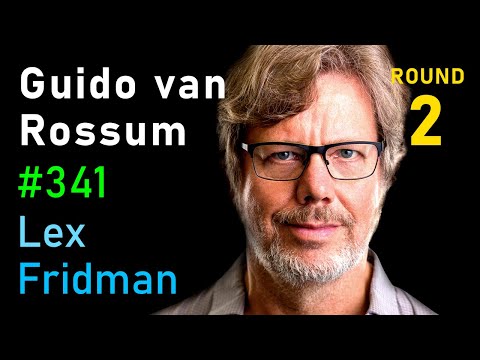
Guido van Rossum: Python and the Future of Programming | Lex Fridman Podcast #341
Lex Fridman (host), Guido van Rossum (guest), Guido van Rossum (guest)
In this episode of Lex Fridman Podcast, featuring Lex Fridman and Guido van Rossum, Guido van Rossum: Python and the Future of Programming | Lex Fridman Podcast #341 explores guido van Rossum on Python’s design, speed, types, and future Guido van Rossum and Lex Fridman explore Python’s design philosophy, from readability and indentation to dynamic typing and optional static type hints. They dig into major performance work in CPython 3.11, explaining how adaptive, specializing bytecode interpretation speeds up common operations without a JIT. The conversation compares concurrency models, the global interpreter lock (GIL), async I/O, and possible futures such as sub-interpreters and a no‑GIL Python 4. They also discuss tooling (MyPy, IDEs, GitHub Copilot), why Python conquered scientific computing and machine learning, open‑source culture, and what it meant for Guido to step down as BDFL.
Guido van Rossum on Python’s design, speed, types, and future
Guido van Rossum and Lex Fridman explore Python’s design philosophy, from readability and indentation to dynamic typing and optional static type hints. They dig into major performance work in CPython 3.11, explaining how adaptive, specializing bytecode interpretation speeds up common operations without a JIT. The conversation compares concurrency models, the global interpreter lock (GIL), async I/O, and possible futures such as sub-interpreters and a no‑GIL Python 4. They also discuss tooling (MyPy, IDEs, GitHub Copilot), why Python conquered scientific computing and machine learning, open‑source culture, and what it meant for Guido to step down as BDFL.
Key Takeaways
Readability and consistent style are core to Python’s identity.
Guido emphasizes that Python was designed for humans first: indentation-as-syntax, four-space blocks, and PEP 8 all exist to make code easier for teams to read, debug, and evolve over time—not just to satisfy the interpreter.
Get the full analysis with uListen AI
CPython 3.11 is faster by specializing common operations at runtime.
Without adding a JIT, 3. ...
Get the full analysis with uListen AI
Python’s type hints are for tools and humans, not the runtime.
PEP 484-style annotations are optional metadata consumed by static type checkers such as MyPy, Pyright, and Pytype; the interpreter currently ignores them for performance and backward‑compatibility reasons, though they may inform optimizations in the future.
Get the full analysis with uListen AI
Concurrency is conceptually hard; the GIL is a practical compromise.
Humans are bad at reasoning about multiple threads sharing mutable state, so Python’s global interpreter lock simplifies the runtime model: it limits true CPU‑parallelism in one process but avoids many subtle, hard‑to‑debug concurrency errors.
Get the full analysis with uListen AI
Async I/O in Python was deliberately designed around tasks, not callbacks.
Guido favored a task/coroutine model over callback-based APIs, using language support (async/await) to let developers write sequential-looking code that can interleave I/O-bound work efficiently without spawning OS threads.
Get the full analysis with uListen AI
If Python 4 happens, it will be about runtime changes, not syntax shock.
Given the pain of the 2→3 transition, Guido imagines a Python 4. ...
Get the full analysis with uListen AI
Python dominates scientific computing because it sits atop fast native code.
Libraries like NumPy, SciPy, pandas, TensorFlow, and PyTorch put heavy numeric work in optimized C/Fortran/C++ while exposing a clean, expressive Python interface, letting scientists and ML engineers share tools and focus on high-level logic.
Get the full analysis with uListen AI
Notable Quotes
“Even the mad scientist sitting alone in his lab can’t type fast enough to remember what his code means later, so readability still matters.”
— Guido van Rossum
“Python is always called an interpreted language, but there’s also a compiler in there—it just compiles to bytecode for an imaginary machine.”
— Guido van Rossum
“The GIL is actually a pretty nice Goldilocks point between no threads and all threads all the time.”
— Guido van Rossum
“You can’t expect to learn Python from a one-hour video. You have to practice; memorizing the syntax doesn’t make you a coder.”
— Guido van Rossum
“Eventually Python will become a legacy language that permeates everything, like mitochondria in biology—fundamental, but most people won’t know it’s there.”
— Guido van Rossum
Questions Answered in This Episode
How might Python’s runtime eventually take advantage of type hints for optimization without breaking the language’s dynamic nature?
Guido van Rossum and Lex Fridman explore Python’s design philosophy, from readability and indentation to dynamic typing and optional static type hints. ...
Get the full analysis with uListen AI
In what real-world workloads would a no‑GIL Python deliver transformative benefits, and are those benefits worth the added complexity?
Get the full analysis with uListen AI
How should a new programmer today think about choosing a primary language and ecosystem, given the rapid pace of change in tools and frameworks?
Get the full analysis with uListen AI
Could the async/await and task-based model eventually replace most multi-threaded code in Python, or will both paradigms coexist indefinitely?
Get the full analysis with uListen AI
What lessons from Python’s 2-to-3 transition should other language communities heed when planning major breaking changes?
Get the full analysis with uListen AI
Transcript Preview
Can you imagine possible features that Python 4.0 might have that would necessitate the creation of the new 4.0, given the amount of pain and joy, suffering and triumph-
Mm-hmm.
... that was involved in the move between version two and version three? The following is a conversation with Guido van Rossum, his second time on this podcast. He is the creator of the Python programming language and is Python's emeritus BDFL, benevolent dictator for life. This is the Lex Fridman podcast. To support it, please check out our sponsors in the description and now, dear friends, here's Guido van Rossum. Python 3.11 is coming out very soon, in it, CPython claimed to be 10 to 60% faster. How'd you pull that off? And what's CPython?
CPython is the last Python implementation standing, also the first one that was ever created. The original Python implementation that I started over 30 years ago.
So what does it mean that Python, the programming language, is implemented in another programming language called C?
What kind of audience do you have in mind here?
Uh...
People who know programming or-
No. There's somebody on a boat that's into fishing and they've never heard about programming but also some world-class programmers. You're gonna have to speak to both. Imagine a boat with two people, one of them has not heard about programming and is really into fishing and the other one is like a- an incredible Silicon Valley programmer that's programmed in everything, C, C++, Python, Rust, Java, and knows the entire history of programming languages so you're gonna have to speak to both.
I imagine that boat in the middle of the ocean-
Yes.
... I'm- I'm gonna please the guy who knows how to fish first (laughs) .
Yes, please (laughs) . He seems like the most useful in the middle of the ocean, you got- (laughs) you gotta make him happy.
I'm sure he has a cellphone so, uh-
(laughs)
... he's probably very suspicious about what goes on in that cellphone but he must have heard that inside a cellphone is a tiny computer. And a programming language is computer code that tells the computer what to do.
It's a very low level language, it's zeros and ones and then there's assembly and then-
Oh, yeah. But we- we don't talk about these really low levels because those just confuse people. I mean, when we're talking about human language, we're not usually talking about vocal tracts and how you position your tongue. I was talking yesterday about how when you have a Chinese person and they speak English, uh, there's- there's a bit of a stereotype, they often don't know... Or they- they can't- can't seem to make the difference well between an L and an R.
Mm-hmm.
And I have a theory about that and I've never checked this with linguists, uh, that it probably has to do with the fact that in Chinese there is not really a difference and it could be that there are regional variations in how Chi- native Chinese speakers pronounce that one sound that sounds to L to some... Like L to some of them, like R to others.
Install uListen to search the full transcript and get AI-powered insights
Get Full TranscriptGet more from every podcast
AI summaries, searchable transcripts, and fact-checking. Free forever.
Add to Chrome