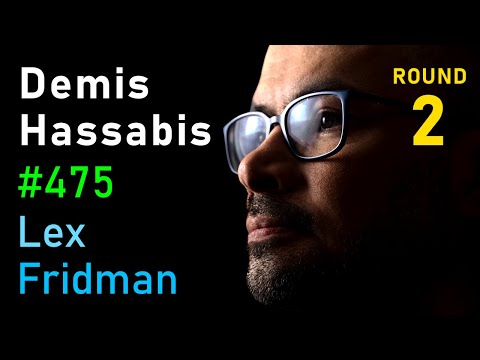
Demis Hassabis: Future of AI, Simulating Reality, Physics and Video Games | Lex Fridman Podcast #475
Lex Fridman (host), Demis Hassabis (guest), Narrator
In this episode of Lex Fridman Podcast, featuring Lex Fridman and Demis Hassabis, Demis Hassabis: Future of AI, Simulating Reality, Physics and Video Games | Lex Fridman Podcast #475 explores demis Hassabis maps AI’s future: nature, games, AGI, civilization’s fate Demis Hassabis discusses a sweeping vision of AI as a classical learning process that can efficiently model most structured phenomena in nature, from protein folding and weather to potential simulations of cells and even the origin of life.
Demis Hassabis maps AI’s future: nature, games, AGI, civilization’s fate
Demis Hassabis discusses a sweeping vision of AI as a classical learning process that can efficiently model most structured phenomena in nature, from protein folding and weather to potential simulations of cells and even the origin of life.
He argues that modern neural networks reveal deep structure in reality—intuitive physics, world models, and emergent capabilities—and that AGI built on such systems could radically accelerate science, energy breakthroughs, and human flourishing.
The conversation explores AGI timelines, safety, self-improving systems, and the balance between scaling compute and discovering new algorithms, alongside how AI will reshape video games, work, economics, and even politics.
Lex Fridman and Hassabis also reflect on human uniqueness, consciousness, meaning, and the need for cautious optimism, global cooperation, and a humanistic perspective as AI approaches transformative capabilities.
Key Takeaways
Nature’s structure makes many ‘intractable’ problems learnable by classical AI.
Hassabis conjectures that any pattern evolved or shaped by natural processes has exploitable structure, so a neural net can learn a lower-dimensional manifold rather than brute-forcing an astronomically large space, as seen with AlphaGo, AlphaFold, and weather models.
Get the full analysis with uListen AI
Modern models are acquiring ‘intuitive physics’ purely from passive video.
Systems like Veo 3 generate highly realistic liquid behavior, lighting, and materials by training on internet video, suggesting they’ve internalized dynamic rules of the world without robotics or embodiment—challenging the belief that action is required for physical understanding.
Get the full analysis with uListen AI
Hybrid systems that combine foundation models with search or evolution are powerful.
AlphaEvolve and related work show that LLMs proposing candidates plus evolutionary search or Monte Carlo tree search can yield novel algorithms, indicating that creativity in science and code may come from stacking optimization layers on top of learned models.
Get the full analysis with uListen AI
AGI will likely require both scaling and a few more conceptual breakthroughs.
Hassabis sees strong returns from scaling compute, data, and inference-time ‘thinking,’ but also expects at least one or two AlphaGo- or Transformer-level ideas; Google DeepMind is explicitly pursuing both brute-force scaling and blue-sky research in parallel.
Get the full analysis with uListen AI
A true AGI must show broad, consistent competence—and deep originality.
His bar for AGI includes matching human cognitive breadth without ‘jagged’ weaknesses plus landmark feats like inventing an Einstein-level theory from a 1900 knowledge cutoff or creating a game as elegant and deep as Go, not just solving benchmark tests.
Get the full analysis with uListen AI
AI could revolutionize biology via full-cell simulations and origin-of-life models.
Building on AlphaFold and AlphaFold 3, Hassabis outlines a ‘Virtual Cell’ project that would simulate all key molecular interactions in a yeast cell to 100× lab productivity, and later possibly simulate emergent life from a primordial chemical soup.
Get the full analysis with uListen AI
Civilization may enter an era of radical abundance if AI cracks energy.
He anticipates AI-accelerated breakthroughs in fusion, solar materials, batteries, and grid optimization, which could make clean energy effectively free, transform water, spaceflight, and resource scarcity, and help humanity approach a Type I civilization.
Get the full analysis with uListen AI
Notable Quotes
“Anything that can be evolved can be efficiently modeled.”
— Demis Hassabis
“In a way, that’s what I want to build AGI for—to help us, as scientists, answer these questions like P equals NP.”
— Demis Hassabis
“I think we haven’t even scratched the surface yet of what a classical system could do.”
— Demis Hassabis
“For the next era, I think people who really embrace these technologies will become almost superhumanly productive.”
— Demis Hassabis
“Given the uncertainty and the importance, the only rational approach is cautious optimism.”
— Demis Hassabis
Questions Answered in This Episode
If most natural systems are learnable by classical AI, what kinds of phenomena do you suspect will remain fundamentally out of reach—and how would we recognize them?
Demis Hassabis discusses a sweeping vision of AI as a classical learning process that can efficiently model most structured phenomena in nature, from protein folding and weather to potential simulations of cells and even the origin of life.
Get the full analysis with uListen AI
What concrete experiments would convincingly show that a model like Veo 3 has a genuine ‘world model’ rather than an incredibly rich but shallow pattern-matching surface?
He argues that modern neural networks reveal deep structure in reality—intuitive physics, world models, and emergent capabilities—and that AGI built on such systems could radically accelerate science, energy breakthroughs, and human flourishing.
Get the full analysis with uListen AI
How would a Virtual Cell or origin-of-life simulation practically change drug discovery, medicine, and our philosophical understanding of life and death?
The conversation explores AGI timelines, safety, self-improving systems, and the balance between scaling compute and discovering new algorithms, alongside how AI will reshape video games, work, economics, and even politics.
Get the full analysis with uListen AI
What governance or institutional structures could realistically prevent a ‘Manhattan Project 2.0’ dynamic with AGI while still allowing intense innovation and competition?
Lex Fridman and Hassabis also reflect on human uniqueness, consciousness, meaning, and the need for cautious optimism, global cooperation, and a humanistic perspective as AI approaches transformative capabilities.
Get the full analysis with uListen AI
As AI absorbs more cognitive labor, what new forms of human mastery and meaning do you personally expect—or hope—to see emerge in work, games, and daily life?
Get the full analysis with uListen AI
Transcript Preview
It's hard for us humans to make any kind of clean predictions about highly non-linear dynamical systems. But again, to your point, we might be very surprised what classical learning systems might be able to do about even fluid.
Yes, exactly. I mean, fluid dynamics, Navier–Stokes equations, these are traditionally thought of as very, very difficult, intractable problems to do on classical systems. They take enormous amounts of compute, you know, weather prediction systems. You know, these kind of things all involve fluid dynamics calculations. But again, if you look at something like Veo, our video generation model, it can model liquids quite well, surprisingly well, and materials, specular lighting. I love the ones where, you know, there's, there's people who generate videos where there's, like, clear liquids going through hydraulic presses and then s- being squeezed out. I, I used to write, uh, physics engines and graphics engines in, in my early days in gaming. And I know, uh, it's just so painstakingly hard to build programs that can do that, and yet somehow these systems are, you know, reverse engineering from just watching YouTube videos. So th- presumably what's happening is, it's extracting some underlying structure around how these materials behave. So perhaps there is some kind of lower dimensional manifold that can be learned if we actually fully understood what's going on under the hood. That's maybe, you know, maybe true of most of reality.
The following is a conversation with Demis Hassabis, his second time on the podcast. He is the leader of Google DeepMind and is now a Nobel Prize winner. Demis is one of the most brilliant and fascinating minds in the world today, working on understanding and building intelligence, and exploring the big mysteries of our universe. This was truly an honor and a pleasure for me. This is the Lex Fridman Podcast. To support it, please check out our sponsors in the description and consider subscribing to this channel. And now, dear friends, here's Demis Hassabis. In your Nobel Prize lecture, you proposed what I think is a super interesting conjecture, that, quote, "Any pattern that can be generated or found in nature can be efficiently discovered and modeled by a classical learning algorithm." What kind of patterns or systems might in- be included in that, biology, chemistry, physics, maybe cosmology-
Yeah.
... neuroscience? What, what are we talking about?
Sure. Well, look, uh, I felt that it's sort of a tradition, I think, of Nobel Prize lectures that you're supposed to be a little bit provocative, and I wanted to follow that tradition. What I was talking about there is, if you take a step back and you look at, um, all the work that we've done, especially with the AlphaX projects, so I'm thinking AlphaGo, of course AlphaFold, what they really are is, we're building models of very combinatorially high dimensional spaces that, you know, if you tried to brute force a solution, find the best move in Go, or find the, the exact shape of a protein, and if you enumerated all the possibilities, you'd... there wouldn't be enough time in the, in the, you know, the time of the universe. So, you have to do something much smarter. And what we did in both cases was build models of those environments, um, and that guided the search in a, in a smart way, and that makes it tractable. So if you think about protein folding, which is obviously a natural system, you know, why should that be possible? How does physics do that? You know, proteins fold in milliseconds in our bodies, so somehow physics solves this problem that we've now also solved computationally. And I think the reason that's possible is that in nature, natural systems have structure because they were subject to evolutionary processes that, that shaped them. And if that's true, then you can maybe learn, uh, uh, what that structure is.
Install uListen to search the full transcript and get AI-powered insights
Get Full TranscriptGet more from every podcast
AI summaries, searchable transcripts, and fact-checking. Free forever.
Add to Chrome