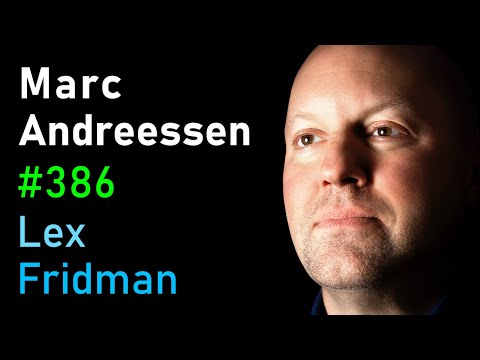
Marc Andreessen: Future of the Internet, Technology, and AI | Lex Fridman Podcast #386
Marc Andreessen (guest), Lex Fridman (host), Narrator, Narrator
In this episode of Lex Fridman Podcast, featuring Marc Andreessen and Lex Fridman, Marc Andreessen: Future of the Internet, Technology, and AI | Lex Fridman Podcast #386 explores marc Andreessen Defends AI, Warns Against Doom, Champions Open Future Marc Andreessen argues that AI is fundamentally an intelligence amplifier that will improve nearly every aspect of human life, from education and health to creativity and productivity. He is sharply critical of AI doomerism and “kill switch” regulation, comparing it to historical moral panics and warning that overregulation would do real, measurable harm while addressing speculative risks. A major theme is the inevitability and desirability of open, widely distributed AI—he believes attempts to tightly control it would require authoritarian measures and still fail. Throughout, he and Lex Fridman explore how AI will reshape search, the web, work, geopolitics, and truth itself, drawing lessons from nuclear history, the evolution of the internet, and Andreessen’s own experience building Mosaic and Netscape.
Marc Andreessen Defends AI, Warns Against Doom, Champions Open Future
Marc Andreessen argues that AI is fundamentally an intelligence amplifier that will improve nearly every aspect of human life, from education and health to creativity and productivity. He is sharply critical of AI doomerism and “kill switch” regulation, comparing it to historical moral panics and warning that overregulation would do real, measurable harm while addressing speculative risks. A major theme is the inevitability and desirability of open, widely distributed AI—he believes attempts to tightly control it would require authoritarian measures and still fail. Throughout, he and Lex Fridman explore how AI will reshape search, the web, work, geopolitics, and truth itself, drawing lessons from nuclear history, the evolution of the internet, and Andreessen’s own experience building Mosaic and Netscape.
Key Takeaways
AI will transform search from links to direct answers and assistants.
Andreessen expects traditional search interfaces (“ten blue links”) to be largely subsumed by conversational AI that directly answers questions and cites sources, turning the entire web into underlying content for AI rather than the primary user-facing layer.
Get the full analysis with uListen AI
Doomer claims about AI extinction lack scientific grounding but drive extreme policy proposals.
He argues that “AI will kill us all” scenarios are unfalsifiable, more religious than scientific, yet are already being used to justify ideas like bans, halts, and even talk of military strikes on data centers—policies he sees as vastly more dangerous than the speculative risk.
Get the full analysis with uListen AI
Open-source AI is both inevitable and essential to avoid authoritarian control.
Because AI is ultimately math, code, and widely available knowledge, suppressing open models would require pervasive surveillance and hardware control; instead, Andreessen advocates embracing open systems and focusing on defensive uses of AI rather than trying to outlaw capability.
Get the full analysis with uListen AI
Synthetic and self-generated data could be a decisive competitive edge.
Whether models can meaningfully improve by training on their own outputs or simulated multi-agent conversations is, in his view, a “trillion-dollar question” that could determine who wins the AI race and how far capabilities scale.
Get the full analysis with uListen AI
LLMs can debias and contextualize information, not just generate it.
He highlights how LLMs can strip sentiment and bias from news, present opposing arguments, and even host “debates” between viewpoints with tunable levels of tension, making them powerful tools for understanding contentious issues—if users remain critical about truth and hallucinations.
Get the full analysis with uListen AI
AI is likely to raise human “effective IQ” rather than mass-unemploy people.
Framing AI as augmentation, Andreessen predicts individuals will gain 140‑IQ-equivalent assistants, improving outcomes in education, work, and decision-making; he rejects static “lump of labor” thinking and points to history showing technology ultimately creates more and better jobs.
Get the full analysis with uListen AI
The biggest real AI risk is authoritarian regimes winning the AI race.
He believes China’s explicit plan to use AI for surveillance, social credit, and exportable digital infrastructure (the “Digital Silk Road”) is a concrete, near-term threat; if the West cripples its own AI sector through overregulation, it risks ceding technological and ideological ground.
Get the full analysis with uListen AI
Notable Quotes
“The competence and capability and intelligence and training and accomplishments of senior scientists and technologists working on a technology, and then being able to then make moral judgments in the use of that technology—that track record is catastrophically bad.”
— Marc Andreessen
“Hallucination is what we call it when we don’t like it. Creativity is what we call it when we do.”
— Marc Andreessen
“AI is going to be like air; it’s going to be everywhere. You can’t pull this back anymore—you just have to figure out how to live in this world.”
— Marc Andreessen
“Some people confess guilt to claim credit for the sin.”
— Marc Andreessen (quoting John von Neumann on Oppenheimer)
“Capitalism is how you take care of people you don’t know.”
— Marc Andreessen
Questions Answered in This Episode
Where should we draw the line between necessary safety constraints on AI systems and overreach that drifts into centralized thought control?
Marc Andreessen argues that AI is fundamentally an intelligence amplifier that will improve nearly every aspect of human life, from education and health to creativity and productivity. ...
Get the full analysis with uListen AI
If synthetic data and self-play do turn out to add real signal, how might that change the competitive landscape between incumbents and small open-source teams?
Get the full analysis with uListen AI
How can societies practically use AI to strengthen truth-seeking institutions (science, journalism, law) without empowering new gatekeepers to define “the truth”?
Get the full analysis with uListen AI
What specific policies could the U.S. and its allies adopt to stay ahead in AI while avoiding both catastrophic misuse and authoritarian regulation?
Get the full analysis with uListen AI
For an individual professional today, what concrete steps make sense to become a “hyperproductive” person using LLMs and other AI tools rather than being displaced by them?
Get the full analysis with uListen AI
Transcript Preview
... the competence and capability and intelligence and training and accomplishments of senior scientists and technologists working on a technology, and then being able to then make moral judgments in the use of that technology, that track record is terrible. That track record is catastrophically bad. The policies that are being called for to prevent this, I think were gonna cause extraordinary damage.
So, the moment you say, "AI is gonna kill all of us, therefore we should ban it or that we should-
Yeah.
... uh, regulate it," all that kinda stuff, that's when it starts getting serious?
Or start, you know, military airstrikes on data centers.
Oh, boy. The following is a conversation with Marc Andreessen, co-creator of Mosaic, the first widely used web browser, co-founder of Netscape, co-founder of the legendary Silicon Valley venture capital firm, Andreessen Horowitz, and is one of the most outspoken voices on the future of technology, including his most recent article, Why AI Will Save the World. This is a Lex Fridman podcast. To support it, please check out our sponsors in the description. And now, dear friends, here's Marc Andreessen. I think you're the right person to talk about the future of the internet and technology in general. Um, do you think we'll still have Google Search in five, in 10 years? Or search in general?
Yes. You know, it would be a question if the use cases have really narrowed down.
Well, now with AI-
Yeah.
... and AI assistants being able to interact and expose the entirety of human wisdom and knowledge and information and facts and truth to us via the, uh, natural language interface, it seems like that's what search is designed to do. And if AI assistants can do that better, doesn't the nature of search change?
Sure. But we still have horses.
Okay (laughs) .
(laughs)
Uh, when's the last time you rode a horse?
It's been a while.
All right (laughs) . But, uh, what I mean is-
Yeah.
... will we still have Google Search as the primary way that human civilization uses to interact with knowledge?
I mean, search was a technology, it was a moment in time technology, which is you have, in theory, the world's information out on the web and, you know, this is, this is sort of the optimal way to get to it. But yeah, like, and, and by the way, actually Google, Google has known this for a long time. I mean, they've been driving away from the ten blue links for, you know, for like two days. They've been trying to get away from them for a long time.
What kind of links?
Th- they call it the ten blue links.
Ten blue links?
So, the standard Google search result is just ten blue links to random websites.
And they turn purple when you visit them.
Install uListen to search the full transcript and get AI-powered insights
Get Full TranscriptGet more from every podcast
AI summaries, searchable transcripts, and fact-checking. Free forever.
Add to Chrome