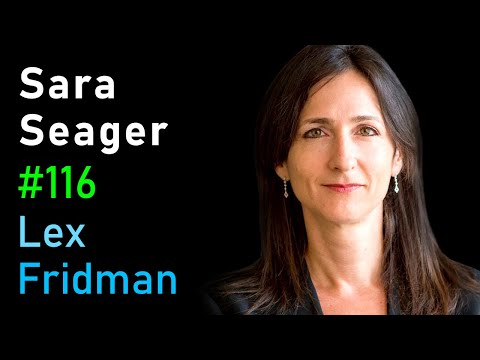
Sara Seager: Search for Planets and Life Outside Our Solar System | Lex Fridman Podcast #116
Lex Fridman (host), Sara Seager (guest), Narrator
In this episode of Lex Fridman Podcast, featuring Lex Fridman and Sara Seager, Sara Seager: Search for Planets and Life Outside Our Solar System | Lex Fridman Podcast #116 explores sara Seager on exoplanets, alien life, grief, and human meaning Lex Fridman speaks with MIT planetary scientist Sara Seager about the search for exoplanets and the scientific quest to detect life beyond our solar system.
Sara Seager on exoplanets, alien life, grief, and human meaning
Lex Fridman speaks with MIT planetary scientist Sara Seager about the search for exoplanets and the scientific quest to detect life beyond our solar system.
They outline how modern telescopes, transit methods, atmospheric spectroscopy, and concepts like the Seager equation and Starshade could reveal habitable worlds and potential biosignature gases.
Seager also discusses more speculative ideas—interstellar probes, gravitational lensing, Starshot sails, and the likelihood of intelligent life—while remaining grounded in what current and near‑future science can test.
In the second half, she opens up about losing her husband, navigating grief, finding “the smallest lights in the universe” in her own life, and how that experience reshaped her scientific purpose and views on love and mortality.
Key Takeaways
We will likely be able to scientifically test for extraterrestrial life within decades.
Seager argues that new and upcoming space telescopes and instruments will allow us to study exoplanet atmospheres for water and out‑of‑equilibrium gases that may be produced by life, giving us our first real chance at an evidence‑based answer to “Are we alone?”
Get the full analysis with uListen AI
Most stars probably host planets, but true Earth analogs are extremely hard to detect.
Thousands of exoplanets have been found—many unlike anything in our solar system—but finding an Earth‑sized world at an Earth‑like distance from a Sun‑like star is a needle‑in‑a‑haystack problem that demands billion‑dollar, space‑based observatories and very precise instruments.
Get the full analysis with uListen AI
Biosignature gases offer a realistic, if indirect, way to infer life at a distance.
Because we cannot image exoplanet surfaces in detail, scientists look instead for atmospheric gases (like oxygen or certain complex molecules) that are hard to explain without ongoing biological activity, while rigorously ruling out non‑biological (abiotic) sources.
Get the full analysis with uListen AI
Ambitious engineering concepts are moving from ‘science fiction’ to real roadmaps.
Ideas such as the Starshade (a giant flower‑shaped occulting screen formation‑flying with a telescope), using the Sun as a gravitational lens, or Starshot’s laser‑pushed sails are being decomposed into concrete technical challenges, funded, and prototyped, slowly shifting them into mainstream engineering.
Get the full analysis with uListen AI
The desire to explore—whether Mars or distant star systems—is fundamentally human.
Seager views crewed missions and colonization efforts less as immediate commercial ventures and more as long‑term, high‑risk explorations that historically yield unforeseen discoveries and technologies, driven by our built‑in urge to go beyond current boundaries.
Get the full analysis with uListen AI
Personal tragedy can radically refocus one’s priorities and sense of purpose.
Losing her husband and confronting the medical system, grief, and single parenthood led Seager to question how she used her time and to deliberately commit the rest of her career to finding another Earth and evidence that we are not alone.
Get the full analysis with uListen AI
Connection, community, and small moments of joy are crucial ‘lights’ in deep grief.
She describes grief as an ocean dotted with tiny islands—children’s laughter, supportive colleagues, a group of local widows—that gradually grow into continents, illustrating how small but consistent sources of meaning can slowly reconstruct a life after loss.
Get the full analysis with uListen AI
Notable Quotes
““Soon could be a decade or two decades… we’ll have the capability to answer that question.””
— Sara Seager (on whether we’re alone in the universe)
““I believe absolutely there is life out there somewhere… even if life is rare, the numbers are so huge that things have to come together someplace.””
— Sara Seager
““In exoplanets, the line between what is considered completely crazy and what is considered mainstream research is constantly shifting.””
— Sara Seager
““Grief is an ocean, with tiny islands of the little lights… eventually that ocean gets smaller and the islands become continents with lakes.””
— Sara Seager
““Finding another Earth… seeing water and gases that don’t belong, so I know the search will continue after I’m gone—that would bring me joy.””
— Sara Seager
Questions Answered in This Episode
How should we weigh the risk of revealing our presence (METI) against the potential benefits of making contact with an advanced extraterrestrial civilization?
Lex Fridman speaks with MIT planetary scientist Sara Seager about the search for exoplanets and the scientific quest to detect life beyond our solar system.
Get the full analysis with uListen AI
What specific biosignature gases beyond oxygen does Seager think are most promising, and how will we convincingly distinguish them from purely geological or chemical processes?
They outline how modern telescopes, transit methods, atmospheric spectroscopy, and concepts like the Seager equation and Starshade could reveal habitable worlds and potential biosignature gases.
Get the full analysis with uListen AI
Given limited resources, should humanity prioritize building Earth‑like exoplanet telescopes (e.g., Starshade) over nearer‑term goals like Mars colonization or lunar bases?
Seager also discusses more speculative ideas—interstellar probes, gravitational lensing, Starshot sails, and the likelihood of intelligent life—while remaining grounded in what current and near‑future science can test.
Get the full analysis with uListen AI
How did Seager’s experience with grief and mortality change the way she evaluates scientific projects and career choices compared to before her husband’s illness?
In the second half, she opens up about losing her husband, navigating grief, finding “the smallest lights in the universe” in her own life, and how that experience reshaped her scientific purpose and views on love and mortality.
Get the full analysis with uListen AI
If we discovered strong evidence of microbial life on an exoplanet but no signs of intelligence, how might that reshape philosophy, religion, and our sense of human uniqueness?
Get the full analysis with uListen AI
Transcript Preview
The following is a conversation with Sara Seager, a planetary scientist at MIT known for her work on the search for exoplanets, which are planets outside of our solar system. She's an author of two books on this fascinating topic. Plus, in a couple of days, August 18th, her new book, a memoir called The Smallest Lights in the Universe is coming out. I read it and I can recommend it highly, especially if you love space and are a bit of a romantic like me. It's beautifully written. She weaves the stories of the tragedies and the triumphs of her life with the stories of her love for and research on exoplanets, which represent our hope to find life out there in the universe. Quick summary of the ads. Three sponsors: Public Goods, that's a new one, PowerDot, and Cash App. Click the links in the description to get a discount. It really is the best way to support this podcast. As a quick side note, let me say that extraterrestrial life, aliens, I think represent our civilization longing to make contact with the unknown, with others like us or maybe others that are very different from us, entities that might reveal something profound about why we're here. The possibility of this is both exciting and, at least to me, terrifying, which is exactly where we humans do our best work. If you enjoy this thing, subscribe on YouTube, review it with five stars on Apple Podcasts, support it on Patreon, or connect with me on Twitter @lexfridman. As usual, I'll do a few minutes of ads now, and never any ads in the middle that could break the flow of the conversation. I try to make these ad reads interesting if you do listen, but if you like, I give you timestamps so you can skip to the conversation. But still, please do check out the sponsors by clicking the special links in the description. It's the best way to support this podcast. This show is sponsored by Public Goods, the one-stop shop for affordable, sustainable, healthy household products. Their products have a minimalist black and white design that I find to be just clean, elegant, and beautiful. It's a style that makes me feel like I'm living in the future. I imagine we'll all be using Public Goods products once we colonize Mars. They got all the basics you need from healthy snacks like almonds, to my favorite, the bamboo toothbrush, and other stuff for personal care, home essentials, healthy food, and vitamins and supplements. I take their fish oil, for example, which I recommend highly for everyone. They use a membership model to keep costs low and pass on the savings to us, the people. They plant one tree for every order placed, and have planted over 100,000 trees since September 2019. Visit publicgoods.com/lex or use code LEX at checkout to get 15 bucks off your first order. This show is sponsored by PowerDot. Get it at powerdot.com/lex and use code LEX at checkout to get 20% off and to support this podcast. It's an e-stim, electrical stimulation device, that I've been using a lot for muscle recovery, mostly for my shoulders and legs as I've been doing the crazy amounts of body weight reps and six miles every other day now after the challenge. Yes, I'm still doing it. They call it the smart muscle stimulator since the app that goes with it is amazing. It has 15 programs for different body parts and guides you through everything you need to do. I take recovery really seriously these days and PowerDot has been a powerful addition to stretching, ice, massage, and sleep and diet. It's used by professional athletes and by slightly insane, but mostly normal people like me. It's portable, so you can throw it in a bag and bring it anywhere. Get it at powerdot.com/lex and use code LEX at checkout to get 20% off on top of the 30-day free trial, and of course to support this podcast. This show is presented by a sponsor that arguably made this whole podcast even possible. Our first sponsor, the great, the powerful Cash App, the number one finance app in the App Store. I will forever be grateful to them for sponsoring this podcast. They're awesome people, awesome company, awesome product. Okay, back to the read. When you get it (laughs) , use code LEXPODCAST. Cash App lets you send money to friends, buy Bitcoin, invest in the stock market with as little as $1. Since Cash App allows you to buy Bitcoin, let me mention that cryptocurrency and the context of the history of money is fascinating. I recommend The Scent of Money is a great book on this history. Debits and credits on ledgers started around 30,000 years ago. Time flies. (laughs) The US dollar created over 200 years ago, and the first decentralized cryptocurrency released just over 10 years ago. So given that history, cryptocurrency is still very much in its early days of development, but it's still aiming to, and just might, redefine the nature of money. So again, if you get Cash App from the App Store or Google Play and use code LEXPODCAST, you get $10 and Cash App will also donate $10 to FIRST, an organization that is helping to advance robotics and STEM education for young people around the world. And now here's my conversation with Sara Seager. When did you first fall in love with the stars?
Install uListen to search the full transcript and get AI-powered insights
Get Full TranscriptGet more from every podcast
AI summaries, searchable transcripts, and fact-checking. Free forever.
Add to Chrome