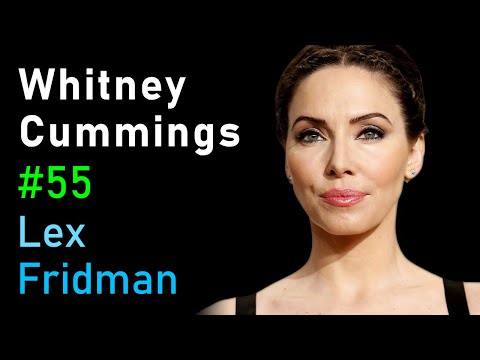
Whitney Cummings: Comedy, Robotics, Neurology, and Love | Lex Fridman Podcast #55
Lex Fridman (host), Whitney Cummings (guest), Narrator
In this episode of Lex Fridman Podcast, featuring Lex Fridman and Whitney Cummings, Whitney Cummings: Comedy, Robotics, Neurology, and Love | Lex Fridman Podcast #55 explores whitney Cummings on robots, neurology, love, and human hypocrisy Whitney Cummings and Lex Fridman explore how robots and AI intersect with sex, caregiving, emotional support, and broader social fears about technology. Whitney argues that anxiety over robots is often classist and gendered, noting that vulnerable and lower‑income people might actually benefit most from robotic help and companionship.
Whitney Cummings on robots, neurology, love, and human hypocrisy
Whitney Cummings and Lex Fridman explore how robots and AI intersect with sex, caregiving, emotional support, and broader social fears about technology. Whitney argues that anxiety over robots is often classist and gendered, noting that vulnerable and lower‑income people might actually benefit most from robotic help and companionship.
They dive into neurology, addiction, and codependency as lenses for understanding human behavior, emphasizing how much of what we call ‘personality’ is driven by brain chemistry and survival wiring. The conversation also examines surveillance, social media, animal ethics, and how we dehumanize certain groups—animals, robots, even each other—while projecting deep emotion onto objects.
On relationships and love, Whitney questions the cultural obsession with eternal passion, frames love partly as a pragmatic, daily decision, and suggests robots can offer non‑judgmental, low‑stakes spaces for intimacy and authenticity. Throughout, she uses humor to surface uncomfortable truths about denial, fear of death, and the stories we tell ourselves to manage existential terror.
Key Takeaways
Robots can fill real emotional and practical gaps, especially for vulnerable people.
Whitney notes that many sex‑robot buyers are disabled, have sexual dysfunction, or are safely exploring sexuality; she argues robots could also tutor kids, provide childcare, or protect women, suggesting a potential social good often ignored in elite panic about AI.
Get the full analysis with uListen AI
Fear of robots is often more about class, gender, and status than risk.
She points out that affluent men tend to worry about existential AI threats, while people without healthcare or safety may see robots as welcome help; she frames “robots will kill us” as a champagne problem compared with everyday human dangers.
Get the full analysis with uListen AI
Our disgust at near‑human robots reveals deep evolutionary wiring.
Audience reactions to her Whitney‑lookalike robot (“BearClaw”) led Whitney to pathogen‑avoidance theory: we evolved to be repelled by things that look human but ‘off’ to avoid disease and death, which helps explain the uncanny valley response.
Get the full analysis with uListen AI
Surveillance can improve behavior but poses serious ethical risks.
Whitney argues people act better when watched (from traffic cameras to the ‘Santa Claus is watching’ myth) and is pro‑surveillance for safety, yet she distinguishes this from abuses like insurers using behavioral data or health signals to quietly raise premiums.
Get the full analysis with uListen AI
Understanding neurology increases compassion and reduces self‑blame.
Through migraines, her parents’ strokes, and family addiction, she learned to see outbursts, road rage, or relapse as brain chemistry and structural damage, not pure moral failure—making room for empathy while still supporting responsibility and treatment.
Get the full analysis with uListen AI
Codependency and social media feed off the same need for approval.
She defines codependency as intolerance of others’ discomfort, then links it to compulsive checking of likes, comments, and status rankings; she manages it by outsourcing some social media, muting higher‑status accounts, and viewing platforms as business tools, not emotional lifelines.
Get the full analysis with uListen AI
Love is less magic and more ongoing, conditional behavior.
Whitney frames love as consistent, long‑term production of connection (dopamine, oxytocin) plus reliability: you should feel safe and undrained when the person isn’t there. ...
Get the full analysis with uListen AI
Notable Quotes
“It's a champagne problem to be afraid of robots.”
— Whitney Cummings
“We're forgetting about a huge part of the population who maybe isn't as charming and solvent as people like you and Elon Musk—these robots could solve very real problems in their life.”
— Whitney Cummings
“We behave better when we know we're being watched. That's why we invented Santa Claus.”
— Whitney Cummings
“Genetics loads the gun, environment pulls the trigger.”
— Whitney Cummings
“We’re all just managing our terror, because we know we’re going to die, so we create and build all these things just to distract ourselves from imminent rotting.”
— Whitney Cummings
Questions Answered in This Episode
If robots become capable of genuine emotional responsiveness, should abusing a robot be treated similarly to abusing an animal or even a person?
Whitney Cummings and Lex Fridman explore how robots and AI intersect with sex, caregiving, emotional support, and broader social fears about technology. ...
Get the full analysis with uListen AI
How should designers decide when robots should be gendered versus genderless, especially in roles like sex work, childcare, and medicine?
They dive into neurology, addiction, and codependency as lenses for understanding human behavior, emphasizing how much of what we call ‘personality’ is driven by brain chemistry and survival wiring. ...
Get the full analysis with uListen AI
Where is the ethical line between helpful surveillance that increases safety and invasive data collection that quietly harms people (e.g., through insurance or employment decisions)?
On relationships and love, Whitney questions the cultural obsession with eternal passion, frames love partly as a pragmatic, daily decision, and suggests robots can offer non‑judgmental, low‑stakes spaces for intimacy and authenticity. ...
Get the full analysis with uListen AI
Can relationships with robots ultimately make our human relationships healthier by giving us practice in non‑judgmental connection, or will they encourage withdrawal from difficult but necessary human intimacy?
Get the full analysis with uListen AI
In a world where so much behavior is driven by neurochemistry and survival wiring, how much responsibility can we fairly place on individuals for their ‘choices’ in love, addiction, and aggression?
Get the full analysis with uListen AI
Transcript Preview
The following is a conversation with Whitney Cummings. She's a stand-up comedian, actor, producer, writer, director, and recently, finally, the host of her very own podcast called Good For You. Her most recent Netflix special called Can I Touch It? features, in part, a robot she affectionately named BearClaw that is designed to be visually a replica of Whitney. It's exciting for me to see one of my favorite comedians explore the social aspects of robotics and AI in our society. She also has some fascinating ideas about human behavior, psychology, and urology, some of which she explores in her book called I'm Fine and Other Lies. It was truly a pleasure to meet Whitney and have this conversation with her, and even to continue it through texts afterwards. Every once in a while, late at night, I'll be programming over a cup of coffee and will get a text from Whitney saying something hilarious, or weirder yet, sending a video of Bryan Callen saying something hilarious. That's when I know the universe has a sense of humor, and it gifted me with one hell of an amazing journey. Then I put the phone down and go back to programming with a stupid, joyful smile on my face. If you enjoy this conversation, listen to Whitney's podcast, Good For You, and follow her on Twitter and Instagram. This is the Artificial Intelligence Podcast. If you enjoy it, subscribe on YouTube, give it five stars on Apple Podcasts, support it on Patreon, or simply connect with me on Twitter @lexfridman, spelled F-R-I-D-M-A-N. This show is presented by Cash App, the number one finance app in the App Store. They regularly support Whitney's Good For You podcast as well. I personally use Cash App to send money to friends, but you can also use it to buy, sell, and deposit Bitcoin in just seconds. Cash App also has a new investing feature, you can buy fractions of a stock, say $1 worth, no matter what the stock price is. Broker services are provided by Cash App Investing, a subsidiary of Square and member SIPC. I'm excited to be working with Cash App to support one of my favorite organizations called FIRST, best known for their FIRST Robotics and LEGO competitions. They educate and inspire hundreds of thousands of students in over 110 countries, and have a perfect rating on Charity Navigator, which means the donated money is used to maximum effectiveness. When you get Cash App from the App Store or Google Play and use code LEXPODCAST, you'll get $10 and Cash App will also donate $10 to FIRST, which, again, is an organization that I've personally seen inspire girls and boys to dream of engineering a better world. This podcast is supported by ZipRecruiter. Hiring great people is hard, and to me, is the most important element of a successful mission-driven team. I've been fortunate to be a part of and to lead several great engineering teams. The hiring I've done in the past was mostly through tools that we built ourselves, but reinventing the wheel was painful. ZipRecruiter's a tool that's already available for you. It seeks to make hiring simple, fast, and smart. For example, Kodable co-founder Gretchen Hebner used ZipRecruiter to find a new game artist to join her education tech company. By using ZipRecruiter's screening questions to filter candidates, Gretchen found it easier to focus on the best candidates and finally hiring the perfect person for the role in less than two weeks from start to finish. ZipRecruiter, the smartest way to hire. See why ZipRecruiter is effective for businesses of all sizes by signing up, as I did, for free at ziprecruiter.com/lexpod. That's ziprecruiter.com/lexpod. And now here's my conversation with Whitney Cummings. I have trouble making eye contact, as you can tell, right?
Install uListen to search the full transcript and get AI-powered insights
Get Full TranscriptGet more from every podcast
AI summaries, searchable transcripts, and fact-checking. Free forever.
Add to Chrome