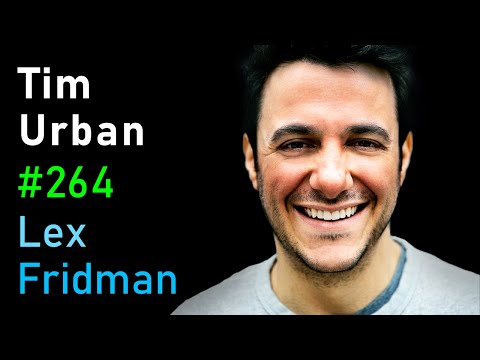
Tim Urban: Elon Musk, Neuralink, AI, Aliens, and the Future of Humanity | Lex Fridman Podcast #264
Tim Urban (guest), Lex Fridman (host), Narrator, Narrator, Narrator
In this episode of Lex Fridman Podcast, featuring Tim Urban and Lex Fridman, Tim Urban: Elon Musk, Neuralink, AI, Aliens, and the Future of Humanity | Lex Fridman Podcast #264 explores tim Urban, Lex Fridman Explore Aliens, Mars, Minds, and Meaning Lex Fridman and Tim Urban range across cosmology, alien civilizations, human collective intelligence, AI/Neuralink, Mars colonization, and the current dysfunction of society.
Tim Urban, Lex Fridman Explore Aliens, Mars, Minds, and Meaning
Lex Fridman and Tim Urban range across cosmology, alien civilizations, human collective intelligence, AI/Neuralink, Mars colonization, and the current dysfunction of society.
They contrast the mystery of the very big and very small with the “middle” world of life and emergence, framing humans as part of larger collective organisms and intelligence.
Urban explains Elon Musk’s first-principles thinking, Neuralink’s potential to transform communication and consciousness, and why Mars is both “life insurance” and a unifying adventure.
They close by examining polarization, free speech, procrastination, habits like daily reading, and what gives an individual life meaning amid technological and social upheaval.
Key Takeaways
Think in terms of emergence and collective intelligence, not just individuals.
Viewing humans as part of higher-level organisms (communities, civilizations, even Earth itself) clarifies how cooperation, division of labor, and shared knowledge create superhuman capabilities—no single person can even build a simple pencil alone.
Get the full analysis with uListen AI
Use first-principles reasoning where it truly matters.
Instead of copying conventional wisdom, break problems down to basic facts and constraints (like physics, costs, incentives) and reason upward, especially for life-defining choices about career, relationships, and major projects.
Get the full analysis with uListen AI
Small, consistent habits compound into life-changing outcomes.
Reading just 30 minutes a day can amount to 1,000 books in 50 years; similarly, writing a couple of pages a day or doing brief daily workouts can accumulate into major bodies of work or fitness without feeling extreme.
Get the full analysis with uListen AI
Design your environment to compensate for your weaknesses.
If you’re prone to procrastination, introduce “panic monsters” and external accountability—deadlines, social commitments, people who can see your screen—so you reliably start the hard thing instead of endlessly circling the pool.
Get the full analysis with uListen AI
Protect idea-lab culture and free speech to keep society’s ‘big brain’ smart.
When topics (like climate or COVID) become sacred and criticism is punished socially, public reasoning shifts from open, scientific debate to fearful conformity, making the collective dumber precisely when complex decisions are most needed.
Get the full analysis with uListen AI
AI and bio-sensing can radically personalize health and lifestyle.
Future wearables and implants could continuously track your genome, biomarkers, mood, and environment, letting AI optimize your meals, sleep, exercise, and medical care, freeing cognitive bandwidth for work, relationships, and creativity.
Get the full analysis with uListen AI
Neural interfaces could redefine communication, creativity, and identity.
If tools like Neuralink can safely read and write neural activity at scale, we could stream music directly into auditory cortex, visualize designs from imagination, and share thoughts at high bandwidth—blurring lines between individuals and collective minds.
Get the full analysis with uListen AI
Notable Quotes
“Humans did not build any of this. Collective humans is a super-intelligent being that can do absolutely magical things.”
— Tim Urban
“If you read a half hour a night, you can read a thousand books in 50 years.”
— Tim Urban
“What makes Elon unusual is that he’s sane in a way that almost every human is crazy.”
— Tim Urban
“Free speech is the mechanism by which the big brain can think.”
— Tim Urban
“Be humbler about what you know, more confident about what’s possible, and less afraid of things that don’t matter.”
— Tim Urban (quoted by Lex Fridman at the end)
Questions Answered in This Episode
If Neuralink-like interfaces become reliable, how should we redefine concepts like privacy, identity, and consent when thoughts can be shared or recorded?
Lex Fridman and Tim Urban range across cosmology, alien civilizations, human collective intelligence, AI/Neuralink, Mars colonization, and the current dysfunction of society.
Get the full analysis with uListen AI
What concrete policies or cultural norms could strengthen “idea labs” and weaken punitive echo chambers in universities, media, and tech?
They contrast the mystery of the very big and very small with the “middle” world of life and emergence, framing humans as part of larger collective organisms and intelligence.
Get the full analysis with uListen AI
How many people—and which kinds of skills—would we really need to preserve today’s civilization if a catastrophe drastically reduced the population?
Urban explains Elon Musk’s first-principles thinking, Neuralink’s potential to transform communication and consciousness, and why Mars is both “life insurance” and a unifying adventure.
Get the full analysis with uListen AI
In your own life, which important decisions are you still making by analogy instead of from first principles, and what would change if you re-thought them from the ground up?
They close by examining polarization, free speech, procrastination, habits like daily reading, and what gives an individual life meaning amid technological and social upheaval.
Get the full analysis with uListen AI
If Mars colonies and brain–computer interfaces both succeed, what should count as the next genuine “great leap” for life after multi-planetary civilization?
Get the full analysis with uListen AI
Transcript Preview
If you read a half hour a night, uh, the, the calculation I came to is that you can read a thousand books in 50 years.
All of the components are there to engineer intimate experiences.
Extraterrestrial life is a true mystery, probably the most tantalizing mystery of all.
How many humans need to disappear for us to be completely lost? The following is a conversation with Tim Urban, author and illustrator of the amazing blog called Wait But Why? This is a Lex Fridman podcast. To support it, please check out our sponsors in the description, and now, dear friends, here's Tim Urban. You wrote a Wait But Why? blog post about the big and the small, from the observable universe to the atom. What world do you find most mysterious or beautiful, the very big or the very small?
The very small seems a lot more mysterious. And I mean, the very big, I feel like we kind of understand. I mean, not the very, very big, not the, not the multiverse, if there is a multiverse, uh, not anything outside of the observable universe. Um, but the very small, yeah, I think we really have no idea what's going on, um, or very, you know, much less idea. But I find the... So I think the small is more mysterious but I think the big is sexier. Um, I just cannot get enough of the bigness of space and the farness of stars, and it just continually blows my mind.
I mean, we still... The, the vastness of the observable universe has the mystery that we don't know what's out there. We know how it works perhaps, like general relativity can tell us how the, the movement of bodies works, how they're born, all that kinda things, but, like, how many li- how many civilizations are out there? How many... Like, what are the weird things that are out there?
Oh, yeah, life, well, extraterrestrial life is a true mystery, prob- the most tantalizing mystery of all. Um, uh, but th- that's, like, our size, so that's maybe it's... That the actual, um... The big and the small are really cool, but it's actually the things that are potentially our size that are the most tantalizing.
Potentially our size is probably the key word there.
Yeah, I mean, I wonder how small intelligent life could get.
Right.
Probably not that small, um, and I assume that it... That there's a limit, that you're not gonna... I mean, you might have, like, an, a whale, blue whale-sized intelligent being, that would be kinda cool, um, but I, I, um, feel like it's in... We're in the range of order of magnitude smaller and bigger than us for life. But maybe, maybe not. Maybe you could have some giant life form, just seems like... I don't know, there's got to be some reason that anything intelligent between kind of like a little tiny rodent or finger monkey up to a blue whale on this planet... I don't know, maybe, maybe when you change the gravit- you know, gravity and other things.
Install uListen to search the full transcript and get AI-powered insights
Get Full TranscriptGet more from every podcast
AI summaries, searchable transcripts, and fact-checking. Free forever.
Add to Chrome