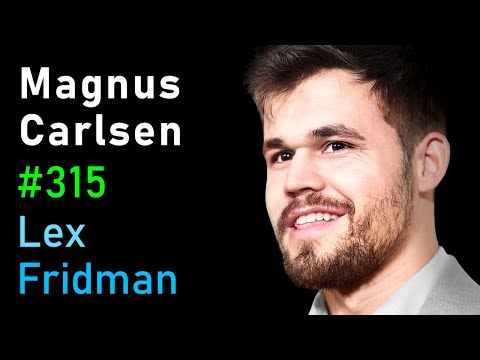
Magnus Carlsen: Greatest Chess Player of All Time | Lex Fridman Podcast #315
Lex Fridman (host), Magnus Carlsen (guest), Narrator, Lex Fridman (host)
In this episode of Lex Fridman Podcast, featuring Lex Fridman and Magnus Carlsen, Magnus Carlsen: Greatest Chess Player of All Time | Lex Fridman Podcast #315 explores magnus Carlsen Dissects Greatness, Chess Mastery, Pressure, and Fun Magnus Carlsen and Lex Fridman explore what makes someone the greatest in fields like football, basketball, and especially chess, weighing statistics against intangible brilliance. Carlsen breaks down his own evolution as a player: intuition, short-line calculation, endgame mastery, and modern opening preparation in the age of engines and neural networks.
Magnus Carlsen Dissects Greatness, Chess Mastery, Pressure, and Fun
Magnus Carlsen and Lex Fridman explore what makes someone the greatest in fields like football, basketball, and especially chess, weighing statistics against intangible brilliance. Carlsen breaks down his own evolution as a player: intuition, short-line calculation, endgame mastery, and modern opening preparation in the age of engines and neural networks.
They examine the world championship’s format, pressure, and politics, including why Magnus walked away despite being the clear best player and why rating and consistent performance matter more to him than the title. The conversation also covers variants like Chess960, training habits, health and lifestyle, poker, and the psychological aspects of competition, bluffing, and trash talk.
On a personal level, Magnus talks about anxiety, his toughest loss, loneliness, love, and meaning, emphasizing playing for fun, cultivating obsession organically, and living well rather than chasing some grand cosmic purpose.
Key Takeaways
Greatness is best measured by long-term performance, not single events.
Magnus argues World Cups (in football) and short world championship matches (in chess) are overrated because of small sample size and luck; he values sustained rating dominance and statistical contribution to winning over isolated titles.
Get the full analysis with uListen AI
Elite chess at Magnus’s level is built on intuition and evaluation, not just deep calculation.
He says his edge is superior intuitive understanding and short-line calculation (2–4 moves) combined with excellent evaluation of resulting positions, especially in endgames, where early accurate evaluation simplifies the rest into ‘technique.’
Get the full analysis with uListen AI
Modern opening preparation is about surprising humans, not finding ‘perfect’ engine moves.
With engines equalizing mainstream lines, Magnus focuses on semi-bluff ideas engines undervalue at low depth, steering games into areas where he has more practical human knowledge—even if the moves are slightly suboptimal by computer standards.
Get the full analysis with uListen AI
Too much engine knowledge can harm practical play if it’s shallow or misunderstood.
Magnus limits his own direct engine usage, letting his team use engines heavily while he focuses on human evaluation and discomfort, because partial engine lines without deep understanding can be worse than no prep at all in real games.
Get the full analysis with uListen AI
The current world championship format poorly identifies the best overall player.
He criticizes 12–14 long classical games as too few and too drawish, masking weaknesses via deep prep and defense, and suggests more games with faster time controls to better reflect true strength and reduce the crushing ‘fear of losing’ incentive structure.
Get the full analysis with uListen AI
Obsession and enjoyment beat rigid, ‘perfect’ training plans for long-term excellence.
Magnus admits he’s never been good at deliberate practice like solving exercises; instead he read tons of chess books, let his curiosity drive self-study, and constantly thought about positions in his head, turning work into play.
Get the full analysis with uListen AI
Emotional management—of fear, impatience, and confidence—directly shapes results at the top.
He describes his worst loss (Karjakin 2016) as a cascade from impatience and panic once he realized he’d overpressed, contrasted with how even small edges and psychology (opponents’ timidity against him) allow him to take more risk and convert advantages.
Get the full analysis with uListen AI
Notable Quotes
“All the statistics say that Messi is the best finisher of all time, which I think helps a lot.”
— Magnus Carlsen
“My intuitive understanding of chess has, over those years, always been a little bit better than the others.”
— Magnus Carlsen
“I’ve been world number one since 2011 in an even more competitive era than Garry. I have the highest rating of all time… but I’m still not that interested in style when talking about the greatest ever.”
— Magnus Carlsen
“For the world championship, it’s been fear of losing. Other tournaments, love of winning is a great factor.”
— Magnus Carlsen
“There is obviously no meaning to life. I think we’re here by accident. But it’s still a great thing.”
— Magnus Carlsen
Questions Answered in This Episode
If you could redesign the world championship format from scratch, with no regard for tradition or politics, what exact structure (time controls, number of games, tie-breaks) would you choose and why?
Magnus Carlsen and Lex Fridman explore what makes someone the greatest in fields like football, basketball, and especially chess, weighing statistics against intangible brilliance. ...
Get the full analysis with uListen AI
How do you think widespread use of neural-network engines will shape the next generation’s playing style compared to your own and Kasparov’s eras?
They examine the world championship’s format, pressure, and politics, including why Magnus walked away despite being the clear best player and why rating and consistent performance matter more to him than the title. ...
Get the full analysis with uListen AI
In your view, what would a truly ‘universal’ player 20–30 years from now need to do better than you—technically, psychologically, and in preparation—to surpass your level?
On a personal level, Magnus talks about anxiety, his toughest loss, loneliness, love, and meaning, emphasizing playing for fun, cultivating obsession organically, and living well rather than chasing some grand cosmic purpose.
Get the full analysis with uListen AI
How has your relationship with fear of losing evolved, and what concrete methods (mental or practical) have helped you keep that fear from paralyzing you over the board?
Get the full analysis with uListen AI
If chess were ‘solved’ tomorrow and everyone knew the perfect drawing lines, what aspects of the game—or of competition more broadly—would still keep you interested and motivated?
Get the full analysis with uListen AI
Transcript Preview
The following is a conversation with Magnus Carlsen, the number one ranked chess player in the world, and widely considered to be one of, if not the greatest chess player of all time. The camera on Magnus died 20 minutes into the conversation. Most folks still just listened to the audio through a podcast player anyway, but if you're watching this on YouTube or Spotify, we did our best to still make it interesting by adding relevant image overlays. I mess things up sometimes, like in this case, but I'm always working hard to improve. I hope you understand. Thank you for your patience and support along the way. I love you all. This is the Lex Fridman Podcast. To support it, please check out our sponsors in the description. And now dear friends, here's Magnus Carlsen. You're considered by many to be one of the greatest, if not the greatest chess players of all time, but you're also one of the best fantasy football, AKA soccer, competitors in the world. Plus recently picking up poker and, uh, competing at a world-class level. So before chess, let's talk football and greatness. Uh, you're a Real Madrid fan, so let me ask you the ridiculous big question. Who do you think is the greatest football, AKA soccer, player of all time? Can you make the case for Messi? Can you make the case for Cristiano Ronaldo, Pele, Maradona? Does someb- anybody jump to mind?
No, I think it's pretty hard to make a case for anybody else-
Uh-oh.
... u- than Messi for his, uh, for his all-around game. And, uh, uh, frankly, like, my Real Madrid fandom sort of, uh, predates the Ronaldo era, era, uh, the s- the second Ronaldo, not, not, not the first one. So I always liked Ronaldo, but I always kind of thought that Messi was, uh, was, uh, better. Uh, and, um, I went to quite a number of, uh, Madrid games, and they've always been super helpfulful to me down there. The only thing is that, like, they asked me... They were gonna do an interview, and they were gonna ask me who my favorite player was, and, um, I said somebody else. I s- I think I said Isco at that point, and I was like, "Okay, take two." Now, you say Ronaldo.
(laughs)
So for them, it was, um, it was very important, but it wasn't, wasn't that huge to, um, uh, to me.
So Messi over Maradona?
Yeah, but it's... I think it... Just like with chess, it's hard to compare eras. Um, obviously, the improvements in football have been, like, in, in technique and such, have been even greater than they have been in, in, in chess. But it's, um, it's always, um, it's always a weirdis- weird discussion, uh, to have.
But just as a fan, what do you think is beautiful about the game? What defines greatness? Is it... You know, with Messi, one, he's really good at finishing, two, very good at assists, like, three, there's just magic. It's just beautiful to see the play, so it's not just about the finishing. There's some... It's like Maradona's Hand of God. There's some creativity on the pitch. Is, is that important or is it very important to get the World Cups and the big championships and that kind of stuff?
Install uListen to search the full transcript and get AI-powered insights
Get Full TranscriptGet more from every podcast
AI summaries, searchable transcripts, and fact-checking. Free forever.
Add to Chrome