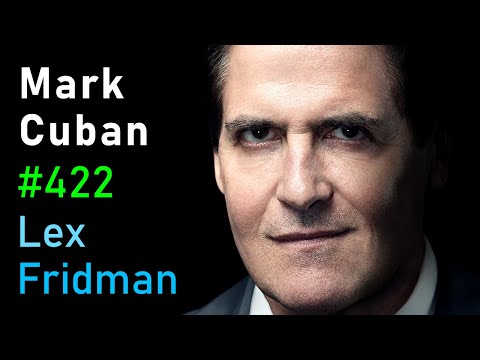
Mark Cuban: Shark Tank, DEI & Wokeism Debate, Elon Musk, Politics & Drugs | Lex Fridman Podcast #422
Mark Cuban (guest), Lex Fridman (host), Narrator
In this episode of Lex Fridman Podcast, featuring Mark Cuban and Lex Fridman, Mark Cuban: Shark Tank, DEI & Wokeism Debate, Elon Musk, Politics & Drugs | Lex Fridman Podcast #422 explores mark Cuban on Entrepreneurship, DEI, AI, Healthcare, and American Power Mark Cuban and Lex Fridman cover Cuban’s entrepreneurial journey from selling garbage bags to building and exiting Broadcast.com, buying the Dallas Mavericks, and launching Cost Plus Drugs.
Mark Cuban on Entrepreneurship, DEI, AI, Healthcare, and American Power
Mark Cuban and Lex Fridman cover Cuban’s entrepreneurial journey from selling garbage bags to building and exiting Broadcast.com, buying the Dallas Mavericks, and launching Cost Plus Drugs.
They dissect what makes a great entrepreneur—curiosity, agility, salesmanship—and how luck and timing separate millionaires from billionaires.
Cuban defends DEI when done well, critiques culture-war narratives around “wokeism,” and argues that leadership failures and opaque algorithms are bigger threats than ideology itself.
They also explore AI, open source, U.S. politics (Biden vs. Trump, immigration), and the broken incentives in American healthcare that Cuban is trying to disrupt through radical price transparency.
Key Takeaways
Curiosity and constant learning matter more than innate talent in entrepreneurship.
Cuban insists great entrepreneurs are voracious information consumers who adapt as the world changes, rather than relying on being “born” with business skills.
Get the full analysis with uListen AI
Sales is fundamentally about helping people solve real problems.
He frames selling as putting yourself in the customer’s shoes and asking, “Can I help this person? ...
Get the full analysis with uListen AI
Luck and timing are indispensable in becoming a billionaire.
Cuban argues you can plan your way to being a millionaire, but hitting billionaire status requires external factors—market bubbles, technological shifts, and capital access—that no one fully controls.
Get the full analysis with uListen AI
DEI done right broadens talent pools and supports high performance; done badly it’s a management problem, not an inherent flaw.
He defines DEI in strictly business terms—widening recruitment, setting people up to succeed, and fostering inclusion—and blames poor implementation and leadership, not DEI itself, for most backlash.
Get the full analysis with uListen AI
Algorithmic control and information bubbles pose a bigger threat than “woke ideology.”
Cuban warns that when people rely on one platform, whoever controls that algorithm effectively shapes their reality, amplifying extremism and tribalism regardless of political side.
Get the full analysis with uListen AI
U.S. healthcare wastes massive sums because CEOs don’t understand opaque intermediaries.
He shows how pharmacy benefit managers and consultants quietly extract value via non-transparent contracts and rebates, arguing that in-house healthcare expertise and full price transparency can save companies millions.
Get the full analysis with uListen AI
AI will spawn millions of specialized models, making openness and competition more important than centralized control.
Cuban is optimistic about AI, expects branded, domain-specific models (e. ...
Get the full analysis with uListen AI
Notable Quotes
“Somebody who's curious, agile, and can sell—that's what makes a great entrepreneur.”
— Mark Cuban
“Selling is just helping. I’ve always looked at it as, ‘Can I help this person?’”
— Mark Cuban
“If you were happy when you were broke, you’re gonna be really, really, really happy when you’re rich.”
— Mark Cuban
“The person who controls the algorithm controls the world.”
— Mark Cuban
“I’m a hardcore believer that everybody has something they can be world‑class great at—the hard part is just finding what that is.”
— Mark Cuban
Questions Answered in This Episode
How can companies implement DEI in a way that measurably improves performance while minimizing perceived unfairness or reverse discrimination?
Mark Cuban and Lex Fridman cover Cuban’s entrepreneurial journey from selling garbage bags to building and exiting Broadcast. ...
Get the full analysis with uListen AI
If algorithm designers effectively ‘control the world,’ what practical checks and balances could prevent abuse of that power?
They dissect what makes a great entrepreneur—curiosity, agility, salesmanship—and how luck and timing separate millionaires from billionaires.
Get the full analysis with uListen AI
What concrete steps should a mid-sized company take to audit and overhaul its healthcare and PBM contracts in the spirit of Cost Plus Drugs?
Cuban defends DEI when done well, critiques culture-war narratives around “wokeism,” and argues that leadership failures and opaque algorithms are bigger threats than ideology itself.
Get the full analysis with uListen AI
Given Cuban’s emphasis on luck and timing, how should aspiring entrepreneurs think about when to pursue a risky idea versus waiting for better conditions?
They also explore AI, open source, U. ...
Get the full analysis with uListen AI
As AI models proliferate, how can individuals and institutions evaluate which models to trust, especially in high-stakes domains like medicine and politics?
Get the full analysis with uListen AI
Transcript Preview
The person who controls the algorithm controls the world, right? And if you are committed to one specific platform as your singular source of information, or affiliated platforms, then whoever controls the algorithm or the programming there, controls you.
The following is a conversation with Mark Cuban, a multi-billionaire businessman, investor and star of the series Shark Tank, longtime principal owner of the Dallas Mavericks, and is someone who is unafraid to get into frequent battles on X, most recently over topics like DEI, wokeism, gender, and identity politics with the likes of Elon Musk and Jordan Peterson. This is the Lex Fridman Podcast. To support it, please check out our sponsors in the description. And now, dear friends, here's Mark Cuban. You started many businesses, invested in many businesses, heard a lot of pitches, privately and on Shark Tank. So you're the perfect person to ask, what makes a great entrepreneur?
Somebody who's curious. They wanna keep on learning 'cause business is ever-changing, it's never static. Um, somebody who's agile, because as you learn new things and the environment around you changes, you have to be able to adapt and make the changes. Um, and somebody who can sell, because no business has ever survived without sales. And as an entrepreneur who's creating a company, whatever your product or service is, if that's not the most important thing and you're just dying and, and excited to tell people about it, then you're not gonna succeed.
But it's also a skill thing. How do you sell? What do you mean by selling?
Selling is just helping. I've always looked at it about putting myself in the shoes of another person and asking a simple question, "Can I help this person? Can my product help?" From the time I was 12 years old, selling garbage bags door-to-door and just asking a simple question, "Do you use garbage bags? Do you need garbage bags? Well, let me save you some time, I'll bring 'em to your house and drop 'em off." To, you know, streaming, um, why do we need streaming when we have TV and radio? Well, you can't get access to your TV and radio everywhere you go. So we kind of break down geographic and physical barriers. And, you know, Cost Plus Drugs. You know, what's the product that we actually sell? We sell trust. Um, in a simplistic approach, we buy drugs and sell drugs, but we add transparency to it. And bringing transparency to an industry is, is a differentiation, and it helps people.
Trust in an industry that's highly lacking in trust.
Exactly.
Okay. So what's, what's the trick to selling garbage bags? Let's go back there. At 12 years old, what, I mean, is it just your natural charisma? I guess a good question to ask, are you born with it or can you develop it?
Oh, you can definitely develop it. Yeah, I mean, because selling garbage bags door-to-door was easy, right? Because like (knocks on table) 12-year-old Mark going, "Hi, my name is Mark. Do you use garbage bags?" You know what the answer is going to be, right? "Can I just drop 'em off for you, you know, once a week? Whenever you need 'em, you just call and I'll bring 'em down?" "Sure." So that was easy.
Install uListen to search the full transcript and get AI-powered insights
Get Full TranscriptGet more from every podcast
AI summaries, searchable transcripts, and fact-checking. Free forever.
Add to Chrome