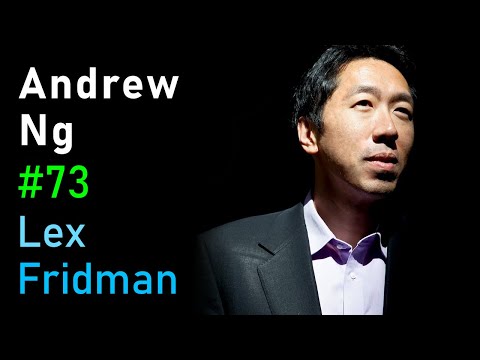
Andrew Ng: Deep Learning, Education, and Real-World AI | Lex Fridman Podcast #73
Lex Fridman (host), Andrew Ng (guest)
In this episode of Lex Fridman Podcast, featuring Lex Fridman and Andrew Ng, Andrew Ng: Deep Learning, Education, and Real-World AI | Lex Fridman Podcast #73 explores andrew Ng on Scaling AI, Democratizing Education, and Real-World Impact Andrew Ng discusses his personal journey into computer science and AI, from childhood coding and early fascination with expert systems to founding Google Brain, Coursera, DeepLearning.AI, Landing AI, and the AI Fund.
Andrew Ng on Scaling AI, Democratizing Education, and Real-World Impact
Andrew Ng discusses his personal journey into computer science and AI, from childhood coding and early fascination with expert systems to founding Google Brain, Coursera, DeepLearning.AI, Landing AI, and the AI Fund.
He explains how online education and MOOCs revealed massive global demand for AI knowledge, and shares detailed thoughts on how people should learn machine learning, build careers, and choose between academia, industry, and startups.
Ng emphasizes practical, real-world AI: small-data challenges, deployment gaps between notebooks and production, the importance of data-centric thinking, and transforming traditional industries like manufacturing and agriculture.
Throughout, he contrasts long-horizon AGI debates with more urgent issues such as bias, inequality, and job displacement, arguing that meaningful work is defined by whether it truly helps people at scale.
Key Takeaways
Start small but be consistent when learning AI.
Ng stresses that regular, habit-based study (even short daily sessions) and small projects like MNIST are far more powerful than sporadic all‑nighters, gradually compounding into deep expertise.
Get the full analysis with uListen AI
Master fundamentals and debugging, not just architectures.
Understanding core ideas like gradient descent, overfitting, data quality, and systematic debugging strategies can make you 10–100× more effective than simply stacking trendy models.
Get the full analysis with uListen AI
Data quality and tooling are as crucial as model design.
From inconsistent human labels in factories to shifting real-world conditions, Ng argues that managing, cleaning, and versioning data is an underdeveloped but central challenge for impactful AI.
Get the full analysis with uListen AI
Real-world AI success demands robust deployment, not just good test accuracy.
He highlights the huge gap between a Jupyter notebook result and a production system: changing environments, maintenance, integration into workflows, and MLOps often dominate the actual work.
Get the full analysis with uListen AI
Choose careers and jobs based primarily on the people you’ll work with.
Ng advises that the logo on the building matters less than the manager and peers you interact with daily; great teammates dramatically accelerate learning and long-term growth.
Get the full analysis with uListen AI
AI startups should be obsessively customer-focused and socially constructive.
Many AI ventures fail by building cool tech nobody needs; Ng’s AI Fund emphasizes validating real customer problems and explicitly avoiding businesses that don’t genuinely help people.
Get the full analysis with uListen AI
Today’s urgent AI issues are bias, inequality, and displacement—not sci‑fi AGI catastrophes.
He argues that fixation on far-future AGI risks distracts from concrete harms and structural shifts already caused by AI and the internet, such as winner-take-all dynamics and unfair systems.
Get the full analysis with uListen AI
Notable Quotes
“The number one priority is to do what’s best for learners, do what’s best for students.”
— Andrew Ng
“I like stuff that works.”
— Andrew Ng
“If you ask yourself, ‘Why doesn’t it work yet?’ that’s the core question of debugging machine learning systems.”
— Andrew Ng
“What matters most is not the logo above the door, but who are the ten or thirty people you interact with every day.”
— Andrew Ng
“Ask yourself, if what you’re working on succeeds beyond your wildest dreams, would you have significantly helped other people? If not, then keep searching for something else to work on.”
— Andrew Ng
Questions Answered in This Episode
How can AI practitioners systematically handle small, noisy, and shifting real-world datasets, especially outside big tech environments?
Andrew Ng discusses his personal journey into computer science and AI, from childhood coding and early fascination with expert systems to founding Google Brain, Coursera, DeepLearning. ...
Get the full analysis with uListen AI
What concrete steps can universities and online platforms take to scale Ng’s learner-first philosophy across more technical and non-technical subjects?
He explains how online education and MOOCs revealed massive global demand for AI knowledge, and shares detailed thoughts on how people should learn machine learning, build careers, and choose between academia, industry, and startups.
Get the full analysis with uListen AI
How should an aspiring AI professional decide between pursuing a PhD, joining a large AI lab, or founding a startup, given their personal goals and risk tolerance?
Ng emphasizes practical, real-world AI: small-data challenges, deployment gaps between notebooks and production, the importance of data-centric thinking, and transforming traditional industries like manufacturing and agriculture.
Get the full analysis with uListen AI
What new tooling and best practices are most urgently needed to make data management and MLOps as mature as software version control (e.g., Git)?
Throughout, he contrasts long-horizon AGI debates with more urgent issues such as bias, inequality, and job displacement, arguing that meaningful work is defined by whether it truly helps people at scale.
Get the full analysis with uListen AI
How can AI leaders practically address bias, wealth concentration, and job displacement while still pursuing aggressive innovation and commercialization?
Get the full analysis with uListen AI
Transcript Preview
The following is a conversation with Andrew Ng, one of the most impactful educators, researchers, innovators, and leaders in artificial intelligence and technology space in general. He co-founded Coursera and Google Brain, launched Deep Learning AI, Landing AI, and the AI Fund, and was the chief scientist at Baidu. As a Stanford professor and with Coursera and Deep Learning AI, he has helped educate and inspire millions of students, including me. This is the Artificial Intelligence Podcast. If you enjoy it, subscribe on YouTube, give it five stars on Apple Podcast, support it on Patreon, or simply connect with me on Twitter @lexfridman, spelled F-R-I-D-M-A-N. As usual, I'll do one or two minutes of ads now and never any ads in the middle that can break the flow of the conversation. I hope that works for you and doesn't hurt the listening experience. This show is presented by Cash App, the number one finance app in the App Store. When you get it, use code LEXPODCAST. Cash App lets you send money to friends, buy Bitcoin, and invest in the stock market with as little as $1. Broker services are provided by Cash App Investing, a subsidiary of Square and member SIPC. Since Cash App allows you to buy Bitcoin, let me mention that cryptocurrency in the context of the history of money is fascinating. I recommend A Cent of Money as a great book on this history. Debits and credits on ledgers started over 30,000 years ago. The US dollar was created over 200 years ago. And Bitcoin, the first decentralized cryptocurrency, released just over 10 years ago. So given that history, cryptocurrency is still very much in its early days of development, but it's still aiming to and just might redefine the nature of money. So again, if you get Cash App from the App Store or Google Play and use the code LEXPODCAST, you'll get $10 and Cash App will also donate $10 to FIRST, one of my favorite organizations that is helping to advance robotics and STEM education for young people around the world. And now here's my conversation with Andrew Ng. The courses you taught on machine learning at Stanford and later on Coursera that you co-founded have educated and inspired millions of people. So let me ask you, what people or ideas inspired you to get into computer science and machine learning when you were young? When did you first fall in love with the field, is another way to put it?
Growing up in Hong Kong and Singapore, I started learning to code when I was five or six years old. Uh, at that time, I was learning the basic programming language and I would take these books and, you know, they'll tell you, "Type this program into your computer." So I'd type that program to my computer. And as a result of all that typing, uh, I would get to play these very simple shoot them up games that, that, you know, I had implemented on my, on my little computer. So I thought it was fascinating as a young kid, uh, that I could write this code that was really just copying code from a book into my computer to then play these cooler video games. Another moment for me was, um, when I was a teenager and my father, who's a doctor, was reading about expert systems and about neural networks. So he got me to read some of these books and, um, I thought it was really cool that you could provide a computer that started to exhibit intelligence. Then I remember doing an internship while I was in high school, uh, this is in Singapore, where I remember doing a lot of photocopying and, and, uh, as office assistant. Um, and the highlight of my job was when I got to use the shredder. So the teenager me remembers thinking, "Boy, this is a lot of photocopying. If only you could write software, build a robot, something to automate this, maybe I could do something else." So I think a lot of my work since then, um, has centered on the theme of automation. Even the way I think about machine learning today, we're very good at writing learning algorithms that can automate things that people can do, um, or even launching the first, uh, MOOCs, Mass Open Online Courses, that later led to Coursera. I was trying to automate what could be automatable in how I was teaching on campus.
Install uListen to search the full transcript and get AI-powered insights
Get Full TranscriptGet more from every podcast
AI summaries, searchable transcripts, and fact-checking. Free forever.
Add to Chrome