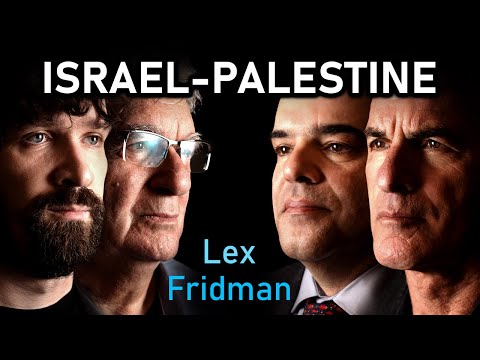
Israel-Palestine Debate: Finkelstein, Destiny, M. Rabbani & Benny Morris | Lex Fridman Podcast #418
Benny Morris (guest), Norman Finkelstein (guest), Steven Bonnell (Destiny) (guest), Lex Fridman (host), Mouin Rabbani (guest), Steven Bonnell (Destiny) (guest), Norman Finkelstein (guest), Lex Fridman (host), Lex Fridman (host), Lex Fridman (host), Norman Finkelstein (guest), Norman Finkelstein (guest), Lex Fridman (host), Benny Morris (guest), Norman Finkelstein (guest), Benny Morris (guest), Norman Finkelstein (guest), Mouin Rabbani (guest), Lex Fridman (host), Lex Fridman (host), Lex Fridman (host), Lex Fridman (host), Lex Fridman (host)
In this episode of Lex Fridman Podcast, featuring Benny Morris and Norman Finkelstein, Israel-Palestine Debate: Finkelstein, Destiny, M. Rabbani & Benny Morris | Lex Fridman Podcast #418 explores historians Clash Over 1948, Gaza, and Prospects for Lasting Peace Lex Fridman hosts a tense, unmoderated debate on Israel-Palestine featuring Norman Finkelstein, Benny Morris, Muin Rabbani, and streamer Steven “Destiny” Bonnell, using 1948 and October 7 as anchors for a broader historical and moral argument.
Historians Clash Over 1948, Gaza, and Prospects for Lasting Peace
Lex Fridman hosts a tense, unmoderated debate on Israel-Palestine featuring Norman Finkelstein, Benny Morris, Muin Rabbani, and streamer Steven “Destiny” Bonnell, using 1948 and October 7 as anchors for a broader historical and moral argument.
The guests argue fiercely over Zionism’s intentions, the Nakba, the role of transfer and expulsion, the legality and morality of Israeli policies, and whether Hamas’s October 7 attack and Israel’s Gaza war are genocidal.
Repeated flashpoints include the use (or dismissal) of international law, the credibility of human rights reports, the meaning of apartheid and genocide, and whether any realistic two‑state solution was ever on the table.
All four end on a largely pessimistic note about near‑term peace, disagreeing over causes and culpability but converging on the depth of the conflict and the difficulty of imagining a mutually acceptable political resolution.
Key Takeaways
The meaning of 1948 is foundational and contested, shaping every later argument.
Finkelstein and Rabbani emphasize the Nakba and ethnic cleansing as inherent to Zionism, while Morris and Bonnell frame the Palestinian refugee crisis as a wartime byproduct triggered by Arab rejection of partition and military assault after UN Resolution 181.
Get the full analysis with uListen AI
Intent—about transfer, genocide, or coexistence—is interpreted very differently from the same evidence.
Morris insists expulsions were not pre‑war Zionist policy and became widespread only under wartime pressure, whereas Finkelstein and Rabbani quote extensively from his own scholarship and early Zionist sources to argue population transfer was “inevitable and in‑built” in Zionist thinking.
Get the full analysis with uListen AI
International law is either a core baseline or a largely irrelevant rhetorical tool, depending on the speaker.
Finkelstein and Rabbani treat UN resolutions, ICJ opinions, and the inadmissibility of territorial conquest as the only fair standard; Morris and Bonnell argue real conflicts are settled by power and negotiation, viewing heavy reliance on law and UN votes as politically and practically sterile.
Get the full analysis with uListen AI
There is sharp disagreement over whether Israel’s Gaza campaign is plausibly genocidal.
Rabbani and Finkelstein see a strong genocidal pattern in statements by Israeli officials, massive civilian deaths, and blockade‑induced starvation, citing South Africa’s ICJ filing; Bonnell and Morris counter that the legal bar for genocide is much higher, quotes are cherry‑picked or miscontextualized, and Israel’s stated goal is destroying Hamas, not Gazans as a people.
Get the full analysis with uListen AI
Both sides’ violence is judged asymmetrically by different participants.
All acknowledge Hamas’s deliberate killing of civilians on October 7, but Rabbani refuses “selective outrage” without equal focus on decades of Israeli violence; Bonnell stresses Hamas’s explicit targeting of civilians versus Israel’s claimed focus on military targets with incidental harm; Morris asserts Hamas wanted high Palestinian casualties via human shielding, while Finkelstein points to sniper fire on protesters and repeated killing of journalists and medics as evidence of intentional civilian targeting by Israel.
Get the full analysis with uListen AI
The record of negotiations is read in opposite ways: generous Israeli offers vs. systematic short‑changing of Palestinians.
Morris and Bonnell see Camp David, the Clinton Parameters, and later Olmert offers as the closest to peace, blaming Arafat’s and Palestinian rejectionism; Finkelstein and Rabbani say every “offer” fell short of international law on borders, settlements, Jerusalem, and refugees, and that Palestinians had already conceded 78% of historic Palestine in 1988.
Get the full analysis with uListen AI
There is deep pessimism about solutions, but different conditions for any future peace.
Morris doubts a viable Palestinian leadership will accept a Jewish state; Bonnell calls for a “Sadat‑like” Palestinian leader committed to non‑violence and realism; Rabbani increasingly questions whether peace is possible without dismantling Israel’s current Zionist regime; Finkelstein focuses on documenting injustice so the historical record and Palestinian memory endure, even if political prospects are bleak.
Get the full analysis with uListen AI
Notable Quotes
““Transfer was inevitable and in‑built into Zionism because it sought to transform a land which was Arab into a Jewish state.””
— Norman Finkelstein quoting Benny Morris’s earlier scholarship
““Expulsion, transfer were never policy of the Zionist movement before ’47… It was never adopted as policy even in ’48.””
— Benny Morris
““If you want to forget about the law, Hamas had every right to do what it did.””
— Norman Finkelstein
““The longer that the conflict endures, the worse position the Palestinians will be in… violence has just hurt the Palestinians more and more.””
— Steven “Destiny” Bonnell
““Throughout their entire ordeal, the Palestinian people have never surrendered, and I believe they never will… by hook or by crook, these people are going to achieve their inalienable and legitimate national rights.””
— Muin Rabbani
Questions Answered in This Episode
How should intent be determined in historical and legal debates—through leaders’ private writings, official policies, battlefield behavior, or outcomes on the ground?
Lex Fridman hosts a tense, unmoderated debate on Israel-Palestine featuring Norman Finkelstein, Benny Morris, Muin Rabbani, and streamer Steven “Destiny” Bonnell, using 1948 and October 7 as anchors for a broader historical and moral argument.
Get the full analysis with uListen AI
Can international law credibly guide a resolution to the conflict when key actors either dismiss it or selectively apply it?
The guests argue fiercely over Zionism’s intentions, the Nakba, the role of transfer and expulsion, the legality and morality of Israeli policies, and whether Hamas’s October 7 attack and Israel’s Gaza war are genocidal.
Get the full analysis with uListen AI
What would a truly fair two‑state settlement look like if it simultaneously honored international law, Israeli security concerns, and Palestinian refugee rights?
Repeated flashpoints include the use (or dismissal) of international law, the credibility of human rights reports, the meaning of apartheid and genocide, and whether any realistic two‑state solution was ever on the table.
Get the full analysis with uListen AI
Does framing Israel as genocidal or apartheid help mobilize justice, or does it harden positions and make negotiated compromise less likely?
All four end on a largely pessimistic note about near‑term peace, disagreeing over causes and culpability but converging on the depth of the conflict and the difficulty of imagining a mutually acceptable political resolution.
Get the full analysis with uListen AI
Given the history of failed negotiations and violence, what kind of Palestinian and Israeli leadership—if any—could realistically sell a painful but lasting peace to their own societies?
Get the full analysis with uListen AI
Transcript Preview
That's a good point. No, no, it's a good point.
Now some people accuse me of speaking very slowly, and they're advised on YouTube to turn up the speed twice to three times whenever I'm on. One of the reasons I speak slowly is because I attach value to every word I say.
Norm will say this all... Over and over and over again, "I only deal in facts. I don't deal in hypotheticals. I only deal in facts. I only deal in facts." And that seems to be the case, except for when the facts are completely and totally contrary to the particular point you're trying to push. The idea that Jews would have out of hand rejected any state that had Arabs on it or always had a plan of expulsion is just betrayed by the acceptance of the '47 partition plan.
I don't think you understand politics.
They forced the British to prevent emigration of Jews from Europe-
Well, they-
... and reaching safe shores in Palestine. That's what they did.
Well, again, again, was-
And they knew that the Jews-
Was Palestine-
... were being persecuted in Europe at the time.
Was Palestine the only spot of land on Earth?
Basically, yes. Basically, that was the problem.
What-
The Jews couldn't emigrate in Europe.
What about, what about th- your great friends in Britain, the architects of, of the Balfour Declaration?
By the late 1930s, they weren't-
What about the United States?
... they weren't happy to take in Jews, and the Americans weren't happy to take in Jews.
And, and, and why, and why are Palestinians, who were not Europeans, who had zero role in the rise of Nazism, who had no relation to any of this, why are they somehow uniquely responsible for what happened in Europe?
Because they were w-
And uniquely culpable?
They were helping to close the only safe haven for Jews.
Professor Morris, because of your logic, and I'm not disputing it, that's why October 7th happened.
Oh my God.
Because there was no options left for those people.
The Hamas guys who attacked the kibbutzim, they... Apart from the attacks on the military sites, when they attacked the kibbutzim, were out to kill civilians and they killed family after family-
Okay.
... house after house.
Let's, like, talk fast so people think-
I'm just gonna-
... that you're coherent.
I'm just reading from the UN.
Okay, yeah, but you see-
I know you like them sometimes-
... you got, you got the mo-
... only when they agree with you, though. Like, you've lied about this particular instance in the past.
Uh, uh, listen, listen-
Those kids weren't just on the beaches as often stated in articles. Those kids were literally coming out of a previously identified Hamas compound that they had operated from.
Install uListen to search the full transcript and get AI-powered insights
Get Full TranscriptGet more from every podcast
AI summaries, searchable transcripts, and fact-checking. Free forever.
Add to Chrome