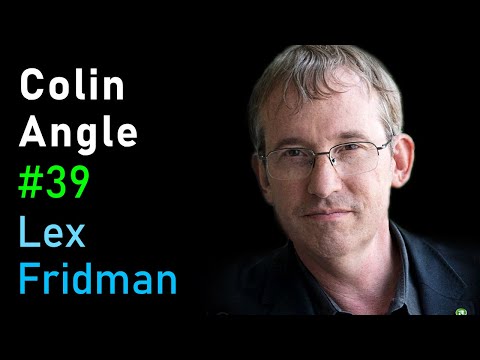
Colin Angle: iRobot CEO | Lex Fridman Podcast #39
Lex Fridman (host), Colin Angle (guest)
In this episode of Lex Fridman Podcast, featuring Lex Fridman and Colin Angle, Colin Angle: iRobot CEO | Lex Fridman Podcast #39 explores iRobot CEO on home robots, privacy, and practical AI futures Colin Angle, CEO and co‑founder of iRobot, discusses how the company built successful consumer robots like Roomba by focusing on clear, repeatable household pain points and delivering more value than the product costs. He explains the evolution from lab robots to mass-market devices that map and understand homes, and outlines a vision where homes largely maintain themselves through coordinated robotic systems. Angle emphasizes robots as partners rather than fully autonomous agents, highlighting human-in-the-loop interaction, natural language commands, and future capabilities like manipulation with arms. He also addresses privacy concerns, iRobot’s data-protection stance, and why emotional behavior may eventually be essential for more intelligent robots.
iRobot CEO on home robots, privacy, and practical AI futures
Colin Angle, CEO and co‑founder of iRobot, discusses how the company built successful consumer robots like Roomba by focusing on clear, repeatable household pain points and delivering more value than the product costs. He explains the evolution from lab robots to mass-market devices that map and understand homes, and outlines a vision where homes largely maintain themselves through coordinated robotic systems. Angle emphasizes robots as partners rather than fully autonomous agents, highlighting human-in-the-loop interaction, natural language commands, and future capabilities like manipulation with arms. He also addresses privacy concerns, iRobot’s data-protection stance, and why emotional behavior may eventually be essential for more intelligent robots.
Key Takeaways
Successful robots must solve a vivid, frequent pain point with clear value.
iRobot thrived by targeting universally disliked, recurring chores (like vacuuming) where robots can demonstrably save time and effort, rather than pursuing clever technology without a compelling, obvious user benefit.
Get the full analysis with uListen AI
Mass-market robotics requires designing for affordability and scale from day one.
Angle notes that shifting from machined aluminum prototypes to injection-molded plastics and leveraging commodity cameras and processors allowed iRobot to price robots for consumers while increasing capability.
Get the full analysis with uListen AI
Home robots are evolving from blind automatons to environment-aware partners.
Roombas have progressed from simple cleaners to devices that build maps, understand rooms (like “kitchen”), and respond to natural language commands, laying groundwork for richer collaboration and future manipulation tasks.
Get the full analysis with uListen AI
Vision plus cheap compute is becoming the dominant sensing stack in homes.
Angle argues that low-cost cameras and increasingly powerful embedded processors enable robust navigation and object understanding, paralleling debates in autonomous vehicles and reducing reliance on expensive sensors like LiDAR.
Get the full analysis with uListen AI
Privacy and data stewardship are existential issues for in-home robotics.
iRobot commits to never selling user data, running visual processing on-device, and only uploading semantic maps with consent, because long-term adoption depends on users trusting robots that move and sense inside their homes.
Get the full analysis with uListen AI
Human–robot interaction should emphasize guided autonomy, not independence.
Angle wants robots that are autonomous enough to act on their own routines but always ready to take user directives like “clean up the flour by the fridge,” interpreting context and preferences rather than operating in isolation.
Get the full analysis with uListen AI
Advanced robots may need something like emotions to act sensibly under uncertainty.
He suggests that as robots gain intelligence, emotion-like mechanisms could help them choose reasonable actions in complex, ambiguous social or risky situations where pure logic is insufficient.
Get the full analysis with uListen AI
Notable Quotes
“We need robots because the average age of humanity is increasing very quickly… robots are going to be the difference between gut‑wrenching declines in our ability to live independently and a future that is the bright one.”
— Colin Angle
“Now we’ve disrupted the entire vacuuming industry. The number one selling vacuums in the US are Roombas… and that’s really crazy and weird.”
— Colin Angle
“Technology alone doesn’t equal a successful business. We need to find the compelling need where the robot can deliver clearly more value to the end user than it costs.”
— Colin Angle
“For me, saying vision is the future, I can say that without reservation.”
— Colin Angle
“Ultimately my theory is that as robots get smarter and smarter, they’re actually going to get more emotional… you can’t actually survive on pure logic.”
— Colin Angle
Questions Answered in This Episode
What new household chores or care tasks beyond cleaning does Angle see as the most promising next targets for home robots?
Colin Angle, CEO and co‑founder of iRobot, discusses how the company built successful consumer robots like Roomba by focusing on clear, repeatable household pain points and delivering more value than the product costs. ...
Get the full analysis with uListen AI
How might iRobot integrate robotic arms into future home robots without making them prohibitively expensive or unsafe?
Get the full analysis with uListen AI
What concrete industry-wide standards or “privacy grades” would help consumers compare and trust different smart home and robotics products?
Get the full analysis with uListen AI
Where is the line between helpful semantic home mapping and invasive data collection, and who should decide what’s acceptable?
Get the full analysis with uListen AI
How could emotion-like systems in robots be designed so they guide decisions under uncertainty without deceiving users about the robot’s true capabilities or consciousness?
Get the full analysis with uListen AI
Transcript Preview
The following is a conversation with Colin Angle. He's the CEO and co-founder of iRobot, a robotics company that for 29 years has been creating robots that operate successfully in the real world, not as a demo or on a scale of dozens, but on a scale of thousands and millions. As of this year, iRobot has sold more than 25 million robots to consumers, including the Roomba vacuum cleaning robot, the Braava floor mopping robot, and soon, the Terra lawn mowing robot. 29 million robots successfully operating autonomously in real people's homes, to me, is an incredible accomplishment of science, engineering, logistics, and all kinds of general entrepreneurial innovation. Most robotics companies fail. iRobot has survived and succeeded for 29 years. I spent all day at iRobot, including a long tour and conversation with Colin about the history of iRobot, and then sat down for this podcast conversation that would have been much longer if I didn't spend all day learning about and playing with the various robots in the company's history. I'll release the video of the tour separately. Colin, iRobot, its founding team, its current team, and its mission has been and continues to be an inspiration to me and thousands of engineers who are working hard to create AI systems that help real people. This is the Artificial Intelligence podcast. If you enjoy it, subscribe on YouTube, give it five stars on iTunes, support it on Patreon, or simply connect with me on Twitter, @lexfridman, spelled F-R-I-D-M-A-N. And now, here's my conversation with Colin Angle. In his 1942 short story, Runaround, from his iRobot collection, Isaac Asimov proposed the three laws of robotics, in order: don't harm humans, obey orders, protect yourself. So two questions. First, does the Roomba follow these three laws? And also, more seriously, what role do you hope to see robots take in modern society and in the future world?
So the three laws are very thought-provoking and require such a profound understanding of the world a robot lives in, the ramifications of its action and its own sense of self that, uh, it's not a relevant bar. At least it won't be a relevant bar for decades to come. And so, uh, if Roomba follows the three laws, and I- I believe it does. Uh, you know, it is designed to help humans, not hurt them. It's designed to be inherently safe, and, uh, we designed it to last a long time. It's not through any AI or intent on the robot's part. Uh, it's because following the three laws is aligned with being a good robot product. So, um, so I guess it does-
(laughs) It does.
... but not by, uh, not by explicit design.
So then the bigger picture, what- what role do you hope to see robotics, robots take in our, what's currently mostly a world of humans?
We need robots to help us continue to improve our standard of living. We need robots because the average age of humanity is increasing very quickly. And simply the number of people young enough and spry enough to care for the elder growing demographic is inadequate. And so what is the role of robots? Today the role is to make our lives a little easier, uh, a little cleaner, maybe a little healthier. But in time, robots are going to be the difference between real gut-wrenching declines in our ability to live independently, uh, and maintain our standard of living and a future that is the bright one, where we have more control over our lives, can spend more of our time focused on, uh, activities we choose. And, um, I'm so honored and excited to be playing a role in that journey.
Install uListen to search the full transcript and get AI-powered insights
Get Full TranscriptGet more from every podcast
AI summaries, searchable transcripts, and fact-checking. Free forever.
Add to Chrome