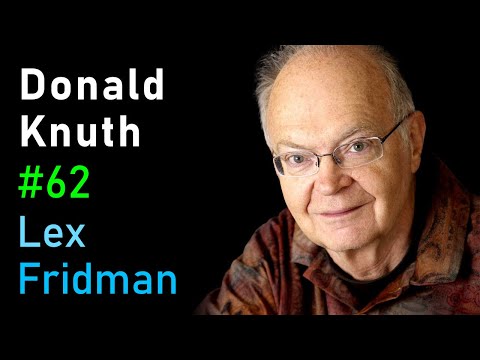
Donald Knuth: Algorithms, Complexity, and The Art of Computer Programming | Lex Fridman Podcast #62
Lex Fridman (host), Donald Knuth (guest), Lex Fridman (host)
In this episode of Lex Fridman Podcast, featuring Lex Fridman and Donald Knuth, Donald Knuth: Algorithms, Complexity, and The Art of Computer Programming | Lex Fridman Podcast #62 explores donald Knuth on algorithms, beauty, randomness, and human limits Donald Knuth reflects on his early days with the IBM 650, the emergence of “geek thinking,” and how his lifelong work on The Art of Computer Programming has tracked the evolution of algorithms and complexity theory.
Donald Knuth on algorithms, beauty, randomness, and human limits
Donald Knuth reflects on his early days with the IBM 650, the emergence of “geek thinking,” and how his lifelong work on The Art of Computer Programming has tracked the evolution of algorithms and complexity theory.
He contrasts formal, theoretical rigor with literate, human-centered programming, arguing that true understanding comes from combining precise formalisms with clear informal explanations.
Knuth discusses breakthroughs like BDDs and SAT solvers, his nuanced view that P may equal NP yet still be practically elusive, and why worst-case analysis must coexist with delight in practical speedups.
The conversation ranges into typography, aesthetics, religion, randomness, mortality, and happiness, revealing his broader philosophy: pursue excellence, accept profound uncertainty, and aim for a sustainable “0.8” level of happiness.
Key Takeaways
Jumping between abstraction levels is central to 'geek' thinking.
Knuth argues that people who resonate with computers can fluidly move from high-level concepts to low-level implementation details (and back), and that training this ability—mixing machine-level and conceptual views—is crucial for deep programming competence.
Get the full analysis with uListen AI
Explain every technical idea at least twice: formally and informally.
His notion of literate programming and good technical writing is to present algorithms both as rigorous formalisms and as narrative explanations, giving readers multiple cognitive paths to understanding and greatly aiding maintenance and debugging.
Get the full analysis with uListen AI
Rigorous analysis plus experimentation is how algorithms really advance.
For TAOCP, Knuth not only proves properties and derives asymptotics but systematically writes and runs many programs (often literate ones) to test ideas, compare methods, and refine the exposition—treating implementation as an integral part of theory-building.
Get the full analysis with uListen AI
Breakthrough representations can completely change a problem domain.
He cites Binary Decision Diagrams and modern SAT solvers as transformative ideas that reshaped Boolean reasoning and combinatorial search, showing that even in 'mature' areas, new data structures and algorithmic paradigms can yield orders-of-magnitude improvements.
Get the full analysis with uListen AI
Worst-case complexity doesn’t negate the value of huge practical gains.
Knuth is happy with algorithms that are still theoretically exponential but a million times faster on real instances, emphasizing that practical solvability and new capabilities matter even when asymptotic lower bounds remain forbidding.
Get the full analysis with uListen AI
P may equal NP, but a proof might not yield usable algorithms.
He notes there are already theorems (like Robertson–Seymour on graph minors) that guarantee polynomial-time algorithms without giving any explicit, workable method, and he expects a P=NP proof, if true, could be similarly non-constructive.
Get the full analysis with uListen AI
Art in programming is about human-made elegance, not just correctness.
For Knuth, 'art' means human-crafted structure and beauty—whether in code, typography, or music—and he deliberately optimizes typesetting, layout, and program structure for aesthetic quality, not just function, because that improves comprehension and joy.
Get the full analysis with uListen AI
Notable Quotes
“The goal of a writer is to understand the reader.”
— Donald Knuth
“A good technical writer says everything twice: formally and informally.”
— Donald Knuth
“Many more algorithms exist than anybody can ever understand or make use of.”
— Donald Knuth
“I like a good case that is maybe only a million times faster than I was able to do before.”
— Donald Knuth
“.8 is enough. If everyone were 100% happy, it would be like everybody’s on drugs and nothing works.”
— Donald Knuth
Questions Answered in This Episode
How can educators practically train students to 'jump levels' of abstraction the way Knuth describes?
Donald Knuth reflects on his early days with the IBM 650, the emergence of “geek thinking,” and how his lifelong work on The Art of Computer Programming has tracked the evolution of algorithms and complexity theory.
Get the full analysis with uListen AI
In what kinds of software projects would literate programming be most beneficial today, and where might it be overkill?
He contrasts formal, theoretical rigor with literate, human-centered programming, arguing that true understanding comes from combining precise formalisms with clear informal explanations.
Get the full analysis with uListen AI
What recent developments in combinatorial optimization or SAT solving would Knuth likely consider worthy of inclusion in future TAOCP volumes?
Knuth discusses breakthroughs like BDDs and SAT solvers, his nuanced view that P may equal NP yet still be practically elusive, and why worst-case analysis must coexist with delight in practical speedups.
Get the full analysis with uListen AI
How should we balance worst-case complexity theory with empirical performance when choosing algorithms for real systems?
The conversation ranges into typography, aesthetics, religion, randomness, mortality, and happiness, revealing his broader philosophy: pursue excellence, accept profound uncertainty, and aim for a sustainable “0. ...
Get the full analysis with uListen AI
What lessons from Knuth’s integration of aesthetics (in typography, prose, and code) could inform the design of modern programming languages and tools?
Get the full analysis with uListen AI
Transcript Preview
The following is a conversation with Donald Knuth, one of the greatest and most impactful computer scientists and mathematicians ever. He's the recipient of the 1974 Turing Award, considered the Nobel Prize of computing. He's the author of the multi-volume work, the magnum opus, The Art of Computer Programming. He made several key contributions to the rigorous analysis of computational complexity of algorithms, including the popularization of asymptotic notation that we all affectionately know as the Big O notation. He also created the TeX typesetting system, which most computer scientists, physicists, mathematicians, and scientists and engineers in general use to write technical papers and make them look beautiful. I can imagine no better guest to end 2019 with than Don, one of the kindest, most brilliant people in our field. This podcast was recorded many months ago. It's one I avoided because, perhaps counterintuitively, the conversation meant so much to me. If you can believe it, I knew even less about recording back then, so the camera angle is a bit off. I hope that's okay with you. The office space was a bit cramped for filming, but it was a magical space where Don does most of his work. It meant a lot to me that he would welcome me into his home. It was quite a journey to get there. As many people know, he doesn't check email, so I had to get creative. The effort was worth it. I've been doing this podcast on the side for just over a year. Sometimes I had to sacrifice a bit of sleep, but always happy to do it, and to be part of an amazing community of curious minds. Thank you for your kind words of support and for the interesting discussions, and I look forward to many more of those in 2020. This is the Artificial Intelligence Podcast. If you enjoy it, subscribe on YouTube, give us five stars on Apple Podcast, follow on Spotify, support on Patreon, or simply connect with me on Twitter @lexfridman, spelled F-R-I-D-M-A-N. I recently started doing ads at the end of the introduction. I'll do one or two minutes after introducing the episode, and never any ads in the middle that break the flow of the conversation. I hope that works for you and doesn't hurt the listening experience. I provide timestamps for the start of the conversation that you can skip to, but it helps if you listen to the ad and support this podcast by trying out the product or service being advertised. This show is presented by Cash App, the number one finance app in the App Store. I personally use Cash App to send money to friends, but you can also use it to buy, sell, and deposit Bitcoin in just seconds. Cash App also has a new investing feature. You can buy fractions of a stock, say $1 worth, no matter what the stock price is. Brokerage services are provided by Cash App Investing, a subsidiary of Square and member SIPC. I'm excited to be working with Cash App to support one of my favorite organizations called FIRST, best known for their FIRST Robotics and Lego competitions. They educate and inspire hundreds of thousands of students in over 110 countries, and have a perfect rating on Charity Navigator, which means the donated money is used to maximum effectiveness. When you get Cash App from the App Store or Google Play and use code LEXPODCAST, you'll get $10 and Cash App will also donate $10 to FIRST, which again is an organization that I've personally seen inspire girls and boys to dream of engineering a better world. And now, here's my conversation with Donald Knuth. In 1957 at Case Tech, you were once allowed to spend several evenings with a IBM 650 computer, as you've talked about in the past, and you fell in love with computing then.
Install uListen to search the full transcript and get AI-powered insights
Get Full TranscriptGet more from every podcast
AI summaries, searchable transcripts, and fact-checking. Free forever.
Add to Chrome