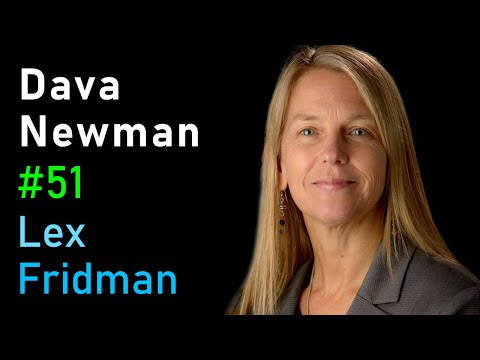
Dava Newman: Space Exploration, Space Suits, and Life on Mars | Lex Fridman Podcast #51
Lex Fridman (host), Dava Newman (guest)
In this episode of Lex Fridman Podcast, featuring Lex Fridman and Dava Newman, Dava Newman: Space Exploration, Space Suits, and Life on Mars | Lex Fridman Podcast #51 explores designing Future Space Suits and Missions for a Human Mars Era Lex Fridman interviews MIT professor and former NASA deputy administrator Dava Newman about human exploration, from Magellan’s voyages to interplanetary travel. They discuss why Mars and the Moon matter as exploration targets, how and when we might discover past or present life beyond Earth, and what it will take technologically and psychologically to send humans to Mars. A major focus is Newman's next‑generation “BioSuit,” a skin‑tight mechanical counter‑pressure spacesuit designed for mobility and long-duration planetary exploration. She also emphasizes the urgency of protecting “Spaceship Earth,” the role of AI in climate science, and her optimistic timeline for humans on the Moon in the 2020s and on Mars in the 2030s.
Designing Future Space Suits and Missions for a Human Mars Era
Lex Fridman interviews MIT professor and former NASA deputy administrator Dava Newman about human exploration, from Magellan’s voyages to interplanetary travel. They discuss why Mars and the Moon matter as exploration targets, how and when we might discover past or present life beyond Earth, and what it will take technologically and psychologically to send humans to Mars. A major focus is Newman's next‑generation “BioSuit,” a skin‑tight mechanical counter‑pressure spacesuit designed for mobility and long-duration planetary exploration. She also emphasizes the urgency of protecting “Spaceship Earth,” the role of AI in climate science, and her optimistic timeline for humans on the Moon in the 2020s and on Mars in the 2030s.
Key Takeaways
Lunar exploration is a necessary stepping stone to Mars, not a distraction.
Newman argues we need roughly a decade of operations on the Moon—testing habitats, life support, radiation mitigation, ISRU, and suits—because it is only three days away and offers a safer, cheaper testbed before committing to multi‑year Mars missions.
Get the full analysis with uListen AI
Next‑generation spacesuits must be designed “from the skin out” for mobility.
Current gas-pressurized suits are heavy, bulky ‘balloons’ that limit movement; the BioSuit uses mechanical counter‑pressure—tight fabrics and smart patterning applying about one‑third of an atmosphere directly to the body—to drastically reduce mass and enable athletic, surface-level exploration on the Moon and Mars.
Get the full analysis with uListen AI
Evidence of past life on Mars is likely within the next decade.
Based on Mars’ ancient atmosphere, magnetic field, gravity, organics, and seasonal water, Newman is confident we’ll probably find fossilized signs of past life (and possibly current microbial life) once we can dig below the radiation‑blasted surface, especially with eventual human missions accelerating the search.
Get the full analysis with uListen AI
Human Mars missions will require fully autonomous systems, not Earth-based control.
Because of 20‑minute communications delays, Mars crews and their support systems must operate autonomously; the Moon will serve as a proving ground for such autonomy in both hardware and AI decision-making.
Get the full analysis with uListen AI
Public–private collaboration and reusability are transforming launch economics and cadence.
Government funding of firms like SpaceX and Blue Origin, combined with reusable first stages, is dramatically lowering costs and increasing launch frequency, complementing NASA’s safety culture with faster, higher‑risk innovation and enabling more science (e. ...
Get the full analysis with uListen AI
AI’s most urgent role today is in protecting “Spaceship Earth,” not Mars.
Newman believes current AI should be focused on integrating and visualizing petabytes of Earth observation data to understand climate systems, communicate future scenarios, and drive behavior change toward sustainable living on Earth.
Get the full analysis with uListen AI
Interplanetary expansion does not replace the need to fix Earth.
She rejects the idea of Mars as ‘Option B,’ insisting that Earth doesn’t need us but we need Earth; becoming interplanetary is inspiring and likely, but humanity’s survival in the near term hinges on urgently living in balance with our home planet.
Get the full analysis with uListen AI
Notable Quotes
“A spacesuit is the world’s smallest spacecraft.”
— Dava Newman
“Physics rules. We can’t defy physics.”
— Dava Newman
“We’re not going to Mars to sit around.”
— Dava Newman
“Earth doesn’t need us, but we really need Earth.”
— Dava Newman
“Everyone’s supposed to be an astronaut. We’re all astronauts of Spaceship Earth.”
— Dava Newman
Questions Answered in This Episode
How might mechanical counter‑pressure spacesuits be adapted for real-time emergencies or suit punctures on the Moon or Mars?
Lex Fridman interviews MIT professor and former NASA deputy administrator Dava Newman about human exploration, from Magellan’s voyages to interplanetary travel. ...
Get the full analysis with uListen AI
What specific autonomy and AI capabilities do we still lack for safe human Mars missions, and how should they be tested on the Moon?
Get the full analysis with uListen AI
What ethical framework should guide the balance between human safety and mission success in long-duration deep space missions?
Get the full analysis with uListen AI
How can the space community better translate Earth-observation and climate AI insights into concrete policy and public behavior change?
Get the full analysis with uListen AI
What international collaboration model would best support a sustainable, long-term human presence on the Moon and Mars?
Get the full analysis with uListen AI
Transcript Preview
The following is a conversation with Dava Newman. She's the Apollo Program professor at MIT and the former deputy administrator of NASA, and has been a principal investigator on four space flight missions. Her research interests are in aerospace biomedical engineering, investigating human performance in varying gravity environments. She has designed and engineered and built some incredible spacesuit technology, namely the biosuit that we talk about in this conversation. Due to some scheduling challenges on both our parts, we only had about 40 minutes together, and in true engineering style, she said, "I talk fast, you pick the best questions, let's get it done." And we did. It was a fascinating conversation about space exploration and the future of spacesuits. This is the Artificial Intelligence podcast. If you enjoy it, subscribe on YouTube, give it five stars on Apple Podcasts, support it on Patreon, or simply connect with me on Twitter @lexfridman, spelled F-R-I-D-M-A-N. For the first time, this show is presented by Cash App, the number one finance app in the App Store. Cash App is the easiest way to send money to your friends, and it is also the easiest way to buy, sell, and deposit Bitcoin. Most Bitcoin exchanges take days for a bank transfer to become investable. Through Cash App, it takes seconds. Invest as little as $1, and now you own Bitcoin. I have several conversations about Bitcoin coming up on this podcast. Decentralized digital currency is a fascinating technology in general to explore, both at the technical and the philosophical level. Cash App is also the easiest way to try and grow your money with our new investing feature. Unlike investing tools that force you to buy entire shares of stock, Cash App, amazingly, lets you instantly invest as little or as much as you want. Some stocks in the market are hundreds, if not thousands, of dollars per share, and now you can still own a piece with as little as $1. Broker services are provided by Cash App Investing, a subsidiary of Square and member SIPC. I'm also excited to be working with Cash App to support one of my favorite organizations called FIRST, which is best known for their FIRST robotics and Lego competitions that seeks to inspire young students in engineering and technology fields all over the world. That's over 110 countries, 660,000 students, 300,000 mentors and volunteers, and a perfect rating on Charity Navigator, which means the donated money is used to maximum effectiveness. When you sign up for Cash App and use the promo code LEXPODCAST, you'll instantly receive $10, and Cash App will also donate $10 to FIRST, an amazing organization that I've personally seen inspire girls and boys to learn, to explore, and to dream of engineering a better world. Don't forget to use the code LEXPODCAST when you download Cash App from the App Store or Google Play store today. And now here's my conversation with Dava Newman. You circumnavigated the globe on boat. So let's look back in history. 500 years ago, Ferdinand Magellan's crew was first to circumnavigate the globe. But, uh, he died, wh- I think people don't know, like halfway through and so did 242 of the 260 sailors that took that three-year journey. What do you think it was like for that crew at that time heading out into the unknown to face probably likely death? Do you think they were filled with fear, with excitement?
Install uListen to search the full transcript and get AI-powered insights
Get Full TranscriptGet more from every podcast
AI summaries, searchable transcripts, and fact-checking. Free forever.
Add to Chrome