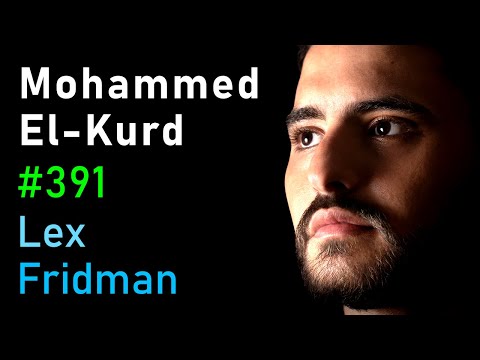
Mohammed El-Kurd: Palestine | Lex Fridman Podcast #391
Mohammed El-Kurd (guest), Lex Fridman (host)
In this episode of Lex Fridman Podcast, featuring Mohammed El-Kurd and Lex Fridman, Mohammed El-Kurd: Palestine | Lex Fridman Podcast #391 explores palestinian poet Mohammed El-Kurd deconstructs occupation, justice, and resistance Mohammed El-Kurd recounts his family’s experience in Sheikh Jarrah, using it to argue that Israel’s legal and military systems function as tools of settler colonialism and demographic engineering rather than neutral law. He situates contemporary expulsions, home demolitions, and movement restrictions within a longer history of the Nakba, Zionist ideology, and British and Western imperial involvement. El-Kurd challenges Western media narratives, legalistic framings, and labels like “terrorism” or “anti-Semitism” that he says are used to criminalize Palestinian resistance while normalizing state violence. Throughout, he defends a full spectrum of Palestinian humanity—anger, humor, dignity, and resistance—while outlining principles for justice: recognition of the Nakba, return of refugees, and redistribution of land and power.
Palestinian poet Mohammed El-Kurd deconstructs occupation, justice, and resistance
Mohammed El-Kurd recounts his family’s experience in Sheikh Jarrah, using it to argue that Israel’s legal and military systems function as tools of settler colonialism and demographic engineering rather than neutral law. He situates contemporary expulsions, home demolitions, and movement restrictions within a longer history of the Nakba, Zionist ideology, and British and Western imperial involvement. El-Kurd challenges Western media narratives, legalistic framings, and labels like “terrorism” or “anti-Semitism” that he says are used to criminalize Palestinian resistance while normalizing state violence. Throughout, he defends a full spectrum of Palestinian humanity—anger, humor, dignity, and resistance—while outlining principles for justice: recognition of the Nakba, return of refugees, and redistribution of land and power.
Key Takeaways
Sheikh Jarrah exemplifies how courts are used to formalize dispossession.
El-Kurd describes decades of eviction orders in Sheikh Jarrah where Israeli courts accept settler documents while dismissing Palestinian, Jordanian, UN, and Ottoman records—revealing a political project of demographic engineering in Jerusalem rather than a neutral real-estate dispute.
Get the full analysis with uListen AI
Legality and morality can sharply diverge under systems of domination.
He likens Israeli laws to Jim Crow, arguing that the fact something is ‘legal’ within a state’s own framework does not make it just; instead, law can bureaucratize ethnic cleansing and obscure responsibility behind procedure.
Get the full analysis with uListen AI
Occupation is sustained through fragmented legal statuses and physical barriers.
Different ID regimes (Jerusalem “residents,” West Bank IDs, Gaza residents, and Palestinian citizens of Israel) combined with the separation wall, checkpoints, and settlement networks create layered systems of control, limiting movement, growth, and political leverage.
Get the full analysis with uListen AI
Narrative control and media framing are central battlegrounds.
He criticizes U. ...
Get the full analysis with uListen AI
Anger and resistance are presented as rational responses to unlivable conditions.
El-Kurd argues that Palestinians have tried “turning the other cheek” through negotiations and compromises with little result, and that resistance—including armed resistance—is understood locally as survival under occupation, much as Western media portray Ukrainian armed resistance as legitimate.
Get the full analysis with uListen AI
Anti-Zionism and anti-Semitism are distinct, but often conflated to silence dissent.
He frames Zionism as a modern, colonial, political movement and rejects the claim that opposing it equals hatred of Jews, pointing to Israeli alliances with openly antisemitic Christian Zionists as evidence that the ‘anti-Semitism’ charge is selectively weaponized.
Get the full analysis with uListen AI
Any just future must include recognition, return, and redistribution.
Rather than arguing technical one-state vs. ...
Get the full analysis with uListen AI
Notable Quotes
“No one has a right to go on slaughtering people, removing them from their homes, and then continuing to live in their homes, continuing to drink coffee on their balconies, decades and decades later, with no shame, with no introspection.”
— Mohammed El-Kurd
“When something is legal, it can also still be wrong. History has shown us time and time again that legality does not necessarily mean morality.”
— Mohammed El-Kurd
“You can’t have a conversation between the sword and the neck.”
— Mohammed El-Kurd, referencing Ghassan Kanafani
“We are told not only are we going to be victimized, but we are going to be polite in our suffering. And I want to reject that completely.”
— Mohammed El-Kurd
“Across history there has not been an injustice that lingered endlessly… what gives me hope is believing in the inevitability of justice.”
— Mohammed El-Kurd
Questions Answered in This Episode
How should international law respond when domestic legal systems are used to legitimize dispossession and demographic engineering?
Mohammed El-Kurd recounts his family’s experience in Sheikh Jarrah, using it to argue that Israel’s legal and military systems function as tools of settler colonialism and demographic engineering rather than neutral law. ...
Get the full analysis with uListen AI
What practical mechanisms could implement a meaningful ‘right of return’ without creating new waves of displacement or violence?
Get the full analysis with uListen AI
How can Western media reform editorial practices to report on Israel-Palestine without erasing the structural realities of occupation?
Get the full analysis with uListen AI
Where is the ethical line between legitimate resistance to oppression and unjustifiable violence against civilians in asymmetrical conflicts?
Get the full analysis with uListen AI
What would a post-national, non-ethno-state political order in historic Palestine actually look like in concrete institutional terms?
Get the full analysis with uListen AI
Transcript Preview
Regardless of whatever was written in these books that were written thousands and thousands of years ago, the fact of the matter is, no one has a right to go on slaughtering people, removing them from their homes, and then continuing to live in their homes, continuing to drink coffee on their balconies, um, decades and decades later, with no shame, with no introspection, uh, with no reflection. That's, no one has the right to do that. No one has the right to keep an entire population of people in a cage, uh, which is what's happening to people in the West Bank, who have no freedom of fo- uh, of movement, which is what's happening in Gaza, which is blockaded through water, air, and land, and is deemed uninhabitable by human rights organizations like the UN. Um, no one has a right to do that.
The following is a conversation with Mohammed el-Kurd, a world-renowned Palestinian poet, writer, journalist, and an influential voice speaking out and fighting for the Palestinian cause. He provides a very different perspective on Israel and Palestine than my previous two episodes with Benjamin Netanyahu and Yuval Noah Harari. I hope his story and his words add to your understanding of this part of the world as it did to mine. I will continue to have difficult, long-form conversations such as these, always with empathy and humility, but with backbone. And please allow me to briefly comment about criticisms I receive of who I am as an interviewer and a human being. I am not afraid to travel anywhere or challenge anyone face to face, even if it puts my life in danger. But I'm also not afraid to be vulnerable, to truly listen, to empathize, to walk a mile in the well-worn shoes of those very different from me. It's this latter task, not the former one, that is truly the most challenging, in conversations and in life. But to me, it is the only way. This is the Lex Fridman Podcast. To support it, please check out our sponsors in the description. And now, dear friends, here's Mohammed el-Kurd. Tell me about Sheikh Jarrah, the neighborhood in East Jerusalem where you grew up.
Sheikh Jarrah is, you know, in a, in a way, a typical neighborhood despite the, despite the absurd reality that surrounds it. It's a typical neighborhood in terms of Palestinian neighborhoods as one that is threatened with colonialism, with settler expansion, and with forced expulsion, and it has been that way since the early '70s. My family, like all of the other families in Sheikh Jarrah, uh, were expelled from their homes in the Nakba in 1948, and they were forced out by the Haganah and other, uh, Zionist paramilitaries that later formed the Israeli military. Um, and they were driven to various cities, and my grandmother moved from city to city and she ended up in Sheikh Jarrah in 1956. Sheikh Jarrah was established as, uh, refugee housing unit, uh, by the United Nations and by the Jordanian government which had, which had control over that part of Jerusalem at the, at the time. And then people lived there harmoniously. They were all from different parts of Palestine, and, you know, they managed to rebuild their lives after the first expulsion. And then in the '70s, you had settler organizations, um, many of whom were registered here in New York and in the United States, claiming our houses and our lands as their own by divine decree. And because, obviously because the judges are Israeli and the laws were written by Israeli settlers and the whole judiciary was established, uh, atop the ra- the rubble of our homes and villages, we had no, you know, we had no real pull in the courts. The Israeli courts would look at the Israeli documents, which we argue are falsified and fabricated, um, and they would take them at face value without authentication and they refused to look at our documents. They refused to look at the documents from the Jordanian government, the documents from the UN, the documents from the Ottoman archives. So, you already have this kind of asymmetry in the court that for any person with common sense would lead you to believe that this is not, in fact, a legal battle, um, or a real estate dispute as the Israeli f- Ministry of Foreign Affairs likes to frame it, but rather a very, very political battle, one that is about, um, social engineering, one that is about demographics, one that is about removing as many Palestinians as possible from occupied Jerusalem. Um, so we did what all Palestinian families in Jerusalem do when they're faced with this kind of threat, and we bought time. We, we pleaded and pleaded and appealed the courts and appealed the cases and we got over 50 expulsion orders. Um, in 2009, rifle-wielding settlers accompanied by police and Israeli military came over and shoved our neighbors out- outside of their home around 5:00 AM. It's like, it was the most brutal, violent thing I'd seen as a child at the time, and I didn't realize that my turn was coming, my turn was next. They threw m- they threw them out in the middle of the night, uh, with sound bombs and rubber bullets and they had to live in tents on the street for many, many months, and even lived in our front yards for a few months, and lived in their cars.
Install uListen to search the full transcript and get AI-powered insights
Get Full TranscriptGet more from every podcast
AI summaries, searchable transcripts, and fact-checking. Free forever.
Add to Chrome