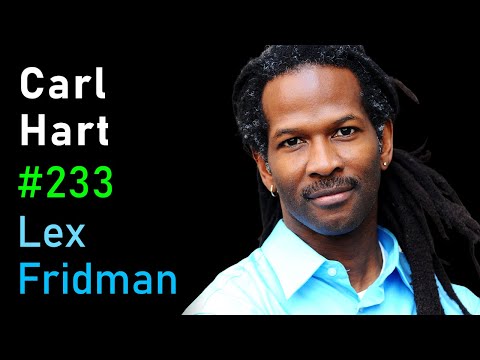
Carl Hart: Heroin, Cocaine, MDMA, Alcohol & the Role of Drugs in Society | Lex Fridman Podcast #233
Lex Fridman (host), Carl Hart (guest)
In this episode of Lex Fridman Podcast, featuring Lex Fridman and Carl Hart, Carl Hart: Heroin, Cocaine, MDMA, Alcohol & the Role of Drugs in Society | Lex Fridman Podcast #233 explores carl Hart Reframes Drugs: Pleasure, Policy, Freedom, and Responsibility Carl Hart argues that most adult drug use—including heroin, cocaine, MDMA, and others—is predominantly positive when done responsibly, and that addiction is driven more by environment and mental health than by the drugs themselves.
Carl Hart Reframes Drugs: Pleasure, Policy, Freedom, and Responsibility
Carl Hart argues that most adult drug use—including heroin, cocaine, MDMA, and others—is predominantly positive when done responsibly, and that addiction is driven more by environment and mental health than by the drugs themselves.
He criticizes media, politics, and popular culture for exaggerating harms, ignoring benefits, and using drugs as a scapegoat for deeper social failures like poverty, job loss, and resource deprivation.
Hart advocates legalizing and strictly regulating all commonly used drugs, pairing access with honest education about real risks (e.g., mixing sedatives, sleep disruption, constipation) instead of fear-based narratives.
He frames the drug debate as fundamentally about individual freedom, mutual responsibility, and our capacity to build a more empathetic, pro‑social society if we stop criminalizing pleasure and start treating adults like adults.
Key Takeaways
Drug effects are shaped as much by context as by chemistry.
Hart stresses that environment, mindset, relationships, responsibilities, and past trauma profoundly shape whether an experience with MDMA, heroin, or any drug is positive or negative—biology alone cannot explain outcomes.
Get the full analysis with uListen AI
Most adult drug use produces positive, not catastrophic, effects.
From decades of research and self-report data, Hart finds that typical users of substances like cannabis, cocaine, heroin, methamphetamine, and psilocybin overwhelmingly report enhanced empathy, sociability, focus, and meaning rather than addiction and ruin.
Get the full analysis with uListen AI
Addiction is primarily driven by environment and co-occurring disorders.
Because the vast majority of users never become addicted, Hart argues we must look to factors like depression, anxiety, unrealistic expectations, job loss, and social dislocation—not the drug molecule itself—to explain addiction.
Get the full analysis with uListen AI
Media and entertainment systematically distort our view of drugs.
News outlets, TV shows, films, and even comedy profit from sensational ‘drug horror’ narratives, rarely explaining real risks (like contamination or mixing sedatives) or everyday positive use, reinforcing stigma and bad policy.
Get the full analysis with uListen AI
Legalization plus regulation could drastically reduce harm.
Hart proposes legal, age-restricted access to commonly used drugs with controlled doses, safer routes of administration, and clear education—similar to alcohol—to prevent contamination deaths and guide responsible use.
Get the full analysis with uListen AI
Criminalization of drugs enriches institutions while devastating communities.
The war on drugs benefits police, prisons, testing labs, media, and politicians, while disproportionately harming marginalized communities; Hart calls for ending drug arrests, freeing and expunging records of drug prisoners, and redirecting focus to real social problems.
Get the full analysis with uListen AI
Honest drug use can deepen empathy, relationships, and self-knowledge.
Hart describes his own responsible use of MDMA, heroin, and other substances as expanding empathy, improving relationships, and helping him better understand both the brain and human potential, when coupled with a stable, responsible life.
Get the full analysis with uListen AI
Notable Quotes
“Addiction has almost nothing to do with the drugs themselves.”
— Carl Hart
“If you want a problem not to be solved, just give it to the military or the cops.”
— Carl Hart
“We tell people Pinocchio: ‘If you lie, your nose grows.’ Who believes that? But that’s exactly what these drug stories are.”
— Carl Hart
“My position as department chairman was far more detrimental to my health than my drug use ever was.”
— Carl Hart
“Once you know, you cannot not know. I have to look in the mirror and ask if I have lived honestly.”
— Carl Hart
Questions Answered in This Episode
If most drug users are not addicted, how should treatment systems and diagnostic criteria change to better reflect reality?
Carl Hart argues that most adult drug use—including heroin, cocaine, MDMA, and others—is predominantly positive when done responsibly, and that addiction is driven more by environment and mental health than by the drugs themselves.
Get the full analysis with uListen AI
What would a practical, step-by-step rollout of full drug legalization and regulation look like in the U.S., and which safeguards would be essential?
He criticizes media, politics, and popular culture for exaggerating harms, ignoring benefits, and using drugs as a scapegoat for deeper social failures like poverty, job loss, and resource deprivation.
Get the full analysis with uListen AI
How can journalists, filmmakers, and artists portray drugs more honestly without glamorizing reckless use or reverting to fear-based tropes?
Hart advocates legalizing and strictly regulating all commonly used drugs, pairing access with honest education about real risks (e. ...
Get the full analysis with uListen AI
What kind of education curriculum could realistically teach teenagers and adults to use drugs as responsibly as we expect them to drive cars or drink alcohol?
He frames the drug debate as fundamentally about individual freedom, mutual responsibility, and our capacity to build a more empathetic, pro‑social society if we stop criminalizing pleasure and start treating adults like adults.
Get the full analysis with uListen AI
How do we persuade politically powerful beneficiaries of the war on drugs—police unions, prison lobbies, testing industries—to accept or even support reform?
Get the full analysis with uListen AI
Transcript Preview
The following is a conversation with Carl Hart, Department Chair and Professor of Psychology at Columbia University. He's the author of several books on the topic of drugs, including his most recent called Drug Use for Grown-Ups that challenges us to, quote, "Use empirical evidence to guide public policy even if it makes us uncomfortable." His research on drugs, including hard drugs like heroin and cocaine, challenges much of what we think we know about drugs and their role in society. His main thesis is that drug addiction has less to do with the drugs themselves and more to do with co-occurring psychiatric disorders such as depression and schizophrenia and socioeconomic factors such as unemployment, underemployment, and resource deprivation within the community. In addition, he believes that we should legalize all drugs so if that people choose to use them, they could do so responsibly and openly and get help if needed in a controlled, safe environment. His ideas are controversial, but are fundamentally grounded in empirical data and rigorous scientific studies. I don't know if his conclusions are right, but they are at least worth thinking about. So, I ask that you consider these ideas with an open mind, and as always, make sure you exercise your critical thinking skills in making decisions about substances you put in your body. You are a free thinking being, the main character, if you will, the hero in a story that's being written by you. So at the end of the day, you are responsible for the choices you make. So choose wisely. This is the Lex Fridman Podcast. To support it, please check out our sponsors in the description, and now here's my conversation with Carl Hart. I think it is bold and powerful to admit to using in your private life the drugs that you study in your research, including heroin and cocaine. So let me ask, what is the experience of taking heroin like? What happens to the body, what happens to the mind when you take it?
Well, you know I take MDMA, cannabis, and all the rest of these drugs too.
Yeah.
I've tried those drugs. Um, the experience in the body and the mind, I- I- I don't really know what people want to know in, in that regard. It's like saying, "What is the experience of having an orgasm in the body and the mind?" Or- or-
(laughs)
... some other sort of event that you really enjoy. Um, so I- I don't really know what people-
Is that what poetry is for, for describing these kinds of experiences? I mean, I guess, uh, given MDMA, given psilocybin in the full context of that, maybe it's more useful to say what are the differences in experiences that your mind goes through, uh, like chemically, biologically, uh, so- so like keeping it strictly to the sort of the- the- the biology of it versus the full environmental human experience?
Install uListen to search the full transcript and get AI-powered insights
Get Full TranscriptGet more from every podcast
AI summaries, searchable transcripts, and fact-checking. Free forever.
Add to Chrome