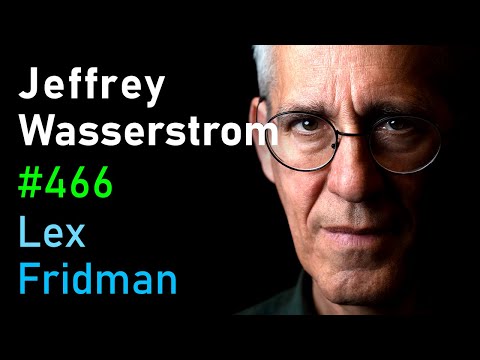
Jeffrey Wasserstrom: China, Xi Jinping, Trade War, Taiwan, Hong Kong, Mao | Lex Fridman Podcast #466
Lex Fridman (host), Jeffrey Wasserstrom (guest), Lex Fridman (host), Lex Fridman (host), Narrator
In this episode of Lex Fridman Podcast, featuring Lex Fridman and Jeffrey Wasserstrom, Jeffrey Wasserstrom: China, Xi Jinping, Trade War, Taiwan, Hong Kong, Mao | Lex Fridman Podcast #466 explores china’s Past, Xi’s Power, And Protest Movements Shaping Its Future Historian Jeffrey Wasserstrom and Lex Fridman explore how modern China under Xi Jinping can only be understood by tracing its past—from Confucianism and Mao to Tiananmen, Hong Kong, and Taiwan.
China’s Past, Xi’s Power, And Protest Movements Shaping Its Future
Historian Jeffrey Wasserstrom and Lex Fridman explore how modern China under Xi Jinping can only be understood by tracing its past—from Confucianism and Mao to Tiananmen, Hong Kong, and Taiwan.
They compare Mao and Xi’s styles of rule, especially personality cults, order vs. chaos, and the fusion of Marxism with Confucian hierarchy and nationalism.
The conversation examines Chinese meritocracy, censorship, protest movements (Tiananmen, Hong Kong, Taiwan, Thailand), and how images like Tank Man influence both domestic control and global opinion.
They also discuss the risks of US–China rivalry, Taiwan, trade wars, and how different “Chinas” (mainland, Hong Kong, Taiwan, diaspora) embody competing visions of Chinese identity and political futures.
Key Takeaways
Xi Jinping mirrors Mao’s personality cult but rejects Mao’s love of chaos.
Both leaders are surrounded by intense propaganda and personal veneration, yet whereas Mao embraced disruptive mass mobilization and revolutionary upheaval, Xi prioritizes stability, order, and tightly managed public space.
Get the full analysis with uListen AI
Modern China fuses Confucian hierarchy with communist ideology and nationalism.
Confucianism’s emphasis on stable, unequal relationships and moral education coexists uneasily with Marxism’s focus on struggle and historical progress, yet Xi selectively celebrates both Confucius and Mao as symbols of China’s greatness and continuity.
Get the full analysis with uListen AI
Meritocracy in China is powerful but fragile, and corruption can trigger outrage.
High-stakes exams like the Gaokao and a deep cultural respect for education create a strong meritocratic ideal; when nepotism and corruption seem to subvert that ideal, as before Tiananmen and in other protests, anger spikes quickly.
Get the full analysis with uListen AI
The Chinese state learned from Tiananmen to fear powerful images more than words.
Iconic visuals like Tank Man undermined the Party’s narrative by making the PLA look like an occupying force; since then, Beijing has focused on controlling visuals—avoiding massacres on camera, limiting photography in Xinjiang and Hong Kong, and flooding media with its preferred images.
Get the full analysis with uListen AI
Contemporary censorship relies less on brute bans and more on friction and flooding.
Beyond repression (fear), authorities slow access to sensitive information (friction) and overwhelm the public sphere with distracting or regime-friendly content (flooding), creating a Brave New World–style environment of managed attention rather than permanent terror.
Get the full analysis with uListen AI
Hong Kong’s struggle reshaped how Taiwan and others view Beijing’s promises.
The erosion of one-country-two-systems and the national security law convinced many in Taiwan and across the region that Beijing will not tolerate genuine autonomy, strengthening separate Taiwanese identity and skepticism toward any future unification formulas.
Get the full analysis with uListen AI
Protest movements often fail in the short term but seed long-term change and networks.
From Tiananmen to Hong Kong, Taiwan, Thailand, and Myanmar, unsuccessful uprisings still transmit tactics, slogans, and ideals across borders and generations, forming an “other China” and broader regional currents of resistance that authoritarian leaders must continually manage.
Get the full analysis with uListen AI
Notable Quotes
“Xi Jinping is the first leader since Mao to have a sustained personality cult where you walk into a bookstore and the first thing you see are his speeches.”
— Jeffrey Wasserstrom
“In Confucianism there are no egalitarian relationships. Even brothers are older brother and younger brother, not equals.”
— Jeffrey Wasserstrom
“The Chinese Communist Party learned from Tiananmen how powerful a single image can be, and Tank Man is the image they can’t allow to circulate.”
— Jeffrey Wasserstrom
“You need to think about China as having the best as well as the worst internet experience in the world.”
— Jeffrey Wasserstrom (quoting Christina Larson’s formulation)
“History doesn’t have a direction. There is no straight road.”
— Jeffrey Wasserstrom
Questions Answered in This Episode
How sustainable is Xi Jinping’s blend of communist ideology, Confucian hierarchy, and hard-edged nationalism over the next several decades?
Historian Jeffrey Wasserstrom and Lex Fridman explore how modern China under Xi Jinping can only be understood by tracing its past—from Confucianism and Mao to Tiananmen, Hong Kong, and Taiwan.
Get the full analysis with uListen AI
In what specific ways do Hong Kong’s and Taiwan’s experiences offer a viable alternative model of ‘being Chinese’ to the one promoted by the Communist Party?
They compare Mao and Xi’s styles of rule, especially personality cults, order vs. ...
Get the full analysis with uListen AI
How might advances in technology and AI change the balance between Brave New World–style soft control and 1984-style coercion in China’s governance?
The conversation examines Chinese meritocracy, censorship, protest movements (Tiananmen, Hong Kong, Taiwan, Thailand), and how images like Tank Man influence both domestic control and global opinion.
Get the full analysis with uListen AI
Could a major domestic economic downturn or legitimacy crisis in China make a military move on Taiwan more or less likely, and why?
They also discuss the risks of US–China rivalry, Taiwan, trade wars, and how different “Chinas” (mainland, Hong Kong, Taiwan, diaspora) embody competing visions of Chinese identity and political futures.
Get the full analysis with uListen AI
What kinds of protest tactics and cross-border solidarities from the Milk Tea Alliance and similar movements are most likely to endure or succeed under increasingly sophisticated authoritarian regimes?
Get the full analysis with uListen AI
Transcript Preview
The following is a conversation with Jeffrey Wasserstrom, a historian of modern China. This is the Lex Fridman podcast. To support it, please check out our sponsors in the description. And now dear friends, here's Jeffrey Wasserstrom. You've compared Xi Jinping and Mao Zedong in the past. What are the parallels between the two leaders and where do they differ? Xi Jinping, of course, is the current leader of China for the past 12 years, and Mao Zedong was the communist leader of China from 1949 to 1976. So what are the commonalities? What are the differences?
So the biggest commonality of them is that they're both the subject of personality cults, and that Mao was the center of a very intensely felt one from 1949 to 1976. And when he died, you know, there was tremendous outpouring of grief, even among people who had objectively suffered enormously because of his policies. Xi Jinping is the first leader in China since him who has had a sustained personality cult of the kind where if you walk into a bookstore in China, the first thing you see are books by him, collections of speeches. And when Mao was alive, you, you might have thought that's sort of what happened with Communist Party leaders in China, but after Mao's death, there was such an effort to not have that kind of personality cult that there was a tendency to not publish the speeches of a leader until they were done being in power. I, I was first in China in 1986, and you could go for days without being intensely aware of who was in charge of the party. You would know, but his face wasn't everywhere. The newspaper wasn't dominated with stories about him and quotations from his words and things like that. So with Xi Jinping, you had a, a throwback to that period in Communist Party rule, which seemed as though it might be a part of the past. So that's, that's a key commonality. And a key difference is that Mao really reveled in chaos, in turning things upside down in a sense that, um, you know, he talked about class struggle, which came out of Marxism, but he also really... His favorite work of Chinese popular fiction was The Monkey King about this legendary figure who, this, this Monkey King who could turn the heavens upside down. So he reveled in disorder and thought disorder was a, was a way to improve things. Xi Jinping is very orderly, is very concerned with kind of stability and predictability. So you can see them as very, very different that way. And Mao also liked to stir things up, liked to have people on the streets, um, clamoring. So Xi Jinping, even though he has a personality cult, it's not manifesting itself. He doesn't like the idea of people on the streets in any- anything that can't be controlled. So you can, you know, there are a lot of ways that they're, they're similar, a lot of ways they're different. They're also different, and this fits with this orderliness, that Xi Jinping talks positively about Confucius and Confucian traditions in China. Um, and Confucian traditions are based on kind of stable hierarchies for the most part and sort of clear categories of superior and inferior, whereas Mao liked things to be turned upside down. He thought of Confucianism as a futile way of thought that it hold, held China back. So you can come up with things that they're similar and you can come up with things where they're really opposites, but they both clearly did want to see China under rule by the Communist Party, and that's been a continuity and that connects them to the leaders in between them too as well.
Install uListen to search the full transcript and get AI-powered insights
Get Full TranscriptGet more from every podcast
AI summaries, searchable transcripts, and fact-checking. Free forever.
Add to Chrome