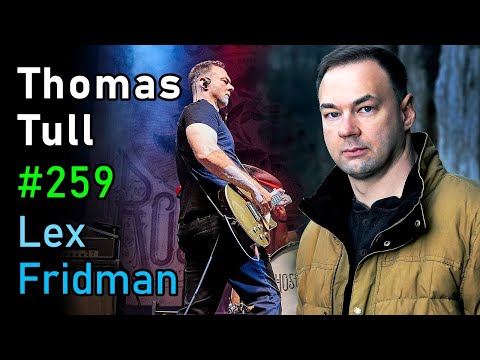
Thomas Tull: From Batman Dark Knight Trilogy to AI and The Rolling Stones | Lex Fridman Podcast #259
Lex Fridman (host), Thomas Tull (guest), Narrator
In this episode of Lex Fridman Podcast, featuring Lex Fridman and Thomas Tull, Thomas Tull: From Batman Dark Knight Trilogy to AI and The Rolling Stones | Lex Fridman Podcast #259 explores thomas Tull on Epic Films, AI Disruption, Grit, and Guitar Dreams Thomas Tull discusses building Legendary Entertainment from scratch, emphasizing that great films are essentially startups powered by strong scripts, visionary directors, and disciplined financing. He explains how he brought institutional capital into Hollywood and later founded Tulco to inject AI and data science into overlooked, traditional industries like insurance, healthcare apparel, and manufacturing.
Thomas Tull on Epic Films, AI Disruption, Grit, and Guitar Dreams
Thomas Tull discusses building Legendary Entertainment from scratch, emphasizing that great films are essentially startups powered by strong scripts, visionary directors, and disciplined financing. He explains how he brought institutional capital into Hollywood and later founded Tulco to inject AI and data science into overlooked, traditional industries like insurance, healthcare apparel, and manufacturing.
Tull and Lex explore the evolving landscape of storytelling—from theatrical blockbusters to streaming, VR, and short-form content—and how technology can enhance, but never replace, strong narrative and character. They also dive into the future of American manufacturing, the role of AI and robotics, and the importance of human–machine collaboration.
On a personal level, Tull reflects on growing up poor, developing grit and work ethic, and the importance of intellectual honesty, long-term thinking, and clear personal principles. He shares his passions for football and music, including playing guitar with his band Ghost Hounds on tour with the Rolling Stones and producing the guitar documentary “It Might Get Loud.”
Key Takeaways
Great films are startups: they live or die on script and director.
Tull frames every major movie as a startup where the foundational ‘product’ is a great script plus a great director; visual effects and big budgets cannot compensate for weak story or miscast roles.
Get the full analysis with uListen AI
Patient, institutional capital can unlock creative and technological breakthroughs.
By raising long-term money from institutional investors instead of ad‑hoc wealthy individuals, Tull insulated projects from short-term pressure, enabling risk-taking in big franchises and later in AI-driven companies.
Get the full analysis with uListen AI
The next storytelling frontier will blend VR, gaming, and social interaction.
He predicts immersive VR experiences with branching paths, missions, and social presence will spawn entirely new kinds of storytellers, much as Netflix and HBO reshaped TV with bingeable, cinematic series.
Get the full analysis with uListen AI
AI’s biggest near-term value is augmenting legacy industries, not replacing humans.
Through Tulco’s lab, Tull applies data science and machine learning to sectors like insurance and healthcare workwear, automating tedious tasks and improving decisions while relying on existing management expertise.
Get the full analysis with uListen AI
Resilience, constraints, and discomfort are catalysts for innovation.
Tull argues that too much capital dulls creativity, while well-calibrated constraints and hard times build the “comfortable being uncomfortable” muscle that underlies extraordinary work in business and art.
Get the full analysis with uListen AI
Intellectual honesty and clear personal rules prevent destructive slippery slopes.
He stresses regularly interrogating your own motivations, strengths, and limits—and having firm ethical lines—so small compromises don’t evolve into major frauds or life paths you never truly wanted.
Get the full analysis with uListen AI
America must pair innovation with a revival of advanced manufacturing.
Citing his investment in Re:Build, Tull sees high-tech, robotics‑enhanced manufacturing in the U. ...
Get the full analysis with uListen AI
Deep passion and hard work sustain excellence for decades.
From filmmakers like James Cameron to musicians like the Rolling Stones and athletes on the Steelers, Tull notes that long-term greatness comes from relentless practice, discipline, and continual reinvention—not shortcuts.
Get the full analysis with uListen AI
Notable Quotes
“Each movie is its own little startup company.”
— Thomas Tull
“There’s a difference between expensive and irresponsible.”
— Thomas Tull
“Never mistake clear line of sight with distance.”
— Thomas Tull
“If you act like a fan, you’ll be sitting with them.”
— Jerry Reinsdorf (as quoted by Thomas Tull)
“We don’t try to think of the smart thing to do. We try to think what’s the dumb thing we could do here.”
— Warren Buffett (as quoted by Thomas Tull)
Questions Answered in This Episode
How would you design an optimal financing model to nurture truly risky, visionary films in today’s streaming-driven environment?
Thomas Tull discusses building Legendary Entertainment from scratch, emphasizing that great films are essentially startups powered by strong scripts, visionary directors, and disciplined financing. ...
Get the full analysis with uListen AI
What criteria would you use to decide which legacy industry to transform next with AI, and how would you avoid cultural resistance inside those companies?
Tull and Lex explore the evolving landscape of storytelling—from theatrical blockbusters to streaming, VR, and short-form content—and how technology can enhance, but never replace, strong narrative and character. ...
Get the full analysis with uListen AI
How might immersive VR storytelling change our emotional relationship with characters compared to traditional films and TV?
On a personal level, Tull reflects on growing up poor, developing grit and work ethic, and the importance of intellectual honesty, long-term thinking, and clear personal principles. ...
Get the full analysis with uListen AI
What practical steps can a young founder take to cultivate the kind of intellectual honesty and ethical guardrails you describe before real pressure hits?
Get the full analysis with uListen AI
In reviving American manufacturing, where should we draw the line between automating repetitive jobs and preserving certain forms of human craftsmanship?
Get the full analysis with uListen AI
Transcript Preview
The following is a conversation with Thomas Tull, founder of Legendary Entertainment, known for producing blockbusters like Batman's Dark Knight Trilogy, the Hangover franchise, Godzilla, Inception, Jurassic World, 300, and many more. He runs Tulco, which is an investment company that focuses on how artificial intelligence can revolutionize large industries. He is part owner of the Pittsburgh Steelers. He's the guitarist for the band Ghosthounds and tours with the Rolling Stones. But most importantly, he's humble, down to earth, and someone who has quickly become a mentor and friend. This is the Lex Fridman Podcast. To support it, please check out our sponsors in the description, and now here's my conversation with Thomas Tull. In 2004, you founded Legendary Entertainment, known for producing blockbusters like Batman's Dark Knight Trilogy, that includes Batman Begins, Dark Knight, and Dark Knight Rises, the Hangover franchise, Godzilla, Inception, Jurassic World, 300, and the list goes on. It's just some of the biggest movies in history. What does it take to make an epic movie like that? What does it take to make it happen from start to finish?
Well, (sighs) look, I, I have been enamored with movies since I was a kid as a fan, and I think what you need is to, is to be able to tell a great story. And if you're gonna tell a great story, you need a great director, you gotta start with a fantastic script, um, that, you know, is able to take some of these iconic characters that we did and put your own stamp on it while still respecting, uh, the mythology. And, uh, I had zero experience in movies and television before I started Legendary, so it was, it was a very interesting trip. Total luck, uh, that, uh, we had the opportunity to make five movies at the time with, uh, Chris Nolan, who turned out to be one of the greatest filmmakers of all time. But it's, uh, each one is its own little startup company, uh, and I don't think there's any formula to get there, but I know that if you don't have a great director and a great script, if you don't have that foundation, it, it's hard to pull off.
Who's the CEO of that little startup company? Is it the, the director? Who would you say kind of defines the success or the failure of a movie?
Well, when you build a big movie like that, it's an enormous effort 360 degrees. I mean, from digital effects, m- certainly the actors. I mean, if you have an amazing script, an amazing director, but you don't believe anybody playing the parts, that's a problem. So the reason I think it was so difficult to pull off is I always used to say you start with a stack of papers with words on it called a script, bring that to life, and you're asking an audience to believe in everything that you're trying to put out there, and you've got to cast that even if they're immensely talented individually, they have to mesh together and they have to have chemistry together. Um, and, you know, the director is kind of the general on the, the battlefield, but if you have a strong, uh, producer who's very hi- hands on, but it truly to me is each one had its own story and its own sort of how it came to be and why it, why it worked or didn't work.
Install uListen to search the full transcript and get AI-powered insights
Get Full TranscriptGet more from every podcast
AI summaries, searchable transcripts, and fact-checking. Free forever.
Add to Chrome